Data classification methodology ppt diagrams
Try Before you Buy Download Free Sample Product
Audience
Editable
of Time
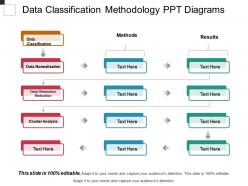
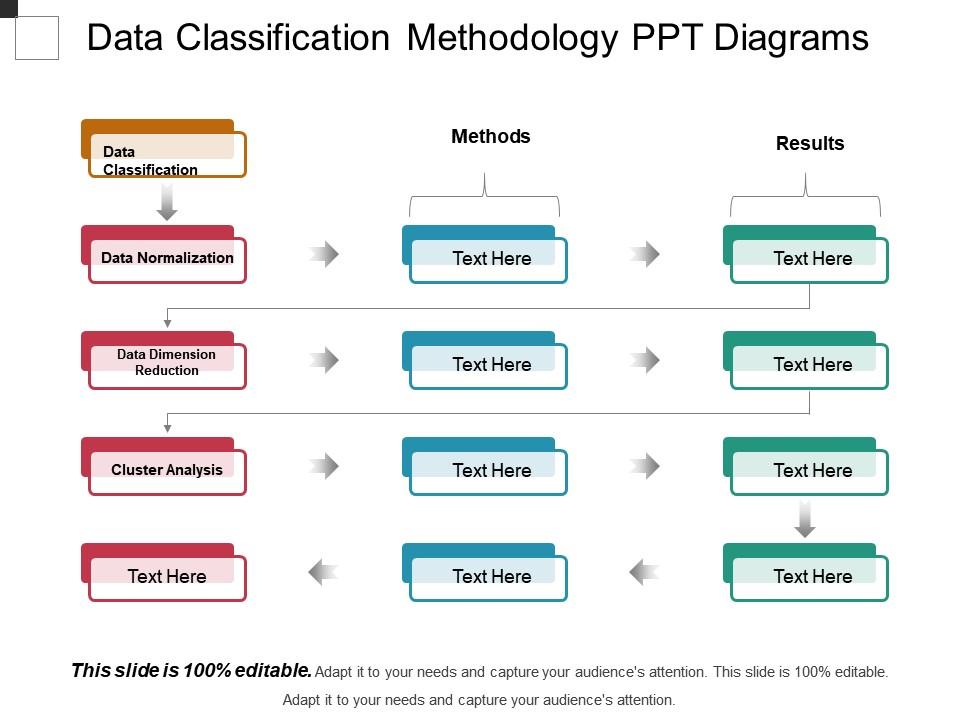
Create a benchmark through our, data classification methodology PPT diagrams. Explore the industry’s profitability potential through these competitive landscape analysis framework. We have included the landscape of a business data classification layout with four stages as, data classification, data normalization, data dimension reduction, cluster analysis. We have shown engaging color patterns and icons here to make this PPT design more interactive. Symbols of arrows and color patterns are shown here to direct the system flow. Include your key points and get your ideas across through the help of a PowerPoint template by editing the text boxes shown here. Show various methods used and results obtained here and include company data. To make it easier for the viewer to understand the concept we have shown vibrant icons and color sequence here to communicate visually. Include your researched data at ease by following a few easy steps. Following strategic analysis PowerPoint allows you to achieve a competitive edge in your business process. Download this data classification methodology PPT diagrams and achieve a defining edge. Let our Data Classification Methodology Ppt Diagrams be the vehicle of your sucessful journey. Ride the bus to glory with your grand ideas.
People who downloaded this PowerPoint presentation also viewed the following :
Data classification methodology ppt diagrams with all 5 slides:
Enhance ability to anticipate with our Data Classification Methodology Ppt Diagrams. Always begin with a firm advantage.
FAQs for Data classification
Data classification methodologies include supervised learning, unsupervised learning, semi-supervised learning, reinforcement learning, and rule-based classification systems. These approaches differ by their training requirements, accuracy levels, and implementation complexity, with supervised methods delivering higher precision through labeled datasets while unsupervised techniques enable pattern discovery in unlabeled data, ultimately helping organizations streamline information management and enhance decision-making processes.
Machine learning algorithms enhance data classification by automating pattern recognition, reducing manual sorting time, and improving accuracy through continuous learning from data patterns. These technologies streamline operations by processing vast datasets quickly, adapting to new data types automatically, and minimizing human error, with many organizations finding that automated classification delivers faster compliance reporting and significantly lower operational costs.
Data labeling serves as the foundation for effective classification by providing training datasets with accurate annotations, enabling machine learning models to recognize patterns, relationships, and categories within structured and unstructured data. Through properly labeled datasets, organizations in healthcare, finance, and retail can automate document processing, improve compliance reporting, and enhance decision-making accuracy, ultimately delivering faster insights and competitive advantage.
Determining the appropriate classification method depends on dataset size, feature complexity, interpretability requirements, and performance goals. Consider decision trees for transparent processes, neural networks for complex patterns, or ensemble methods for robust accuracy, with many organizations finding that testing multiple approaches through cross-validation ultimately delivers optimal results for their specific business requirements.
Data classification faces challenges including data volume complexity, inconsistent formats, privacy compliance requirements, resource allocation constraints, and integration difficulties across systems. Organizations often struggle with balancing automated accuracy and manual oversight, especially in regulated sectors like healthcare and finance, while ensuring scalable processes that maintain data quality standards and deliver reliable insights for strategic decision-making.
Data classification is most critical in healthcare, financial services, government, legal, and retail industries due to stringent regulatory requirements, sensitive personal information handling, and high-value data assets. These sectors face severe compliance penalties, security breaches, and operational risks, with many organizations finding that proper classification streamlines regulatory reporting, enhances data protection, and ultimately delivers competitive advantage through improved data governance and customer trust.
Data classification improves business decision-making by organizing information into structured categories, enabling faster data retrieval, ensuring regulatory compliance, and enhancing data quality and accessibility. Through systematic classification frameworks, organizations streamline analytics processes, reduce information silos, and deliver more accurate insights, with many financial institutions and healthcare providers finding that structured data approaches ultimately accelerate strategic planning and operational efficiency.
Feature selection significantly improves data classification by reducing dimensionality, eliminating irrelevant variables, and enhancing model accuracy while minimizing computational costs. This process enables organizations in healthcare, finance, and retail to streamline predictive analytics, accelerate processing speeds, and deliver more reliable outcomes, ultimately providing competitive advantage through efficient resource allocation and improved decision-making capabilities.
Supervised classification uses labeled training data to learn patterns and predict categories, while unsupervised classification discovers hidden patterns in unlabeled data through clustering and segmentation. Supervised methods excel in fraud detection and medical diagnosis where accuracy is crucial, while unsupervised approaches help banks identify customer segments and retailers discover purchasing patterns, ultimately enabling more targeted strategies.
**INPUT**: What ethical considerations should be taken into account during data classification? **OUTPUT**: Ethical considerations in data classification include privacy protection, bias mitigation, transparency in algorithmic decisions, consent management, and equitable access to services. Organizations must balance operational efficiency with responsible data stewardship, ensuring classification systems don't perpetuate discrimination while maintaining regulatory compliance, ultimately delivering fair outcomes across diverse customer segments.
Standardizing data classification methodologies across sectors requires establishing universal frameworks that address sensitivity levels, compliance requirements, regulatory standards, and access controls while maintaining sector-specific flexibility. Organizations achieve this through collaborative industry initiatives, shared taxonomies, and common security protocols, with sectors like healthcare, finance, and government finding that standardized approaches streamline compliance, enhance data governance, and ultimately deliver improved security consistency across organizational boundaries.
Recommended tools include Microsoft Purview, Varonis Data Security Platform, Symantec Data Loss Prevention, IBM Security Guardium, and Forcepoint Data Classification. These solutions streamline implementation by automating discovery processes, applying consistent labeling policies, and integrating seamlessly with existing infrastructure, with many organizations finding that strategic tool selection significantly accelerates classification initiatives while reducing operational overhead.
Handling imbalanced datasets involves techniques like oversampling minority classes, undersampling majority classes, synthetic data generation through SMOTE, and cost-sensitive learning algorithms. These approaches enhance model accuracy by ensuring balanced representation, with many organizations in healthcare and finance finding that strategic resampling combined with ensemble methods ultimately delivers more reliable predictions and fairer outcomes.
**INPUT**: What metrics are used to evaluate the effectiveness of data classification methods? **OUTPUT**: Data classification effectiveness metrics include accuracy, precision, recall, F1-score, and area under the ROC curve, along with confusion matrices and cross-validation scores. These measurements enable organizations to optimize their classification models by identifying performance gaps, enhancing predictive reliability, and ultimately delivering more accurate automated decision-making across financial services, healthcare diagnostics, and customer segmentation applications.
Data classification methodologies evolve through machine learning automation, AI-powered pattern recognition, blockchain-based data lineage tracking, and cloud-native classification frameworks. These technologies streamline classification by automatically categorizing data types, detecting sensitive information patterns, and maintaining real-time compliance across distributed environments, ultimately delivering faster data governance and enhanced security for organizations scaling their digital operations.
-
Good research work and creative work done on every template.
-
Great designs, Easily Editable.