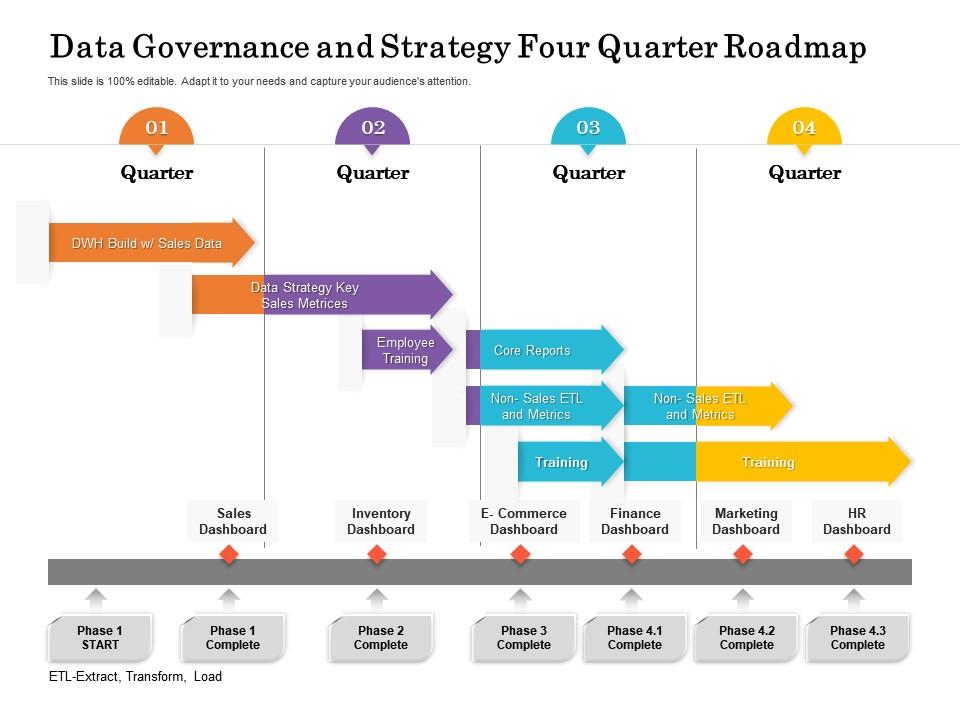
Data governance and strategy four quarter roadmap

Data governance and strategy four quarter roadmap
Slide 1 of 2
Favourites Favourites

Try Before you Buy Download Free Sample Product

Audience Impress Your
Audience
Editable 100%
Editable
Time Save Hours
of Time
The Biggest Sale is ending soon in
0
0
:
0
0
:
0
0
Presenting Data Governance And Strategy Four Quarter Roadmap PowerPoint Template. This PPT presentation is Google Slides compatible hence it is easily accessible. You can download and save this PowerPoint layout in different formats like PDF, PNG, and JPG. This PPT theme is available in both 4,3 and 16,9 aspect ratios. This PowerPoint template is customizable so you can modify the font size, font type, color, and shapes as per your requirements.

FAQs for Data governance and strategy

Honestly, you need five main things to get data governance working. Someone has to own each dataset - like actually be responsible for it. Then you need solid policies, good data quality checks, and proper access controls. A governance committee helps too, though I've seen those turn into total time-wasters if you're not careful. Get tools that can monitor stuff automatically where you can. Here's the thing though - don't try to govern everything right away. Pick your most critical data first and build from there. Way less overwhelming that way.

Honestly, data quality can't be bolted on later - you've gotta bake it into your governance from day one. Start with automated validation at entry points so bad data gets caught early. Get clear standards that people will actually use (not some 50-page document nobody reads). Assign data stewards to own specific datasets. Don't skip the regular audits - I know they're boring but teams always regret skipping them. Document your lineage so you can hunt down where garbage data originated. My advice? Start small with your most critical stuff and build from there.

Data stewards are your day-to-day quality control people - they make governance policies actually happen instead of just sitting in some binder. They're like the bridge between your fancy strategy and real messy datasets. You'll need them checking data quality, approving access requests, enforcing naming rules (good luck with that one honestly). Without them? Your governance framework becomes decoration. Pick stewards for each key data area and give them real power to say no when people try to cut corners.

Okay so first thing - you gotta categorize your data by how sensitive it is. Then set up role-based access controls that only give people what they actually need for their specific jobs. I'd honestly start with a data catalog too, makes it way easier for teams to find stuff they're allowed to use. The whole point is making it super smooth for legit users but a pain for anyone who shouldn't be poking around. Oh and don't forget audit trails - compliance people love that stuff. Yeah it's annoying setup work initially, but it'll save you so much headache later.

Honestly, automation is a game changer for data governance stuff. You can set up automated classification and policy enforcement so you're not constantly monitoring everything yourself. Real-time alerts will ping you when data quality tanks or compliance gets sketchy. The AI discovery tools are actually decent now - they'll hunt down sensitive data across your whole system, which used to take forever manually. Dashboards help too since you can finally see what's happening instead of crossing your fingers that people follow the rules. Oh, and don't go crazy trying to automate everything at once. Pick one process first.

Look, forget vanity metrics - focus on stuff that actually moves the needle. Data quality scores are key (completeness, accuracy, all that). Time-to-insight is massive though. If your teams are still waiting weeks for basic reports, something's broken. Track compliance audit results and how quickly people can actually get the data they need. Data incidents matter too - both how often they happen and resolution times. User adoption of your governance tools tells you if people are buying in. Oh, and stakeholder satisfaction surveys? Game changer. Most people sleep on those. Start with 3-4 metrics max - don't go overboard initially.

Yeah so regulatory stuff isn't optional - GDPR, HIPAA, SOX all basically tell you exactly how to handle your data. Classification, access controls, retention, audit trails, the works. Honestly it's a lot at first. I'd start by figuring out which regulations actually hit your business and data types. Then just build around the strictest ones since that usually covers everything else anyway. Oh and definitely do a compliance audit to see where you're most screwed right now. That'll give you a clear starting point instead of just panicking about everything at once.

Honestly, the worst part is dealing with people who think you're trying to steal "their" data. Cultural pushback is brutal. Then there's the whole mess of nobody wanting to own data governance - like, who's gonna be the bad guy enforcing rules? Your data quality will be all over the place between different systems, budgets are always tight, and executives want to see ROI yesterday when it takes time to show up. Oh, and siloed departments? Forget getting them to agree on anything. My advice: pick one thing that'll make a real difference, prove it works, then build from there. Don't try to fix everything at once.

Look, good data governance basically means you're making decisions based on actual facts instead of just winging it. Once you've got clear ownership and quality standards, your team won't be constantly asking "wait, which spreadsheet should we trust?" - honestly that question drives me crazy. Decisions happen way faster when nobody's second-guessing whether the numbers are legit. Clean data = better outcomes, period. Start by figuring out your biggest business decisions, then work backwards to see what data you're actually using for those calls. It's pretty straightforward once you map it out.

Honestly, don't overthink it too much. Simple templates work best - cover who does what, define your data terms, and map out approval processes. Store everything in one spot where people can actually find it (shocking concept, I know). Most companies create these gorgeous 50-page documents that nobody touches after week one. Keep the language normal, throw in real examples, and assign someone to own each policy. Otherwise it just sits there getting outdated. Oh, and set up regular reviews - like every quarter or whatever makes sense. Dead policies are worse than no policies.

Honestly, get your data governance sorted with vendors before handing anything over. Map out exactly what data they're touching, how they'll use it, where it lives - because this gets ugly real quick if you skip this step. I've watched too many "wait, who was supposed to handle encryption?" meltdowns. Your contracts need specific stuff about data handling, how long they keep it, breach notifications. Don't forget audit rights and deletion procedures for when things end. Basically treat vendor data governance like you would internally, not some checkbox exercise.

Honestly, you gotta get leadership on board first or you're screwed from the start. Don't dump this all on IT - make it everyone's job. Those boring mandatory training sessions? Total waste of time. Do hands-on workshops instead where people actually see why clean data matters for their work. Share success stories constantly and show how it affects the bottom line. Oh, and create data steward roles in each department so there's real ownership. Set up clear policies with actual consequences that get enforced. Celebrate wins big time - people love recognition and it really changes how they act.

Your data governance needs a major upgrade for AI stuff. Traditional "set and forget" is dead - these models keep learning and changing constantly. Start with real-time data lineage tracking and automated decision auditing. Bias monitoring is huge too. You'll need clear accountability for algorithmic decisions, plus feedback loops to catch when things go sideways. Honestly, it's like babysitting a genius toddler who won't stop learning new tricks! Model transparency requirements are non-negotiable now. Just pick your current processes that need AI-specific controls first, then build out from there.

Honestly, you HAVE to get other departments involved - this isn't just an IT thing. Marketing, finance, ops... anyone touching data needs to be part of creating these policies, not just following them later. Otherwise you'll build rules that look perfect but completely break down when people try to use them day-to-day. Each team knows their own data headaches and compliance stuff that you'd totally miss. I learned this the hard way at my last job. Get your key people involved early in the actual policy creation process.

Look, customers trust you more when they actually know what you're doing with their info. Be upfront about data collection and protection - no sneaky stuff. Clear policies matter, but honestly? Following through is what really counts. People can tell when you're hoarding data you don't need (major red flag). Good governance lets you personalize without being weird about it. Start by figuring out what you collect and why. Make your practices easy to understand. Then stick to what you promise. It's pretty straightforward - treat their data like you'd want yours treated.

Ratings and Reviews

0% of 100
Review Form
Write a review
Most Relevant Reviews

No Reviews