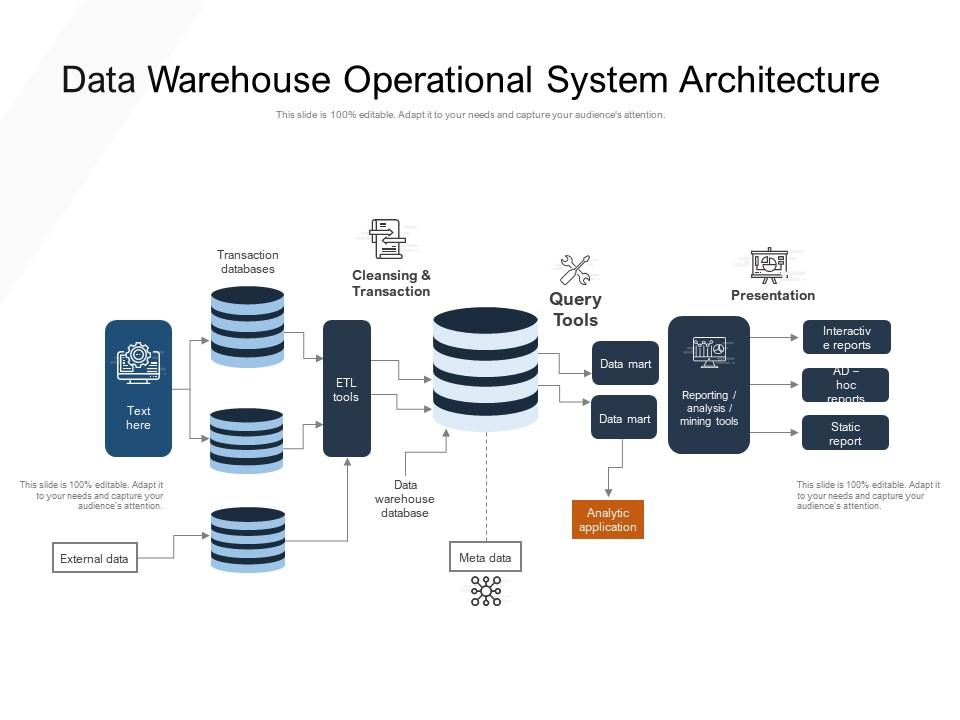
Data warehouse operational system architecture

Slide 1 of 2
Favourites Favourites

Try Before you Buy Download Free Sample Product

Audience Impress Your
Audience
Editable 100%
Editable
Time Save Hours
of Time
The Biggest Sale is ending soon in
0
0
:
0
0
:
0
0
Presenting this set of slides with name Data Warehouse Operational System Architecture. The topics discussed in these slides are Data Warehouse, Operational System, Architecture. This is a completely editable PowerPoint presentation and is available for immediate download. Download now and impress your audience.

FAQs for Data warehouse

Okay so you've got a few main pieces to think about. Your data sources - databases, APIs, files, whatever. Then ETL/ELT processing to clean things up. The warehouse itself for storage, obviously. And your BI tools on top for dashboards and stuff. Most people throw in a data lake too for raw storage, though honestly that whole lake vs warehouse thing is kinda overblown IMO. You'll want Airflow or something similar for orchestration. Oh and don't forget metadata management and security - boring but necessary. I'd actually start by just sketching out how your data moves around right now. Makes it way easier to spot what's missing.

Honestly, cloud data warehousing is a game changer - no more buying servers or getting those fun 2am crash calls. It scales automatically with your data, which is way better than trying to guess what you'll need six months out. You're only paying for what you actually use instead of having expensive equipment collecting dust. Oh, and disaster recovery is way smoother too. I'd suggest crunching the numbers on your current setup versus cloud costs first. The math usually makes the decision pretty obvious. Way faster to get up and running compared to traditional setups.

So ETL is basically your data warehouse's lifeline - it moves stuff from all your messy source systems into something actually useful. You're pulling data from databases, APIs, random files, whatever. Then cleaning and organizing it so it makes sense. Finally dumping it into your warehouse where analysts can dig in. Honestly, skip the ETL work and you'll just end up with a pile of junk nobody trusts. I'd start by figuring out what data sources you're dealing with first, then worry about what transformations you actually need. It's like... data plumbing, but way more important than it sounds.

Honestly, data modeling can totally make or break your warehouse. Normalized schemas give you clean data but queries get painfully slow - those joins are brutal at scale. Star/snowflake schemas work way better for most analytics stuff since they're built for reading data fast. I once worked on a project where someone normalized everything to death and queries took forever (never again lol). The trick is figuring out how people actually query your data first. Then design around their real usage patterns, not what looks theoretically perfect on paper.

First thing - get someone who actually knows the business to own each data area, not just whoever's available. Track where your data comes from and where it goes, seriously document everything. Those automated quality checks at the start? Total lifesaver because bad data will screw you over later. Oh and pick naming standards and stick to them across everything - your future self will thank you. Do monthly check-ins on who can access what. Honestly the biggest game changer is having a decent catalog so people can actually find stuff instead of bugging you constantly.

So basically you dump all your messy stuff in the data lake first - logs, IoT streams, whatever chaos comes in. Then pull out the clean parts and move them to your warehouse for actual reporting. The lake gives you dirt cheap storage, warehouse gives you speed when you need it. Honestly, most people overthink this part. Figure out what datasets actually need that fast query performance first, then build your ETL pipelines around those. Some teams use the lake as staging too which works fine. You get the best of both worlds without breaking the bank.

Honestly, it mostly comes down to speed vs storage space. Star schemas are way faster since your fact table connects straight to dimensions - no weird extra joins to mess with. Snowflake saves storage by normalizing everything, but storage is dirt cheap now so... meh. Also depends on your team's SQL chops - snowflake schemas need more complex joins that can confuse people. I've seen junior analysts get totally lost in those. For most warehouse projects I'd just go with star schema unless you're really hurting for space or dealing with crazy hierarchical dimensions.

Dude, real-time data processing is pretty sweet - you get instant insights instead of waiting around for those annoying overnight batch jobs. Decisions happen faster when you're working with current data. Spot problems immediately, react to what customers are doing right now. Your dashboards actually stay current, fraud detection catches stuff as it happens. Yeah, it's more complex and costs more, but honestly? If your business moves quickly, totally worth the headache. Oh and automated actions based on live streams are clutch. I'd start by figuring out what actually needs real-time updates vs daily refreshes though.

Build validation rules directly into your ETL pipeline - that's honestly where you'll catch most problems before they spiral. Check for completeness, accuracy, all that good stuff at every ingestion stage. Automated monitoring is a lifesaver, trust me on this one. Data profiling tools help spot weird anomalies too. Oh, and set up clear governance policies so people actually know who's responsible for what datasets - sounds boring but it matters. Focus on your most critical data sources first instead of trying to monitor everything at once.

Access controls are your starting point - lock down who can see what based on their actual job needs. Encryption comes next for everything: stored data, transfers, backups, the whole deal. Honestly, the auditing part is kind of boring but you need it to track who's poking around your data. Most platforms these days make this stuff way easier than it used to be, which is nice. I'd tackle permissions first since that's where you're most vulnerable. Then move on to encryption. Those two will handle like 90% of your security headaches right off the bat.

So first thing - benchmark where you're at now with query times and throughput. Then start stress testing with 2x, 10x data loads because that's honestly where things usually fall apart. Check if your storage can expand easily and whether you can add more compute power when needed. Concurrent users will also crush performance if you're not ready for it. I'd run these tests pretty regularly and write down when stuff breaks so you can upgrade before hitting those walls. Oh and definitely test horizontal scaling - some systems just can't handle spreading across multiple servers well.

Data quality will be your worst enemy, trust me. Integration between systems is always messier than expected, and scope creep - ugh, that's what actually kills these projects. Getting everyone to agree on basic definitions? Good luck with that. Different departments hoard their data like dragons, and performance goes to hell if you don't architect things right from the start. Oh, and the politics around data sharing will make you want to pull your hair out. Start with something small that actually works, get your data governance sorted early, and make sure the executives have your back. Otherwise you're screwed.

Honestly, ML is totally changing how we think about data warehouses. You can't just batch process everything overnight anymore - that's dead. Real-time streaming is pretty much mandatory now, plus you need way more compute power for training models. Feature stores, model versioning, all that stuff has to be baked in. Oh and don't even get me started on handling unstructured data alongside your normal tables. I'd start by looking at what you've got now and figuring out where you'll hit bottlenecks when ML workloads ramp up. The infrastructure requirements are just... different.

Honestly, just go with Tableau, Power BI, or Looker - they're the only ones that won't crash when you throw real enterprise data at them. Tableau's super user-friendly if your team isn't tech-savvy. Power BI works great with Microsoft stuff (and let's face it, everyone's using that anyway). Looker handles complex modeling really well. They all connect to data warehouses and update automatically. My advice? Start with whatever licenses you already have lying around, then figure out if you need something fancier based on how complicated your dashboards get.

Partitioning is gonna be your lifesaver here - break up tables by date or whatever key dimensions make sense. Your queries will only touch the data they actually need instead of scanning everything. Also set up proper indexing and get some automated archiving running for old stuff. Oh, and if you're still on row-based storage, seriously consider switching to columnar - it's night and day for analytical queries. I'd start tracking query performance now too. Better to catch the slow ones before your users start complaining, trust me on that one.

Ratings and Reviews

0% of 100
Review Form
Write a review
Most Relevant Reviews

No Reviews