Decentralized web application basic architecture

Decentralized web application basic architecture
Slide 1 of 2

or

Favourites Favourites

Try Before you Buy Download Free Sample Product

Audience Impress Your
Audience
Editable 100%
Editable
Time Save Hours
of Time
The Biggest Sale is ending soon in
0
0
:
0
0
:
0
0
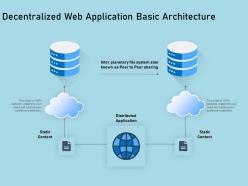
Presenting this set of slides with name Decentralized Web Application Basic Architecture. This is a two stage process. The stages in this process are Static Content, Distributed Application, Static Content. This is a completely editable PowerPoint presentation and is available for immediate download. Download now and impress your audience.

FAQs for Decentralized web

Key components of decentralized web application architecture include distributed storage systems, blockchain networks, peer-to-peer protocols, smart contracts, and decentralized identity management. These technologies streamline data distribution, enhance security through cryptographic validation, and eliminate single points of failure, with many financial services and content platforms finding that this architecture ultimately delivers greater user control and operational resilience.

Decentralized storage distributes data across multiple nodes rather than centralized servers, eliminating single points of failure, reducing costs, and enhancing security through cryptographic protocols. While traditional solutions rely on cloud providers like AWS or Google Cloud, decentralized networks enable organizations to maintain data sovereignty and achieve greater resilience, with many enterprises finding significantly improved uptime and reduced storage expenses.

Blockchain technology secures decentralized web applications through immutable transaction records, cryptographic verification, distributed consensus mechanisms, and tamper-resistant data storage. These security features enable organizations to eliminate single points of failure, reduce fraud risks, and enhance user trust, with financial services and healthcare platforms increasingly finding that blockchain-based architectures deliver superior data integrity and operational transparency.

Smart contracts serve as the backbone of dApp architecture by automating business logic, managing data storage, facilitating user interactions, and ensuring trustless transactions without intermediaries. These self-executing contracts enable organizations across finance, supply chain, and healthcare sectors to streamline operations, reduce costs, and enhance transparency, with many enterprises finding that automated contract execution delivers faster services and improved security.

Scalability challenges in decentralized applications include network congestion, transaction throughput limitations, consensus mechanism bottlenecks, storage distribution complexities, and cross-chain interoperability issues. While these present technical hurdles, many organizations are finding that layer-two solutions, sharding technologies, and hybrid architectures effectively address performance concerns, ultimately delivering enhanced user experiences and competitive advantages in increasingly distributed digital environments.

Decentralized applications handle user identity through blockchain-based digital wallets, cryptographic key pairs, self-sovereign identity protocols, and decentralized identity networks like DID systems. These technologies enable users to control their authentication directly, eliminating traditional password systems while providing enhanced security and privacy, with many financial services and healthcare organizations finding improved user trust and reduced identity management costs.

Decentralized web applications typically experience slower response times and higher latency compared to centralized systems, while offering enhanced security, reduced single points of failure, and improved data sovereignty. These trade-offs present both challenges and opportunities, with many financial services and healthcare organizations finding that strategic implementation of hybrid architectures delivers operational resilience and regulatory compliance, ultimately enabling competitive advantage in increasingly privacy-conscious markets.

Developers ensure interoperability between decentralized platforms through cross-chain protocols, standardized APIs, blockchain bridges, universal identity systems, and shared data formats. These technologies streamline integration by enabling seamless asset transfers, consistent user experiences, and unified communication standards, with many organizations finding that strategic interoperability delivers reduced development costs and enhanced competitive advantage across diverse ecosystems.

Proof of Stake, Proof of Work, Delegated Proof of Stake, Proof of Authority, and Byzantine Fault Tolerance represent the most widely adopted consensus mechanisms in decentralized applications. These protocols enable distributed networks by validating transactions, securing data integrity, and maintaining network consensus, with many financial services and supply chain organizations finding that strategic implementation ultimately delivers enhanced security and operational transparency.

In decentralized application ecosystems, users gain direct control over their data, digital assets, and identity through blockchain-based ownership models, eliminating traditional platform dependencies. This shift enables true data portability, monetization opportunities, and reduced platform lock-in, with many users finding they can seamlessly transfer assets between applications while maintaining sovereignty over their digital presence and economic value.

Best practices for designing decentralized application interfaces include prioritizing transparency through clear transaction status indicators, simplifying wallet connections and blockchain interactions, providing comprehensive error handling and recovery options, ensuring responsive design across devices, and maintaining familiar web patterns despite underlying complexity. These approaches enhance user adoption by reducing technical barriers, building trust through visibility, and delivering intuitive experiences, with many organizations finding that seamless interface design significantly accelerates decentralized application acceptance.

Decentralized applications address data privacy through blockchain encryption, peer-to-peer networks, user-controlled private keys, zero-knowledge proofs, and distributed storage systems. These technologies enhance privacy by eliminating central data repositories, enabling direct user ownership of information, and providing cryptographic security, with many financial services and healthcare organizations finding that decentralized architectures significantly reduce data breach risks while improving user trust.

Decentralized applications can disrupt traditional business models by eliminating intermediaries, reducing transaction costs, and enabling direct peer-to-peer interactions across various sectors. Financial services, supply chain management, and digital marketplaces increasingly find that DApps deliver enhanced transparency, lower operational expenses, and improved customer control, while presenting both integration challenges and significant competitive advantages for early adopters.

Governance in decentralized application ecosystems typically operates through token-based voting systems, decentralized autonomous organizations (DAOs), community proposals, and multi-signature consensus mechanisms. These structures enable stakeholders to collectively make protocol decisions, treasury allocations, and feature updates, with many blockchain platforms finding that transparent governance processes enhance user trust, accelerate adoption, and ultimately deliver more resilient, community-driven applications.

Popular frameworks for decentralized web applications include Ethereum's Web3.js, Truffle Suite, Hardhat, IPFS for storage, and React-based DApp frameworks like Drizzle. These tools streamline development by providing smart contract integration, decentralized storage solutions, and user interface components, with many organizations finding they enable faster deployment and enhanced security.

Ratings and Reviews

0% of 100
Review Form
Write a review
Most Relevant Reviews

No Reviews