Designing and managing integrated marketing communications ppt slides

Designing and managing integrated marketing communications ppt slides
Slide 1 of 5
Favourites Favourites

Try Before you Buy Download Free Sample Product

Audience Impress Your
Audience
Editable 100%
Editable
Time Save Hours
of Time
The Biggest Sale is ending soon in
0
0
:
0
0
:
0
0
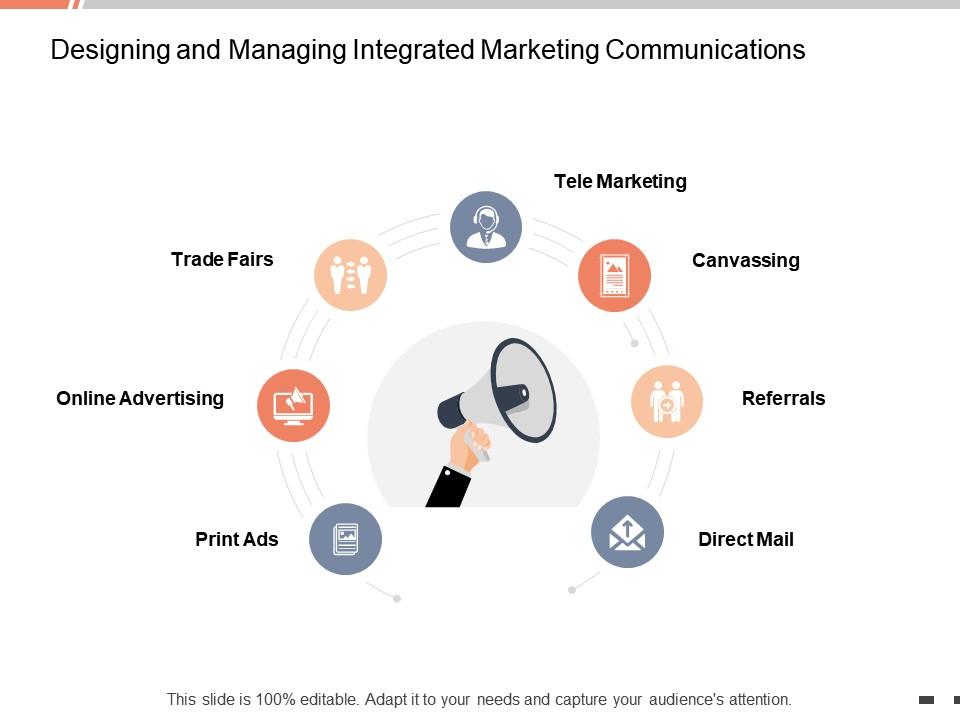
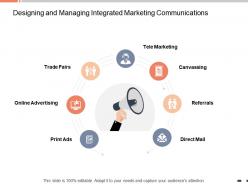
Presenting this set of slides with name Designing And Managing Integrated Marketing Communications Ppt Slides. This is a seven stage process. The stages in this process are Online Advertising, Trade Fairs, Tele Marketing, Canvassing, Referrals. This is a completely editable PowerPoint presentation and is available for immediate download. Download now and impress your audience.

People who downloaded this PowerPoint presentation also viewed the following :

FAQs for Designing and managing integrated marketing

The key components of Integrated Marketing Communications include advertising, public relations, sales promotion, direct marketing, personal selling, and digital marketing channels. These elements work synergistically by maintaining consistent messaging across touchpoints, coordinating timing and creative execution, and leveraging data analytics, with many organizations finding that strategic integration enhances brand recognition, reduces marketing costs, and ultimately delivers stronger customer engagement and measurable ROI.

IMC enhances brand consistency by standardizing messaging, visual identity, tone, and customer experience across all marketing channels and touchpoints. Through coordinated campaigns, unified brand guidelines, and centralized strategy development, companies deliver coherent communications whether customers encounter them through social media, advertising, or retail environments, ultimately strengthening brand recognition and customer trust.

Digital marketing tools integrate into IMC strategies through social media platforms, email marketing, content marketing, search engine optimization, and programmatic advertising that create consistent messaging across touchpoints. These technologies enhance traditional campaigns by enabling real-time customer engagement, personalized experiences, and data-driven targeting, with retail and financial services organizations finding that seamless integration ultimately delivers improved brand recognition and measurable ROI.

Consumer behavior analysis plays a foundational role in IMC by revealing customer preferences, purchase patterns, media consumption habits, and decision-making triggers across different touchpoints. This insight enables marketers to craft cohesive messaging, select optimal channel combinations, and time communications strategically, with retail brands and financial services finding that behavior-driven IMC campaigns deliver significantly higher engagement rates and conversion outcomes.

Measuring IMC campaign success involves tracking brand awareness metrics, customer engagement rates, conversion statistics, cross-channel attribution data, and return on investment calculations. Through unified analytics platforms, organizations monitor message consistency across touchpoints, assess customer journey progression, and evaluate revenue impact, with many companies finding that integrated measurement approaches deliver clearer insights than isolated channel analysis.

Common IMC implementation challenges include siloed departments, inconsistent messaging across channels, budget allocation conflicts, technology integration issues, and measuring unified campaign effectiveness. These obstacles often stem from organizational resistance to change and lack of centralized coordination, with many companies finding that establishing cross-functional teams and unified metrics systems ultimately delivers stronger brand coherence and improved customer experiences.

Storytelling within IMC creates consistent narrative threads across all touchpoints, including social media campaigns, email marketing, content hubs, video series, and experiential events. This strategic approach enables brands to build emotional connections, reinforce key messages seamlessly, and drive deeper audience engagement, with many organizations finding that unified storytelling significantly enhances brand recall and customer loyalty.

Social media significantly enhances integrated marketing communications by enabling real-time customer engagement, amplifying brand messaging across multiple touchpoints, and providing valuable consumer insights through analytics. This digital integration allows brands to maintain consistent messaging while adapting content for different platforms, with retail and hospitality sectors finding that social channels ultimately deliver improved customer relationships and measurable campaign effectiveness.

IMC improves customer retention and loyalty by delivering consistent messaging across all touchpoints, creating personalized experiences based on customer data, and building emotional connections through cohesive brand storytelling. This strategic approach enables companies to reduce churn rates, increase repeat purchases, and foster long-term relationships, with many retail and service organizations finding that coordinated campaigns significantly enhance customer lifetime value.

Traditional marketing relies on individual channels like print, radio, or television working independently, while integrated marketing communications coordinates all marketing channels—digital, social media, PR, advertising, and direct marketing—to deliver consistent messaging. This strategic approach enables organizations to create seamless customer experiences across touchpoints, maximize resource efficiency, and build stronger brand recognition, with many companies finding significantly improved campaign effectiveness and ROI.

Content marketing serves as the foundational layer of IMC by creating valuable, consistent messaging that flows across all communication channels, from social media and email campaigns to PR initiatives and advertising. This strategic approach enables brands to maintain unified storytelling while delivering targeted content through multiple touchpoints, ultimately building stronger customer relationships and driving measurable engagement across diverse marketing platforms.

Organizations can ensure departmental alignment with IMC efforts through cross-functional team formation, unified messaging guidelines, shared performance metrics, regular inter-departmental meetings, and centralized communication platforms. These strategies streamline coordination by establishing clear roles, consistent brand voices, and collaborative workflows, with many companies finding that integrated training programs and shared customer data ultimately deliver stronger campaign consistency and improved customer experiences.

Data analytics enhances IMC strategies by tracking customer behavior across channels, measuring campaign performance, identifying optimal touchpoints, and revealing audience preferences through real-time insights. Through advanced analytics platforms, marketers can personalize messaging, allocate budgets more effectively, and optimize timing, with many brands finding that data-driven integration delivers significantly higher engagement rates and measurable ROI improvements.

Influencer marketing integrates into IMC campaigns through authentic content creation, cross-platform storytelling, product demonstrations, event partnerships, and user-generated content amplification. These collaborations enhance brand credibility by leveraging trusted voices across multiple touchpoints, while enabling consistent messaging through social media, email campaigns, and traditional advertising, ultimately delivering expanded reach and deeper audience engagement.

Businesses should reassess their IMC strategies quarterly for tactical adjustments and conduct comprehensive reviews annually, with additional evaluations triggered by major market shifts, competitive changes, or campaign performance data. This approach enables organizations to maintain message consistency while adapting to evolving consumer behaviors, emerging channels, and market dynamics, ultimately delivering sustained competitive advantage and optimized marketing ROI.

Ratings and Reviews

0% of 100
Write a review
Most Relevant Reviews

No Reviews