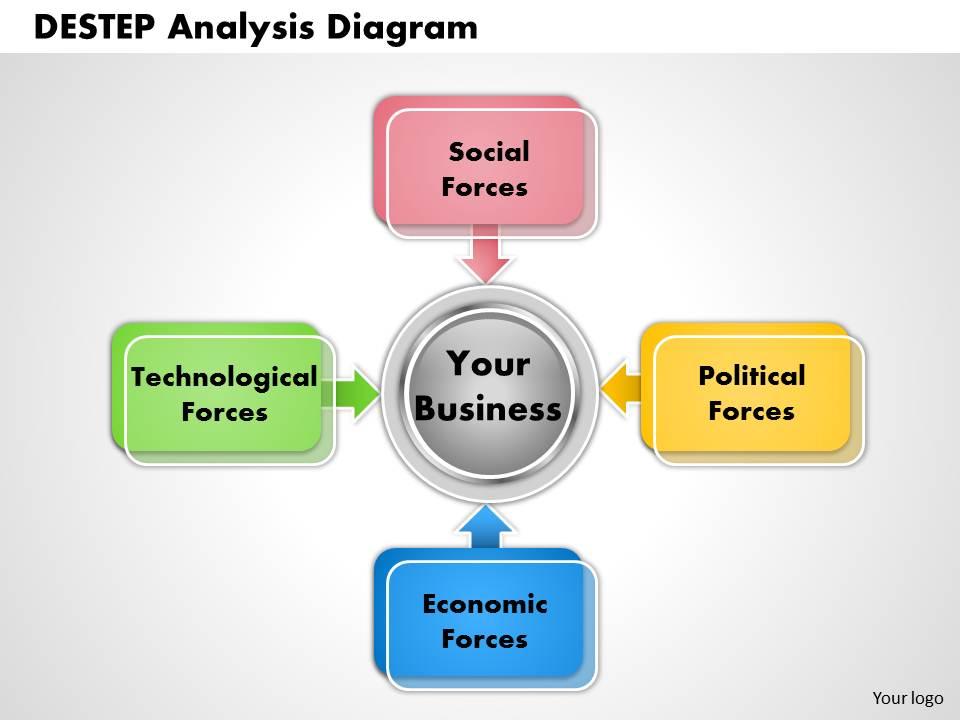
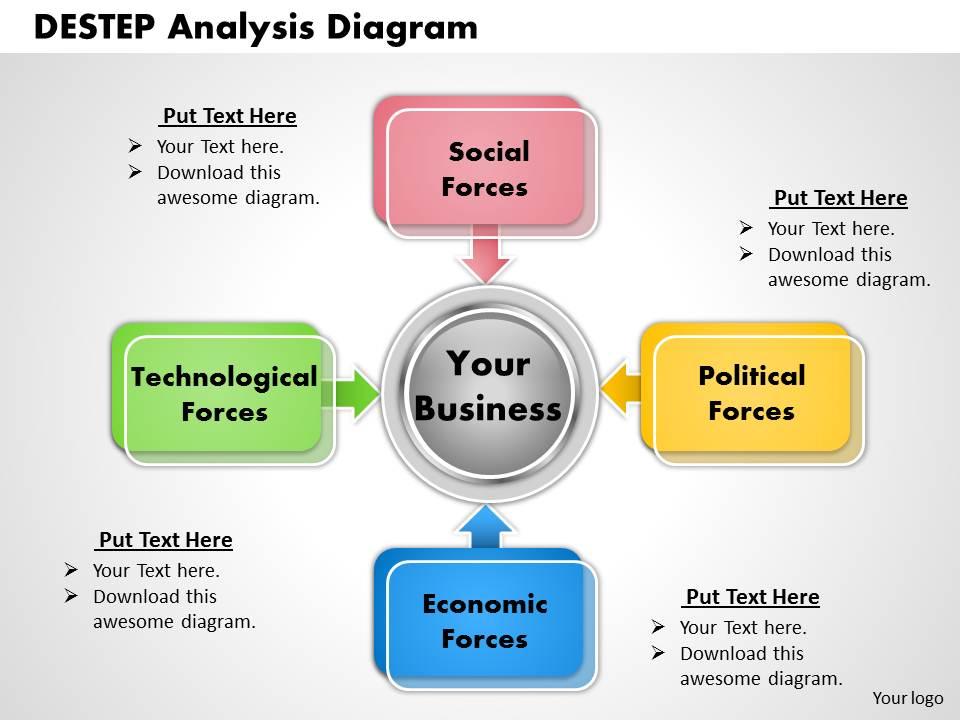
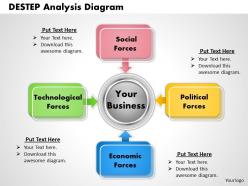
Destep analysis diagram powerpoint template slide
Try Before you Buy Download Free Sample Product
Audience
Editable
of Time
For pitch perfect presentations select one of our thousands of Destep Analysis Diagram PowerPoint Template Slide options. Perfect for any presentation need.
People who downloaded this PowerPoint presentation also viewed the following :
Destep analysis diagram powerpoint template slide with all 6 slides:
Our Destep Analysis Diagram PowerPoint Template Slide are veritable cash cards. Your thoughts will be rewarded on the spot.
FAQs for Destep analysis diagram
DESTEP analysis examines six interconnected factors: demographic shifts, economic conditions, socio-cultural trends, technological advances, environmental concerns, and political-legal frameworks that shape business environments. These components interact dynamically, with demographic changes influencing market demand, economic factors affecting investment capacity, and regulatory shifts creating both compliance challenges and competitive opportunities, ultimately enabling organizations to develop more resilient strategies.
Businesses can effectively gather demographic data through government census reports, market research surveys, industry publications, social media analytics, and customer database analysis. These sources enable organizations to track population trends, age distributions, income levels, and lifestyle changes across target markets, ultimately delivering deeper consumer insights and more strategic market positioning in an increasingly data-driven business environment.
Within DESTEP analysis, the economic environment significantly influences consumer purchasing power, spending patterns, credit availability, and investment confidence, directly affecting demand cycles and market expansion. Economic factors like inflation, interest rates, and employment levels reshape consumer priorities and business strategies, with retail companies adjusting product lines during recessions while financial services modify lending criteria, ultimately determining market viability and growth trajectories.
Technological advancements integrate into DESTEP analysis by examining digital transformation impacts, automation potential, cybersecurity requirements, and innovation cycles across all framework dimensions. Strategic planners assess how emerging technologies like AI, IoT, and blockchain influence demographic shifts, economic models, and regulatory compliance, with organizations finding that comprehensive tech integration enhances competitive positioning and future-readiness.
The social environment in DESTEP analysis reveals changing demographics, cultural shifts, lifestyle preferences, consumer behaviors, and societal values that directly influence market demand and product positioning. These social factors enable organizations to anticipate emerging opportunities, adapt their offerings to evolving customer expectations, and develop targeted strategies, with many companies finding that understanding social trends delivers competitive advantage and enhanced market responsiveness.
Businesses forecast political changes through DESTEP analysis by monitoring regulatory trends, election cycles, policy announcements, lobbying activities, and international relations developments. This systematic approach enables organizations to anticipate shifts in trade policies, tax regulations, and compliance requirements, with many financial services and manufacturing companies finding that proactive political risk assessment delivers competitive advantage and strategic preparedness.
Methods for evaluating ecological factors in DESTEP analysis include environmental impact assessments, carbon footprint calculations, resource consumption audits, waste management evaluations, and sustainability compliance reviews. These approaches enable organizations to measure environmental performance, identify regulatory risks, and develop sustainable practices, with many companies finding that proactive ecological analysis delivers competitive advantage while ensuring long-term operational viability.
Businesses should prioritize DESTEP findings by assessing immediate impact on operations, revenue potential, and regulatory compliance requirements, while evaluating timeframes for implementation and resource availability. Strategic prioritization involves focusing on factors that offer competitive advantage, such as emerging demographic trends in retail or environmental regulations in manufacturing, ultimately enabling organizations to allocate resources effectively and respond proactively to market dynamics.
Common pitfalls include relying on outdated data, focusing too narrowly on obvious factors, failing to consider factor interconnections, and conducting analysis without clear objectives. Organizations often overlook emerging trends, underestimate regional variations, or treat DESTEP as a one-time exercise, with many finding that regular updates and cross-functional input ultimately deliver more accurate strategic insights.
DESTEP analysis helps emerging businesses identify market opportunities by systematically evaluating demographic shifts, economic trends, social changes, technological advances, environmental factors, and political developments. Through this comprehensive framework, startups can pinpoint underserved segments, anticipate regulatory changes, and leverage technological disruptions, with many emerging companies finding that early DESTEP insights enable strategic positioning and competitive advantage in evolving markets.
Cultural diversity significantly influences social factors in DESTEP analysis through varying consumer behaviors, communication preferences, workplace dynamics, and community values across different demographic segments. Organizations leveraging this diversity can enhance market segmentation strategies, improve employee engagement, and develop more inclusive products and services, with many multinational companies finding that culturally-aware social analysis delivers competitive advantages in increasingly diverse markets.
Companies leverage DESTEP analysis to enhance CSR initiatives by systematically evaluating demographic shifts, economic conditions, social expectations, technological capabilities, environmental regulations, and political frameworks that impact stakeholder priorities. This comprehensive assessment enables organizations to align CSR programs with emerging community needs, regulatory requirements, and market expectations, ultimately delivering stronger social impact while building competitive advantage through strategic stakeholder engagement.
**INPUT**: What case studies exemplify successful application of DESTEP analysis in strategic decision-making? **OUTPUT**: Successful DESTEP applications include Netflix's streaming transition analyzing demographic shifts and technological advancement, Tesla's market entry evaluating environmental regulations and political incentives, and pharmaceutical companies assessing social attitudes toward healthcare innovation. These organizations leveraged comprehensive environmental scanning to identify market opportunities, mitigate regulatory risks, and align strategic initiatives with emerging trends, ultimately delivering competitive advantage and sustainable growth. **Word count: 58 words**
DESTEP analysis can be tailored by emphasizing industry-specific factors, adjusting weighting of different elements, and incorporating sector-relevant metrics and timeframes. For technology companies, political regulations around data privacy and environmental sustainability concerns become critical, while healthcare organizations focus heavily on regulatory compliance, demographic shifts, and social acceptance of new treatments, ultimately enabling more precise strategic planning and competitive positioning.
Global trends in DESTEP analysis present both challenges and opportunities for local businesses through demographic shifts, evolving regulations, social media influence, technological disruption, environmental pressures, and political changes. While these forces create complexity, they also enable strategic adaptation, with many local retailers, restaurants, and service providers finding that understanding global patterns enhances competitive positioning and operational efficiency.
-
Unique research projects to present in meeting.
-
Awesome use of colors and designs in product templates.