Double diamond strategy model powerpoint show

Rating:
100%
Double diamond strategy model powerpoint show
Slide 1 of 5
Favourites Favourites

Try Before you Buy Download Free Sample Product

Audience Impress Your
Audience
Editable 100%
Editable
Time Save Hours
of Time
The Biggest Sale is ending soon in
0
0
:
0
0
:
0
0
Rating:
100%
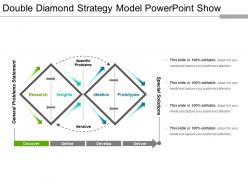
Presenting double diamond strategy model powerpoint show. This Is a double diamond strategy model powerpoint show. This is a two stage process. The stages in this process are strategy diamond, strategy.

FAQs for Double diamond strategy

The Double Diamond Strategy Model comprises four interconnected phases: Discover, Define, Develop, and Deliver, structured across two diamond-shaped cycles of divergent and convergent thinking. These phases systematically guide organizations from initial problem exploration through research and insights, then narrow to specific opportunity definition before expanding again into solution ideation and finally converging on implementation, with many innovation teams finding that this iterative approach significantly reduces development risks while accelerating breakthrough solutions.

Organizations implement the Double Diamond framework by establishing clear phase gates between divergent and convergent thinking stages, training cross-functional teams in design thinking methodologies, and creating structured feedback loops throughout discovery and delivery phases. Through dedicated workshops, stakeholder mapping, and iterative prototyping, companies in sectors like healthcare, financial services, and manufacturing streamline innovation processes while reducing project risks, ultimately delivering more user-centered solutions and enhanced competitive advantage.

The Double Diamond Strategy Model offers structured problem exploration through distinct divergent and convergent phases, clearer milestone tracking, and systematic validation checkpoints compared to more fluid design thinking approaches. While other methodologies can blend exploration with solution development, this model's explicit problem definition stage ensures organizations thoroughly understand challenges before pursuing solutions, ultimately delivering more targeted outcomes and reducing costly pivots.

The first diamond's discovery phase shapes user understanding through comprehensive research methods, including user interviews, surveys, ethnographic studies, behavioral analysis, and stakeholder consultations. These techniques enable organizations to uncover hidden pain points, identify unmet needs, and challenge existing assumptions, with many companies finding that deeper user insights ultimately drive more innovative solutions and stronger market positioning.

Teams can ensure effective divergence in the explore phase by conducting comprehensive user research, brainstorming without constraints, engaging diverse stakeholders, mapping customer journeys, and challenging existing assumptions through multiple research methods. This strategic combination enables organizations to uncover hidden opportunities and user needs across various touchpoints, with many design teams finding that broader exploration ultimately delivers more innovative solutions and competitive advantage.

Synthesis techniques include affinity mapping, thematic analysis, journey mapping, persona development, and problem reframing workshops. These methods enable teams to identify patterns, prioritize user needs, and translate research into actionable insights, with many design teams finding that structured synthesis workshops accelerate decision-making and ensure stakeholder alignment.

The Double Diamond Model's define phase emphasizes divergent thinking followed by convergent synthesis, contrasting with traditional linear problem-solving that rushes to solutions. While conventional approaches often accept initial problem statements at face value, the define phase requires teams to explore multiple problem framings, challenge assumptions, and synthesize research insights before crystallizing the core challenge, ultimately delivering more strategic problem definition and reducing costly pivots later in development.

Stakeholder feedback drives critical insights during both phases, helping teams understand user needs, market conditions, and organizational constraints in the discover phase, while validating problem definitions and priority frameworks in the define phase. Through structured interviews, surveys, and collaborative workshops, organizations gather diverse perspectives that shape strategic direction, ensuring solutions address real challenges while maintaining stakeholder buy-in and competitive alignment.

The Double Diamond Strategy Model guides teams by structuring divergent thinking during problem discovery and solution ideation phases, followed by convergent thinking during definition and development phases. This alternating approach enables teams to explore creative possibilities broadly while systematically narrowing to practical solutions, with organizations in sectors like product development and consulting finding that this balance delivers innovative yet feasible outcomes.

Organizations can assess Double Diamond effectiveness through user satisfaction scores, time-to-market improvements, iteration cycles completed, stakeholder engagement levels, and solution adoption rates. These metrics enable companies to track progress across discovery and delivery phases, with many design-focused organizations finding that measuring both process efficiency and outcome quality delivers clearer insights into innovation performance and competitive advantage.

The Double Diamond Strategy Model adapts to healthcare and education by applying its four phases to sector-specific challenges, with healthcare using it for patient care pathway optimization, treatment protocol development, and medical device innovation, while education leverages it for curriculum design, learning experience enhancement, and institutional process improvement. These sectors find that the model's emphasis on divergent and convergent thinking enables systematic problem-solving, stakeholder engagement, and evidence-based solutions, ultimately delivering improved patient outcomes, enhanced learning experiences, and operational efficiency.

Teams often struggle with transitioning from broad exploration to focused development due to analysis paralysis, difficulty prioritizing insights, and resistance to narrowing options. These challenges can be mitigated through structured decision-making frameworks, clear transition criteria, and stakeholder alignment workshops, with many organizations finding that dedicated synthesis sessions and prototype validation help bridge the gap between divergent thinking and convergent execution.

The Double Diamond promotes collaboration by establishing shared understanding through divergent research phases, convergent decision-making workshops, and structured handoffs between discovery and delivery teams. Cross-functional members from marketing, engineering, and design work together during problem definition and solution validation, with collaborative techniques like co-creation sessions and stakeholder mapping ultimately delivering aligned outcomes and reduced silos.

Technology tools enhance the Double Diamond Strategy Model by integrating data analytics platforms, collaborative software, automation systems, and AI-powered insights throughout discovery, definition, development, and delivery phases. Through digital survey tools, real-time collaboration platforms, and predictive analytics, organizations streamline research processes, accelerate ideation cycles, and optimize solution testing, ultimately delivering faster innovation timelines and more data-driven strategic outcomes.

Successful Double Diamond applications include Airbnb's user experience redesign, IDEO's shopping cart innovation, IBM's customer journey transformation, and Google's accessibility improvements across products. These cases demonstrate how systematic divergent-convergent thinking enables organizations to identify overlooked user needs, challenge assumptions, and develop breakthrough solutions that deliver measurable business outcomes, enhanced customer satisfaction, and sustainable competitive advantages.

Ratings and Reviews

100% of 100
Review Form
Write a review
Most Relevant Reviews
  1. 100%

    by Dennis Stone

    Awesome use of colors and designs in product templates.
  2. 100%

    by O'Ryan Edwards

    Perfect template with attractive color combination.

2 Item(s)

per page: