Driver diagram for crm sample of ppt
Try Before you Buy Download Free Sample Product
Audience
Editable
of Time
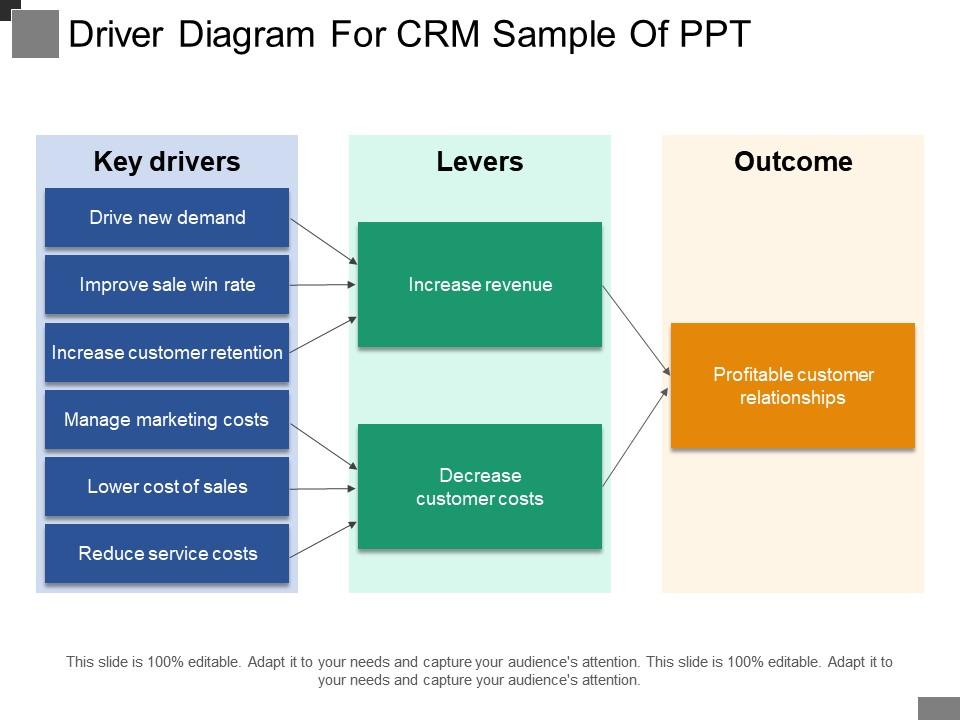
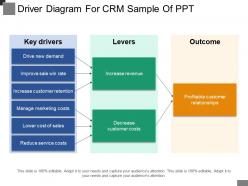
Determining the key drivers that lead to good CRM is essential for the successful running of your business. With this driver diagram for CRM sample of PPT, you can easily display your presentation where you discuss the various strategies for good Customer Relationship Management. The success of your venture depends upon the sales figures and so, Customer Retention is a key factor for you. Similarly, this CRM slide helps you identify more such drivers like driving demand, improving sales win rate, to increase revenue. Also, you can identify parameters for lowering the costs, like, managing marketing costs, lowering costs of sales and services. This will lead you to the main levers - reduction in costs and increase in revenue which leads to good customer relationship. Hence, this template will help you direct your team towards the goals set by you. The slide can be downloaded easily, modified and presented! Caution folks about instability with our Driver Diagram For Crm Sample Of Ppt. Guide them to counter changing circumstances.
People who downloaded this PowerPoint presentation also viewed the following :
Driver diagram for crm sample of ppt with all 5 slides:
Display exemplary competence with our Driver Diagram For Crm Sample Of Ppt. Create benchmarks for others to follow.
FAQs for Driver diagram for crm
Key components include primary drivers like customer acquisition and retention, secondary drivers such as lead management and service quality, outcome measures including revenue growth and satisfaction scores, and process measures like response times and conversion rates. These elements work together by mapping strategic CRM objectives to actionable initiatives, enabling organizations to track performance systematically and identify improvement opportunities that ultimately deliver enhanced customer experiences and competitive advantage.
A driver diagram maps the connections between high-level CRM objectives, key drivers, and specific strategies, creating a visual hierarchy that shows how tactical actions support strategic goals. This visualization enables organizations to align customer retention initiatives, sales processes, and service improvements with broader business outcomes, while identifying gaps in their CRM approach, ultimately delivering clearer strategic focus and measurable progress toward customer relationship excellence.
Driver diagrams enable organizations to systematically map CRM challenges by identifying primary drivers like data quality issues, user adoption barriers, process inefficiencies, and integration problems, then drilling down to specific root causes. Through this structured approach, companies in sectors like financial services and retail can pinpoint exactly why customer retention drops or sales conversions lag, ultimately delivering targeted solutions and measurable improvements in customer relationship outcomes.
Leading indicators in CRM driver diagrams predict future outcomes through metrics like call response times, lead qualification rates, and customer touchpoint frequency, while lagging indicators measure achieved results such as customer retention, revenue growth, and satisfaction scores. This strategic combination enables sales teams to proactively adjust tactics based on predictive data while measuring ultimate success, with many organizations finding that balancing both indicator types delivers enhanced forecasting accuracy and improved customer relationship outcomes.
Teams ensure alignment between CRM goals and driver diagram actions through regular cross-functional reviews, clear KPI mapping, and consistent communication protocols that connect strategic objectives to daily activities. This structured approach enables sales, marketing, and customer service departments to coordinate efforts seamlessly, with many organizations finding that weekly alignment sessions and shared dashboards ultimately deliver improved customer experiences and measurable revenue growth.
Common pitfalls include overcomplicating the diagram with excessive detail, failing to align drivers with specific CRM objectives, neglecting stakeholder input during development, and creating static diagrams without regular updates. These mistakes undermine CRM effectiveness by creating confusion among sales teams, misallocating resources toward irrelevant metrics, and missing critical performance indicators, with many organizations finding that simplified, stakeholder-validated diagrams deliver better user adoption and measurable improvements.
A driver diagram enhances cross-departmental collaboration in CRM initiatives by creating a shared visual framework that aligns teams around common customer objectives, clarifies interdependencies between departments, and establishes measurable outcomes that require coordinated effort. Through this strategic mapping approach, organizations streamline communication between sales, marketing, and customer service teams, ultimately delivering improved customer experiences and operational efficiency across the entire customer journey.
Best practices for drafting a CRM driver diagram include defining clear customer journey stages, identifying key performance indicators, mapping data touchpoints, establishing automation workflows, and aligning sales processes with customer needs. These strategic elements streamline implementation by connecting business objectives to specific system functionalities, with many organizations finding that comprehensive driver diagrams reduce deployment time and enhance user adoption rates.
Driver diagrams enable businesses to monitor CRM performance by mapping key metrics like customer acquisition costs, retention rates, and satisfaction scores against strategic outcomes. Through regular tracking of these interconnected drivers, organizations can identify underperforming areas, adjust resource allocation, and optimize customer engagement tactics, ultimately delivering improved customer experiences and stronger revenue growth.
**INPUT**: What tools or software do you recommend for developing and managing driver diagrams for CRM? **OUTPUT**: Recommended tools for CRM driver diagrams include Lucidchart, Visio, Miro, SmartDraw, and specialized CRM platforms like Salesforce Analytics. These solutions streamline diagram creation through collaborative features, template libraries, and real-time data integration, with many organizations finding that cloud-based platforms enhance team coordination and enable continuous improvement tracking.
Stakeholders can be effectively engaged through collaborative workshops, cross-functional interviews, and structured feedback sessions that capture diverse perspectives on CRM objectives and customer touchpoints. By involving sales teams, marketing departments, customer service representatives, and IT professionals in mapping key drivers, organizations ensure comprehensive input while building consensus around shared goals, ultimately delivering stronger stakeholder buy-in and more accurate driver identification.
Successful driver diagram applications in CRM include Salesforce's customer acquisition optimization, HubSpot's lead conversion improvement, and Microsoft Dynamics' retention strategy enhancement. These implementations streamline sales processes, enhance customer segmentation, and accelerate deal closure rates, with many organizations finding that systematic driver mapping ultimately delivers improved conversion metrics and sustainable revenue growth.
A driver diagram facilitates better CRM communication by creating visual alignment between strategic objectives, key drivers, and specific initiatives across all organizational levels. This shared framework enables departments like sales, marketing, and customer service to understand their role in broader CRM goals, ultimately streamlining coordination and ensuring consistent messaging throughout implementation efforts.
CRM driver diagram metrics should include customer acquisition cost, customer lifetime value, retention rates, conversion rates, and sales cycle length. These metrics enable organizations to streamline performance tracking, enhance customer relationship management, and optimize resource allocation, with many businesses finding that this strategic combination ultimately delivers improved customer experiences and competitive advantage.
Driver diagrams streamline CRM onboarding by mapping specific adoption pathways, identifying key stakeholder requirements, establishing measurable implementation milestones, and connecting training modules to desired outcomes. Through visual process mapping, organizations can accelerate user adoption, minimize resistance to change, and ensure seamless integration across departments, with many companies finding that structured onboarding approaches reduce implementation time while enhancing long-term CRM effectiveness.
-
The Designed Graphic are very professional and classic.
-
Innovative and attractive designs.