E commerce supply chain management sales ppt powerpoint presentation icon visuals cpb
Try Before you Buy Download Free Sample Product
Audience
Editable
of Time
Express empathy with our E Commerce Supply Chain Management Sales Ppt Powerpoint Presentation Icon Visuals Cpb. Display your concern for everyone's feelings.
People who downloaded this PowerPoint presentation also viewed the following :
Content of this Powerpoint Presentation
Description:
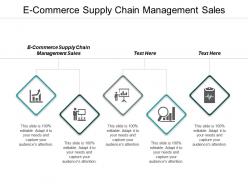
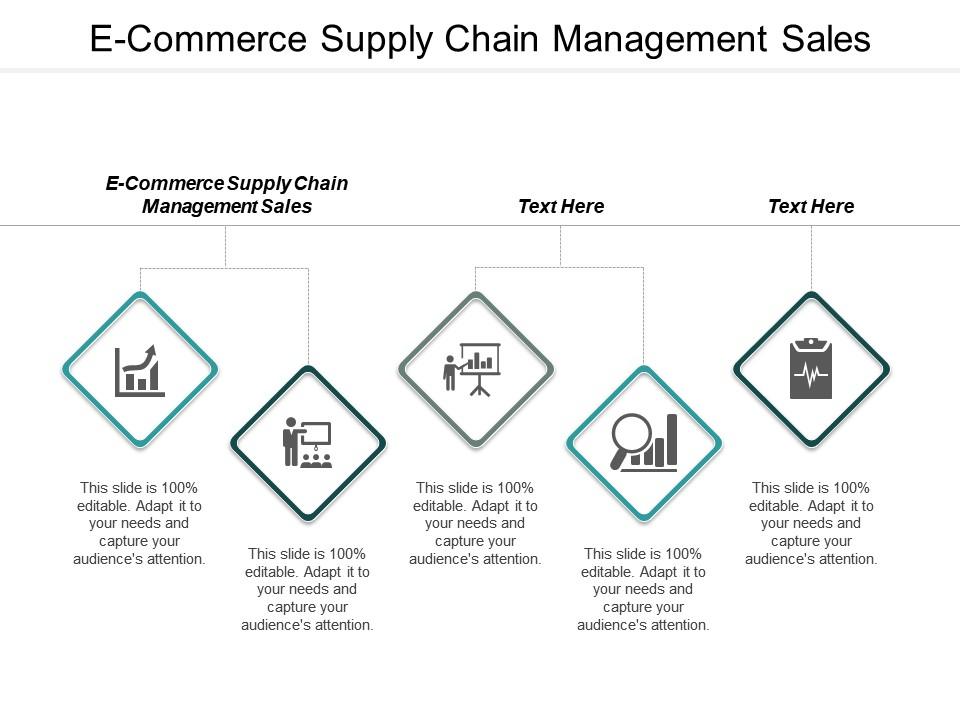
This image presents a PowerPoint slide template titled "E-Commerce Supply Chain Management Sales." It is designed for professional business presentations, specifically tailored to discuss aspects of the supply chain within the e-commerce industry. The slide contains four hexagonal graphics each paired with a place for text. Each graphic represents a different concept or metric relevant to the supply chain, but the exact details are left for customization as indicated by "Text Here". The icons appear to represent growth or factory (first), presentation or reporting (second), worker or operations (third), and pulse or health/performance (fourth).
Use Cases:
This template could be applicable in a range of industries that deal with e-commerce or supply chain components. Here are seven industries and potential use cases:
1. Retail:
Use: Outlining strategies for inventory management and sales forecasting.
Presenter: Supply Chain Analyst.
Audience: Retail Management Team.
2. Logistics:
Use: Presenting the impact of logistics strategies on e-commerce success.
Presenter: Logistics Coordinator.
Audience: Company Stakeholders.
3. Manufacturing:
Use: Explaining the integration of manufacturing processes with e-commerce platforms.
Presenter: Operations Manager.
Audience: Manufacturing Team Leaders.
4. Information Technology:
Use: Showcasing the IT solutions for supply chain management in e-commerce.
Presenter: IT Solutions Architect.
Audience: E-commerce Business Partners.
5. Pharmaceuticals:
Use: Discussing online sales channels and distribution for pharmaceutical products.
Presenter: Pharmaceutical Sales Manager.
Audience: Healthcare Providers and Distributors.
6. Consumer Electronics:
Use: Assessing the performance and delivery timelines for electronic goods sold online.
Presenter: E-Commerce Manager.
Audience: Electronics Supplier and Manufacturer Representatives.
7. Food & Beverage:
Use: Strategy meeting for improving the supply chain for online grocery and food delivery services.
Presenter: Supply Chain Specialist.
Audience: Supermarket and Food Service Executives.
E commerce supply chain management sales ppt powerpoint presentation icon visuals cpb with all 5 slides:
Display your concern for everyone's feelings with our E Commerce Supply Chain Management Sales Ppt Powerpoint Presentation Icon Visuals Cpb. It helps express empathy.
FAQs for E commerce supply chain management sales ppt powerpoint presentation
Key components include demand forecasting, inventory optimization, warehouse automation, multi-channel distribution networks, and real-time tracking systems. These technologies streamline operations by reducing stockouts, minimizing storage costs, and accelerating order fulfillment, with many retailers finding that integrated supply chain platforms ultimately deliver faster customer experiences and significant competitive advantages.
E-commerce businesses can leverage technology through AI-powered demand forecasting, automated inventory management systems, IoT sensors for real-time tracking, robotic warehouse automation, and blockchain for supply chain transparency. These technologies streamline operations by reducing stockouts, minimizing storage costs, and accelerating order fulfillment, with many retailers finding that integrated platforms ultimately deliver faster customer experiences and significant competitive advantages.
Inventory management serves as the backbone of e-commerce supply chain efficiency by optimizing stock levels, reducing carrying costs, minimizing stockouts, and enabling faster order fulfillment. Through automated inventory systems and real-time tracking, retailers like Amazon and fashion brands streamline warehouse operations, enhance customer satisfaction, and ultimately deliver competitive advantages while reducing operational expenses across their distribution networks.
Fulfillment centers revolutionize e-commerce logistics by centralizing inventory management, automating order processing, and enabling faster delivery times through strategic geographic positioning. These facilities streamline operations by reducing shipping distances, minimizing handling costs, and optimizing warehouse efficiency, with many retailers finding that strategically located fulfillment networks ultimately deliver improved customer satisfaction and significant competitive advantage.
E-commerce companies face challenges including carbon footprint reduction from packaging and shipping, ethical sourcing verification across global suppliers, waste management from returns and excess inventory, and balancing cost efficiency with environmental responsibility. These sustainability pressures require strategic investment in green logistics, supplier auditing, and circular economy practices, with many retailers finding that sustainable operations ultimately deliver competitive advantage and customer loyalty.
Data analytics enables e-commerce businesses to forecast demand and manage inventory by analyzing historical sales patterns, seasonal trends, customer behavior data, and market indicators to predict future purchasing patterns. Through machine learning algorithms and predictive modeling, retailers can optimize stock levels, reduce carrying costs, and minimize stockouts, while automatically adjusting inventory based on real-time demand signals, ultimately delivering improved cash flow and enhanced customer satisfaction.
E-commerce supply chain disruption mitigation strategies include diversifying supplier networks, implementing real-time inventory tracking, establishing strategic buffer stock, developing flexible logistics partnerships, and creating automated demand forecasting systems. These approaches enable retailers to maintain operational continuity by reducing single-point failures, enhancing visibility across distribution channels, and rapidly adapting to market fluctuations, ultimately delivering consistent customer experiences.
Last-mile delivery is critically important in e-commerce supply chains, directly impacting customer satisfaction, retention rates, and overall competitive positioning. It represents the final touchpoint between businesses and consumers, where delivery speed, accuracy, and communication quality significantly influence purchase decisions and brand loyalty, with many retailers finding that optimized last-mile operations drive repeat business and reduced operational costs.
Dropshipping benefits include reduced inventory costs, lower startup capital requirements, flexible product offerings, simplified logistics management, and scalable operations without warehouse constraints. This model enables e-commerce businesses to test new markets quickly, minimize financial risk, and focus resources on marketing and customer acquisition, with many retailers finding that dropshipping accelerates expansion while reducing operational complexity.
E-commerce platforms can enhance supplier relationships through transparent communication systems, real-time data sharing, collaborative forecasting tools, performance dashboards, and integrated payment solutions. These technologies streamline operations by improving inventory visibility, reducing lead times, and enabling proactive issue resolution, with many retailers finding that stronger supplier partnerships ultimately deliver cost savings, faster fulfillment, and enhanced customer satisfaction.
Globalization significantly complicates e-commerce supply chain management by introducing longer lead times, currency fluctuations, regulatory compliance challenges, and increased coordination complexity across multiple countries. However, it also enables access to diverse suppliers, cost optimization through global sourcing, and expanded market reach, with many retailers finding that strategic international partnerships ultimately deliver competitive pricing and enhanced product variety for customers.
Automation enhances e-commerce supply chain efficiency by streamlining inventory management, automating order processing, optimizing warehouse operations, and accelerating fulfillment workflows. Through robotic systems and AI-driven analytics, retailers minimize manual errors, reduce processing times, and improve demand forecasting, ultimately delivering faster customer service and significant cost reductions.
Customer expectations fundamentally reshape e-commerce supply chain design by demanding faster delivery, real-time visibility, flexible fulfillment options, and seamless returns processes. These expectations drive companies to establish distributed warehousing, implement advanced tracking systems, and create omnichannel capabilities, with retailers increasingly finding that customer-centric supply chains deliver competitive advantage and enhanced loyalty.
Return logistics significantly impact e-commerce supply chain effectiveness by managing product returns, refurbishments, exchanges, and waste disposal while maintaining customer satisfaction. These reverse supply chain processes streamline inventory recovery, reduce operational costs, and enhance customer loyalty, with many retail organizations finding that efficient return management ultimately delivers competitive advantage and improved profit margins.
Small e-commerce businesses can compete by leveraging third-party logistics providers, implementing automated inventory management systems, forming strategic supplier partnerships, and utilizing data analytics for demand forecasting. Through cloud-based supply chain technologies, smaller retailers achieve operational efficiency, reduce overhead costs, and deliver faster customer experiences, while many find that agility and niche specialization provide competitive advantages over larger, less flexible competitors.
No Reviews