Eight steps to create an effective crm strategy

Rating:
92%
Eight steps to create an effective crm strategy
Slide 1 of 2

or

Favourites Favourites

Try Before you Buy Download Free Sample Product

Audience Impress Your
Audience
Editable 100%
Editable
Time Save Hours
of Time
The Biggest Sale is ending soon in
0
0
:
0
0
:
0
0
Rating:
92%
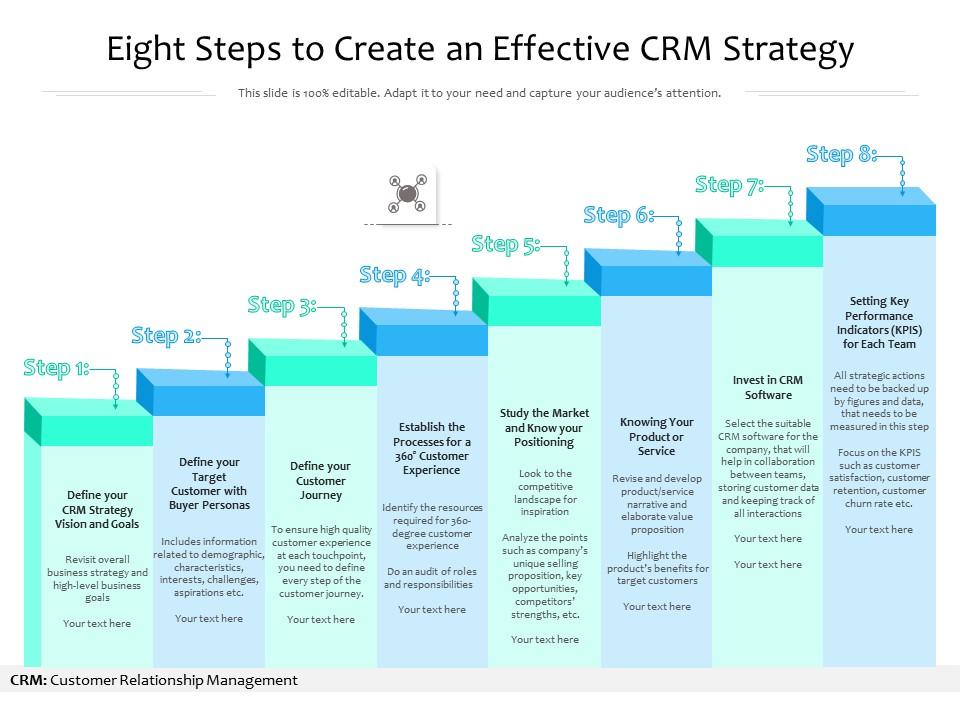
Presenting our set of slides with Eight Steps To Create An Effective CRM Strategy. This exhibits information on eight stages of the process. This is an easy to edit and innovatively designed PowerPoint template. So download immediately and highlight information on Customer, Market, Product.

FAQs for Eight steps to create an

**INPUT**: What key components should be included in an effective CRM strategy? **OUTPUT**: Effective CRM strategies include customer segmentation, data integration, automated workflows, personalized communication channels, and performance analytics. These components work together by streamlining customer interactions, enhancing service delivery, and providing actionable insights, with many organizations finding that this strategic combination ultimately delivers improved customer retention and measurable revenue growth. **Word count: 52 words**

Businesses can measure CRM strategy success through customer retention rates, sales conversion metrics, customer lifetime value, support ticket resolution times, and user adoption statistics. These KPIs enable organizations to track relationship quality improvements, revenue growth acceleration, and operational efficiency gains, with many companies finding that quarterly performance reviews reveal strategic opportunities for enhanced customer experiences and competitive advantage.

Customer data analysis serves as the foundation for effective CRM strategy by identifying customer behaviors, preferences, purchase patterns, and lifecycle stages to enable personalized engagement approaches. Through comprehensive data insights, organizations can segment audiences more precisely, predict customer needs, and optimize touchpoints across sales and marketing channels, ultimately delivering enhanced customer experiences and improved retention rates while maximizing revenue opportunities.

Small businesses can implement CRM strategies through free or low-cost platforms like HubSpot CRM, Zoho CRM, or Google Workspace tools, focusing on basic contact management and automated follow-ups. By starting with essential features like lead tracking and customer communication workflows, these businesses streamline operations while building stronger customer relationships, ultimately delivering improved retention and sales growth without significant upfront investment.

Common pitfalls include inadequate data integration, insufficient user training, poor change management, unrealistic expectations, and lack of executive support. These challenges often arise when organizations underestimate the strategic combination of technology implementation and cultural transformation required, with many businesses finding that successful CRM adoption ultimately depends on comprehensive planning and sustained organizational commitment.

Customer journey mapping and CRM strategy work together by identifying touchpoints, tracking customer interactions, and personalizing experiences throughout the entire lifecycle. Through integrated data collection, organizations streamline communication workflows, automate targeted campaigns, and enhance customer retention rates, with many retail and financial services companies finding that this strategic combination ultimately delivers improved satisfaction scores and increased revenue growth.

Automation significantly enhances CRM strategy effectiveness by streamlining lead scoring, automating follow-up sequences, and personalizing customer interactions at scale. Through intelligent workflows, organizations reduce manual tasks, accelerate response times, and maintain consistent engagement across thousands of customer touchpoints, ultimately delivering improved conversion rates and enhanced customer experiences while freeing sales teams for strategic relationship building.

Businesses can ensure employee buy-in for new CRM strategies through comprehensive training programs, clear communication of benefits, involving staff in selection processes, and demonstrating immediate value through quick wins. By providing hands-on support, addressing concerns proactively, and showing how CRM systems streamline daily workflows while enhancing customer relationships, organizations ultimately deliver improved job satisfaction and operational efficiency across teams.

CRM integration best practices include data mapping and cleansing, API-based connections, phased implementation, user training, and ongoing monitoring. These approaches streamline workflows by ensuring seamless data flow, eliminating silos, and maintaining system compatibility, with many organizations finding that strategic integration ultimately delivers enhanced customer insights, improved operational efficiency, and stronger competitive advantage.

CRM strategies can be customized through industry-specific data fields, workflow automation, compliance features, and integration capabilities tailored to sector requirements. Healthcare organizations emphasize patient relationship management and regulatory compliance, while manufacturing focuses on supply chain integration and B2B sales cycles, ultimately delivering enhanced customer experiences and operational efficiency across diverse business environments.

Ethical CRM considerations include data privacy compliance, transparent consent processes, secure information storage, respectful communication frequency, and honest personalization practices. These principles build customer trust by protecting personal information, ensuring opt-out options, and avoiding manipulative tactics, while many organizations finding that ethical approaches ultimately deliver stronger relationships, reduced legal risks, and sustainable competitive advantage.

CRM strategies enhance customer retention and loyalty by personalizing interactions, tracking customer preferences, automating follow-ups, and identifying at-risk accounts through predictive analytics. These technologies streamline engagement across touchpoints, with many retail and financial services organizations finding that strategic CRM implementation delivers higher satisfaction rates, increased repeat purchases, and ultimately stronger long-term customer relationships.

Current trends shaping CRM strategies include AI-powered personalization, omnichannel integration, predictive analytics, social CRM, and mobile-first approaches. These technologies streamline customer interactions by automating responses, predicting purchasing behaviors, and delivering seamless experiences across platforms, with many organizations finding that strategic CRM transformation ultimately enhances customer retention and accelerates revenue growth.

Feedback loops improve CRM strategies through automated customer surveys, behavioral analytics tracking, sales team input sessions, and performance metric monitoring. These mechanisms enable organizations to identify pain points, optimize customer touchpoints, and refine engagement approaches, with many companies finding that regular feedback integration enhances customer satisfaction while driving revenue growth.

AI and machine learning transform CRM strategies by enabling predictive analytics, automated customer segmentation, personalized engagement at scale, intelligent lead scoring, and real-time behavioral insights. These technologies revolutionize customer relationship management by delivering hyper-personalized experiences, reducing response times, and anticipating customer needs, ultimately enhancing retention rates and competitive advantage.

Ratings and Reviews

92% of 100
Review Form
Write a review
Most Relevant Reviews
  1. 100%

    by BURHAN

    Excellent work, very attention to detail
  2. 80%

    by Derek Mills

    Good research work and creative work done on every template.
  3. 80%

    by Darrick Simpson

    Excellent design and quick turnaround.
  4. 100%

    by Diego Gardner

    Attractive design and informative presentation.
  5. 100%

    by Clyde Sullivan

    It saves your time and decrease your efforts in half.

5 Item(s)

per page: