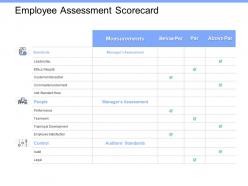
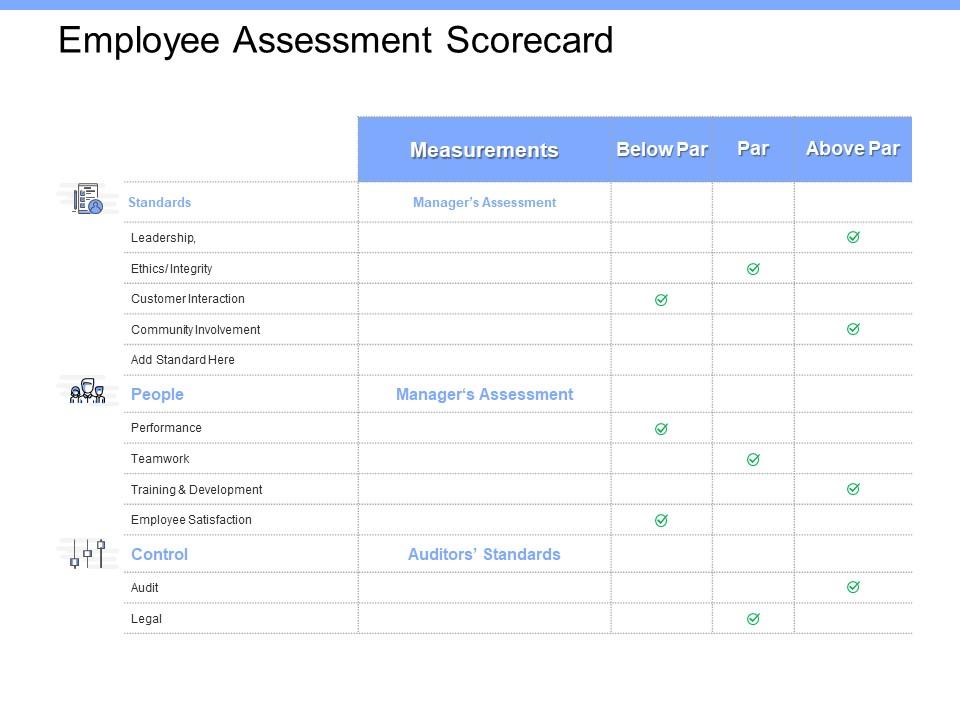
Employee assessment scorecard training and development ppt slides
Try Before you Buy Download Free Sample Product
Audience
Editable
of Time
Elaborate on the interplay between different elements with our Employee Assessment Scorecard Training And Development Ppt Slides. Go into intricate details.
People who downloaded this PowerPoint presentation also viewed the following :
Employee assessment scorecard training and development ppt slides with all 5 slides:
Illustrate the intricate details with our Employee Assessment Scorecard Training And Development Ppt Slides. Explain the functioning of critical components.
FAQs for Employee assessment scorecard training and
Effective employee assessment scorecards include performance metrics, goal achievement indicators, behavioral competencies, skill development measures, and peer feedback components. These elements work together by providing quantifiable data, tracking progress against objectives, and identifying growth opportunities, with many organizations finding that comprehensive scorecards enhance employee development while improving overall workforce performance and retention.
Organizations can align their employee assessment scorecard with business objectives by incorporating strategic KPIs, linking individual performance metrics to company goals, establishing clear competency frameworks, and integrating departmental targets with organizational priorities. Through regular calibration sessions and outcome-based evaluations, companies streamline performance management while ensuring employee development directly supports revenue growth, operational efficiency, and competitive advantage, with many finding that this strategic alignment ultimately enhances both productivity and retention.
Sales team assessment scorecards should prioritize revenue generation metrics like quota attainment, conversion rates, and average deal size, alongside relationship-building indicators such as customer satisfaction scores and pipeline development. These metrics enable organizations to evaluate both immediate performance and long-term growth potential, with many companies finding that balancing quantitative targets with qualitative relationship measures ultimately delivers stronger team performance and sustainable customer retention.
The employee assessment scorecard facilitates performance improvement plans by identifying specific skill gaps, tracking progress metrics, and establishing clear developmental benchmarks through structured evaluation frameworks. These scorecards enable managers to create targeted training programs, set measurable goals, and monitor advancement systematically, with many organizations finding that data-driven assessments accelerate employee development while enhancing overall team productivity.
Self-assessment enhances scorecard effectiveness by promoting employee ownership, encouraging honest self-reflection, and creating dialogue between managers and staff members. This approach enables organizations to identify skill gaps more accurately, build trust through collaborative evaluation processes, and ultimately deliver improved performance outcomes, with many companies finding that employees become more engaged and committed to their development goals.
Organizations ensure scorecard fairness through standardized criteria, diverse evaluation panels, regular bias training for assessors, and transparent scoring methodologies that focus on measurable performance indicators rather than subjective judgments. Many companies implement multi-rater systems and calibration sessions across departments, ultimately delivering more equitable assessments while reducing legal risks and enhancing employee trust in performance management processes.
Technology tools that enhance employee assessment scorecards include AI-powered analytics platforms, cloud-based performance management systems, mobile assessment applications, automated feedback collection tools, and integrated HR dashboards. These technologies streamline data collection, enable real-time performance tracking, and deliver actionable insights through predictive analytics, with many organizations finding that automated scorecards reduce administrative burden while improving assessment accuracy and employee engagement.
Feedback loops integrate into employee assessment scorecards through regular check-ins, real-time performance tracking, peer input collection, and continuous goal adjustment mechanisms. These systems enable managers and employees to address performance gaps immediately, refine development plans dynamically, and enhance engagement levels, with many organizations finding that continuous feedback cycles significantly improve retention and productivity outcomes.
Effective strategies include one-on-one feedback sessions, written performance summaries, goal-setting meetings, development planning discussions, and regular check-ins throughout the review cycle. These approaches enhance transparency and employee engagement by providing clear performance insights, actionable improvement areas, and collaborative goal alignment, with many organizations finding that structured communication ultimately delivers stronger employee satisfaction and improved performance outcomes.
Companies use scorecards to identify high-potential employees by tracking performance metrics, leadership behaviors, skill development rates, and goal achievement consistency across multiple evaluation periods. These comprehensive assessment tools enable organizations to spot emerging talent through objective data analysis, helping HR teams and managers make strategic decisions about promotions, development programs, and succession planning opportunities.
Common pitfalls include using vague criteria, overcomplicating metrics, lacking alignment with business goals, ignoring employee input, and focusing solely on quantitative measures. These design flaws can undermine assessment effectiveness by creating confusion, reducing engagement, and missing critical qualitative insights, with many organizations finding that balanced, clear scorecards ultimately deliver more accurate evaluations and improved performance outcomes.
Employee assessment scorecards can be adapted for remote or hybrid environments by incorporating digital collaboration metrics, virtual communication effectiveness, self-management capabilities, and technology proficiency alongside traditional performance indicators. These enhanced frameworks enable organizations to evaluate remote productivity, team engagement, and goal achievement through video conferencing tools, project management platforms, and digital feedback systems, ultimately delivering comprehensive performance insights regardless of work location.
Best practices for updating employee assessment scorecards include conducting annual comprehensive reviews, gathering multi-source feedback from managers and employees, aligning metrics with evolving business objectives, incorporating industry benchmarks, and ensuring legal compliance with current employment standards. Organizations across sectors like healthcare, finance, and retail find that regular scorecard revisions, coupled with stakeholder input and performance data analysis, ultimately enhance evaluation accuracy and employee development outcomes.
Employee engagement can be measured through survey metrics, performance indicators, retention rates, participation levels, and feedback scores integrated into the assessment scorecard framework. These measurements enable organizations to track engagement trends by department and role, while identifying areas needing improvement, ultimately delivering enhanced productivity and reduced turnover across teams.
Organizations should consider benchmarks including industry performance standards, historical internal metrics, peer group comparisons, regulatory compliance requirements, and strategic goal alignment when evaluating scorecard performance. These benchmarks enable companies to assess employee productivity, identify improvement opportunities, and maintain competitive positioning, with many finding that combining external industry data with internal historical trends delivers the most comprehensive performance insights.
No Reviews