Enterprise Architecture Reference Model Entities

Rating:
90%
Overview of layers and entities in an enterprise architecture model
Slide 1 of 6

or

Favourites Favourites

Try Before you Buy Download Free Sample Product

Audience Impress Your
Audience
Editable 100%
Editable
Time Save Hours
of Time
The Biggest Sale is ending soon in
0
0
:
0
0
:
0
0
Rating:
90%
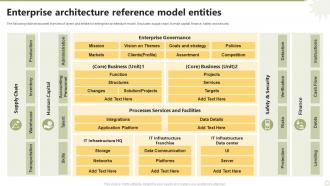
The following slide showcases overview of layers and entities in enterprise architecture model. It includes supply chain, human capital, finance, safety and security. Introducing our Enterprise Architecture Reference Model Entities set of slides. The topics discussed in these slides are Enterprise Governance, Processes Services And Facilities, Supply Chain. This is an immediately available PowerPoint presentation that can be conveniently customized. Download it and convince your audience.
FAQs for Enterprise Architecture

Honestly, you need four main pieces to get your EA framework working right. Business architecture maps out your processes - that's your starting point. Application and tech architectures show how everything connects. Data architecture matters way more than people think since all your info flows through there. Governance is where things usually go sideways, but you can't skip it if you want standards that stick. Stakeholder buy-in throughout the whole thing too. Oh, and audit what you've already got before building something totally new. Trust me on that one.

Look, enterprise architecture is basically your game plan for connecting what the business wants with what IT can actually deliver. Map out your current systems and processes, then figure out what needs to change to hit your business goals. Without it? You're just randomly throwing money at tech problems. EA helps you spot the gaps and decide which projects are actually worth doing. Honestly, most companies skip this step and wonder why their software is a mess. Start by documenting where you are now, then design backwards from where you want to be.

Look, you absolutely need stakeholder buy-in or your EA is dead in the water. These people know the actual business problems you're trying to solve - and honestly, they're the ones who'll make or break your implementation. Without them, you're just building something pretty that nobody uses. They'll tell you what's realistic, what constraints you're dealing with, and whether you're even heading in the right direction. Get them involved early, not just when you need sign-off. I've seen too many "perfect" architectures crash because nobody bothered getting people on board first.

So basically, enterprise architecture is your digital transformation roadmap. Maps out how systems, processes, and data should connect and evolve. Trust me - without it you're just randomly throwing tech at problems, which gets messy fast. EA helps identify what needs upgrading, what's ready for retirement, and where new capabilities fit. Your transformation efforts actually align with business goals instead of creating expensive chaos. Oh, and definitely start by documenting your current setup first. Can't transform what you don't understand - learned that one the hard way.

Honestly, the worst part is dealing with people who hate change - and I totally get why they do. Everyone's super attached to their current systems. Executive buy-in is brutal too, especially since EA projects take forever to show results. Then you've got departments that barely talk to each other, which makes everything ten times harder. Oh, and mapping out all your existing systems? That's a nightmare - everything's connected in ways you didn't even know. Start with some quick wins though. Gets people on board faster. And seriously, find a C-level person who'll fight the political battles for you.

So TOGAF's probably your most flexible option - you can basically mold it however you need, though it gets messy quick if you're not careful. Zachman's the opposite end - super rigid structure but honestly that's why it works so well for huge companies. FEAF is decent if you're in government, but I'd skip it otherwise (trust me on this one). DoDAF scales like crazy but good luck customizing anything - they built it military-style for a reason. Really depends on how much hand-holding your team needs versus how much freedom they want.

So there are a few solid frameworks you can use - TOGAF's Architecture Maturity Model is pretty popular, plus Gartner has one and DoD has their own thing. They basically look at how well you're handling governance, documentation, and integration across your business, data, apps, and tech stuff. NASCIO works well if you're government side. Honestly, the main thing is just picking one that your leadership will actually buy into and then sticking with it. I'd start with a baseline assessment using whatever framework clicks with your team, then maybe do quarterly check-ins to see how you're improving.

Think of enterprise architecture like having a detailed blueprint of your entire tech setup. Super helpful when auditors show up - you can actually point to where your data goes and what controls you've got in place. I've seen companies scramble without this stuff, and it's not pretty. Risk assessments become way more realistic when you know what you're working with. Plus you'll catch compliance issues early instead of dealing with expensive fixes later. My advice? Map out what you currently have first - honestly, you can't fix what you don't understand.

Honestly, just go with Archi first - it's free and does pretty much everything you need for enterprise architecture modeling. Microsoft Visio works fine for basic stuff, but it gets limiting fast. If you've got budget, MEGA and BiZZdesign are solid enterprise options. LucidChart's great when you need to make diagrams that don't scare executives away (learned that one the hard way). Don't get stuck in analysis paralysis picking tools though - I've watched teams waste months debating software. Figure out what you're actually trying to do first. Current state documentation? Future planning? Just need something that looks professional? That'll narrow it down quick.

So EA basically maps out all your tech and processes to show where you're bleeding money. You'd be amazed how many teams end up doing the same work twice or paying for redundant software - I've seen companies with like 5 different project management tools. Start by documenting what you actually have now, then figure out your ideal setup. Look for bottlenecks slowing things down and manual stuff that could be automated. The waste you'll uncover is honestly pretty eye-opening once you see it all laid out.

You'll want to track business stuff like lower IT costs, faster product launches, and better compliance rates. Technical metrics matter too - think application complexity, data quality, integration success. Honestly, the hardest part is waiting for results since EA changes take like 12-18 months to actually show up in your numbers. Don't freak out if nothing improves right away. Pick maybe 3-5 metrics that match your biggest headaches and stick with tracking those consistently. Way better than trying to measure everything at once.

So basically, enterprise architecture gives you this roadmap of how data moves around your company. Total game-changer for keeping everything organized. You'll finally see where data comes from, how it gets changed, and who's actually responsible for what - no more wild guessing about who owns which dataset. Plus it standardizes definitions so marketing and finance aren't talking past each other anymore. It shows you the gaps in your current setup too, which honestly can be pretty eye-opening. I'd start by mapping what you have now - you'll probably find some weird stuff you didn't even know existed.

Look, your enterprise architecture is gonna get stale if you don't keep updating it. Business moves fast - new tech pops up, regulations change, your company pivots. Architecture that worked last year might be totally useless now. It's like using an old map where half the streets got renamed, you know? What I'd do is set up quarterly check-ins to see what's actually working vs what's just taking up space in your documentation. Otherwise you'll have these beautiful blueprints that nobody follows because they don't match reality anymore. Trust me, I've seen it happen.

Honestly, the trick is ditching that whole big-upfront-design thing and breaking architecture work into sprint-sized pieces. Get your architects sitting with the dev teams - like actually in their standups and planning sessions. I know it sounds obvious but most places still have architects working off in their own bubble which is... not great. Create some lightweight docs that can change fast, and set up architectural principles teams can reference on their own. Oh and definitely start small - grab one team to pilot this with rather than trying to flip your whole org at once. The cultural shift part is probably gonna be your biggest headache.

Look, cloud totally flips how you think about enterprise architecture. Instead of those clunky on-premise setups, you're dealing with APIs and microservices everywhere. Map out what you've got first, then figure out which pieces can actually go cloud-native. The governance stuff gets messy - you're juggling different providers and their service catalogs change constantly (which is honestly kind of annoying). But here's the thing: you're not just planning for efficiency anymore. Now it's all about building stuff that can scale fast and bounce back when things break. Start small though.

Ratings and Reviews

90% of 100
Review Form
Write a review
Most Relevant Reviews
  1. 80%

    by Chas Kelly

    I am so thankful for all of the templates I've found on your site. They have saved me hours every week and helped make my presentations come alive. Keep up with these amazing product releases! 
  2. 100%

    by Clifton Jenkins

    Slideteam offers pocket-friendly products. As a college student this is a really necessary thing to look at while paying for something.

2 Item(s)

per page: