
Essential business environmental key forces micro and macro environmental analysis
Try Before you Buy Download Free Sample Product
Audience
Editable
of Time
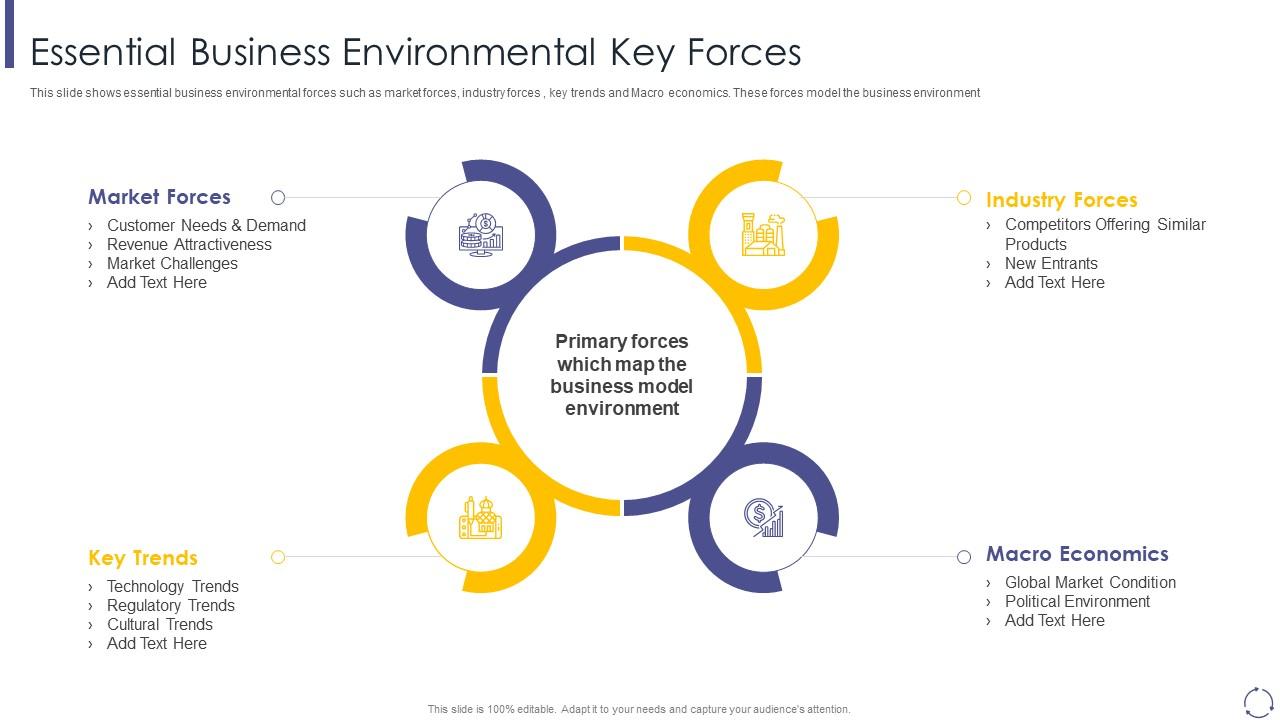
This slide shows essential business environmental forces such as market forces, industry forces , key trends and Macro economics. These forces model the business environment
People who downloaded this PowerPoint presentation also viewed the following :
Essential business environmental key forces micro and macro environmental analysis with all 6 slides:
Use our Essential Business Environmental Key Forces Micro And Macro Environmental Analysis to effectively help you save your valuable time. They are readymade to fit into any presentation structure.
FAQs for Essential business environmental key forces micro and
Business environment analysis includes market conditions, competitive landscape, regulatory frameworks, economic indicators, technological trends, and stakeholder relationships. These components work together by providing comprehensive insights into external opportunities and threats, enabling organizations to make strategic decisions, anticipate market shifts, and maintain competitive advantage in increasingly dynamic business landscapes.
PESTLE analysis systematically examines Political, Economic, Social, Technological, Legal, and Environmental factors that influence business operations, enabling organizations to identify opportunities and threats beyond their control. This comprehensive framework helps companies in sectors like retail, healthcare, and manufacturing anticipate regulatory changes, market shifts, and consumer trends, ultimately delivering strategic insights for risk mitigation and competitive positioning in an increasingly complex business landscape.
Economic indicators influence business strategy by providing insights into market conditions, consumer spending patterns, inflation trends, employment rates, and GDP growth trajectories. These metrics enable organizations to adjust pricing strategies, optimize resource allocation, and time market entries effectively, with many retail and manufacturing companies finding that proactive indicator monitoring delivers competitive advantage and enhanced operational efficiency.
Competitive analysis enhances strategic positioning by identifying market gaps, benchmarking performance metrics, analyzing competitor strengths and weaknesses, and revealing emerging industry trends. Through systematic evaluation of rival strategies, companies can differentiate their offerings, optimize pricing models, and capitalize on unmet customer needs, ultimately delivering sustainable competitive advantage and improved market share.
Social and cultural trends significantly influence consumer preferences, market demand, and operational strategies, creating both opportunities and challenges for businesses. These shifts drive innovation in product development, marketing approaches, and service delivery, with companies in retail, entertainment, and technology finding that adapting to cultural movements like sustainability, remote work, and digital connectivity ultimately delivers competitive advantage and enhanced customer loyalty.
Businesses can effectively assess technological impact through comprehensive audits of current systems, competitor analysis, customer feedback evaluation, operational efficiency metrics, and cost-benefit projections. Through systematic assessment frameworks, organizations identify automation opportunities, streamline workflows, and enhance customer experiences, while many finding that early adoption of relevant technologies delivers significant competitive advantages and operational cost reductions.
Regulatory risks include compliance violations, operational disruptions, increased costs, market access restrictions, and competitive disadvantages from policy shifts. Companies mitigate these through proactive monitoring systems, regulatory affairs teams, scenario planning, and adaptive compliance frameworks, with many organizations in healthcare, finance, and energy finding that early engagement with regulators and flexible operational structures ultimately deliver sustained competitive advantage.
Understanding customer behavior enhances business environment analysis by revealing market demand patterns, purchasing triggers, and competitive positioning opportunities that shape strategic decisions. Through demographic analytics, behavioral segmentation, and preference tracking, organizations can identify emerging market segments, anticipate industry shifts, and optimize resource allocation, ultimately delivering targeted products and services that outperform competitors in increasingly dynamic markets.
Monitoring environmental sustainability trends is crucial because consumer preferences, regulatory requirements, and investor expectations increasingly favor eco-conscious businesses, directly impacting market competitiveness and operational costs. Companies tracking these trends can anticipate regulatory changes, identify cost-saving opportunities through resource efficiency, and capture growing market segments, with many organizations finding that proactive sustainability planning delivers both risk mitigation and competitive advantage.
SWOT analysis enhances business environment analysis by organizing external opportunities and threats alongside internal strengths and weaknesses, creating a comprehensive strategic framework. This integration enables organizations to identify strategic matches between internal capabilities and market opportunities, while highlighting vulnerabilities that require attention, ultimately delivering actionable insights for competitive positioning and resource allocation decisions.
Business environment analysis tools include SWOT analysis, PESTLE framework, Porter's Five Forces, competitor analysis matrices, and stakeholder mapping techniques. These methodologies streamline strategic planning by identifying market opportunities, assessing competitive threats, and evaluating regulatory impacts, with many organizations finding that systematic environmental scanning ultimately delivers enhanced decision-making capabilities and sustainable competitive advantage.
Globalization intensifies competition for local businesses through increased market access for international competitors, lower trade barriers, and digital commerce expansion. While this presents challenges, it also enables local businesses to access global supply chains, reach international customers through e-commerce platforms, and leverage cost-effective resources, ultimately delivering competitive advantages for strategically positioned enterprises.
Scenario planning enables businesses to anticipate environmental changes by developing multiple plausible futures, identifying key uncertainties, and stress-testing strategic decisions against various conditions. Through systematic evaluation of different scenarios, organizations in sectors like financial services, manufacturing, and retail can build adaptive strategies, allocate resources more effectively, and maintain competitive advantage during unexpected market shifts.
Geopolitical factors create trade barriers, regulatory changes, currency fluctuations, supply chain disruptions, and market access restrictions for international businesses. These dynamics present both challenges and opportunities, with many multinational corporations finding that strategic diversification, flexible supply chains, and strong government relations ultimately deliver competitive resilience and enable sustainable growth across volatile markets.
Stakeholder analysis informs strategic decision-making by identifying key stakeholders' interests, influence levels, and potential impacts on business outcomes, enabling leaders to anticipate reactions and build strategic coalitions. Through comprehensive stakeholder mapping, organizations can prioritize initiatives, mitigate risks, and enhance resource allocation, with many companies finding that proactive stakeholder engagement ultimately delivers competitive advantage and smoother strategy implementation.
-
Visually stunning presentation, love the content.
-
Out of the box and creative design.








