Essential management levels for effective governance in organization

Rating:
100%
Essential management levels for effective governance in organization
Slide 1 of 2
Favourites Favourites

Try Before you Buy Download Free Sample Product

Audience Impress Your
Audience
Editable 100%
Editable
Time Save Hours
of Time
The Biggest Sale is ending soon in
0
0
:
0
0
:
0
0
Rating:
100%
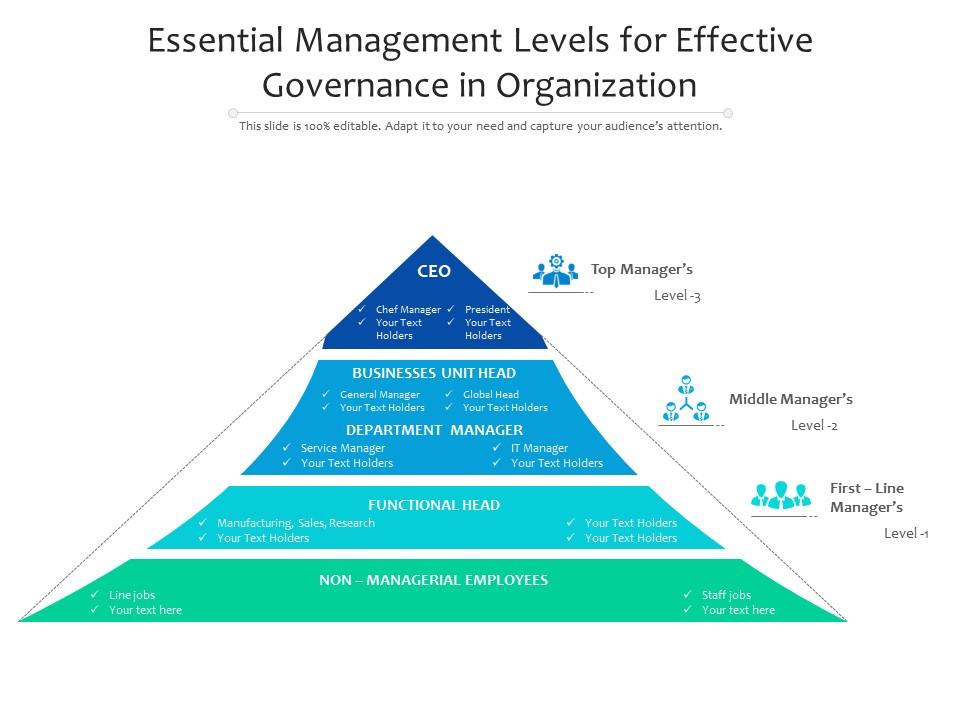
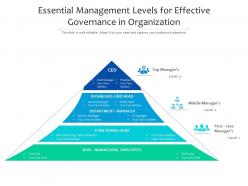
Presenting our set of slides with Essential Management Levels For Effective Governance In Organization. This exhibits information on three stages of the process. This is an easy-to-edit and innovatively designed PowerPoint template. So download immediately and highlight information on Businesses Unit Head, Department Manager, Functional Head.

People who downloaded this PowerPoint presentation also viewed the following :

FAQs for Essential management levels for effective

The main levels of management include top-level executives, middle management, first-line supervisors, team leaders, and operational managers. These hierarchical structures streamline decision-making by establishing clear accountability chains, enabling efficient resource allocation, and facilitating strategic communication flow, with many organizations finding that well-defined management levels ultimately enhance operational efficiency and competitive responsiveness.

Top-level management focuses on strategic planning, organizational vision, and policy formulation, while middle-level management handles tactical implementation, departmental coordination, and translating strategies into actionable plans. Through this division, organizations streamline decision-making processes, enhance operational efficiency, and maintain clear accountability structures, with many companies finding that this hierarchical approach enables faster execution and better resource allocation across departments.

Essential skills for first-line managers include communication, team leadership, problem-solving, decision-making, and performance management capabilities. These competencies enable supervisors to bridge organizational strategy with daily operations, coordinate team activities while maintaining productivity standards, and develop employee potential, with many organizations finding that strong first-line management ultimately delivers improved operational efficiency and enhanced workplace engagement.

Organizational structure directly determines management levels by establishing hierarchical layers, reporting relationships, and decision-making authority throughout the company. Flat structures minimize management tiers to enhance communication speed and employee autonomy, while hierarchical models create multiple levels for specialized oversight and control, with many organizations finding that strategic structural alignment ultimately delivers improved operational efficiency and clearer accountability.

Communication flows differ across management levels through frequency, formality, and focus, with top management emphasizing strategic directives and external stakeholder communications, middle management facilitating cross-departmental coordination and translating strategic goals, and frontline managers handling daily operational updates and direct team interactions. These varying communication patterns enable organizations to maintain strategic alignment while ensuring operational efficiency, with many companies finding that streamlined communication hierarchies ultimately deliver faster decision-making and enhanced organizational responsiveness.

Leaders across all management levels foster collaboration through open communication channels, cross-functional team initiatives, and transparent decision-making processes. Top executives model collaborative behaviors while middle managers facilitate interdepartmental projects, and frontline supervisors encourage team problem-solving, with many organizations finding that this multi-tiered approach significantly enhances innovation and operational efficiency.

Management levels significantly influence decision-making speed, scope, and strategic focus, with top management handling long-term strategic decisions, middle management coordinating tactical implementations, and frontline supervisors managing daily operational choices. This hierarchical structure streamlines organizational efficiency by distributing decision-making authority appropriately, while enabling faster customer responses and better resource allocation, ultimately delivering clearer accountability and competitive advantage.

Leadership styles vary significantly across management levels, with top executives focusing on strategic vision and organizational transformation, middle managers emphasizing coordination and team development, and front-line supervisors prioritizing operational efficiency and direct employee guidance. These distinct approaches reflect each level's responsibilities, with senior leaders driving long-term direction while lower management ensures daily execution and performance standards.

Top-level managers face strategic uncertainty and stakeholder pressure, middle managers encounter communication bottlenecks and resource constraints, while first-line managers deal with employee motivation and operational issues. These challenges vary across industries, with healthcare administrators managing regulatory compliance, retail managers balancing customer demands, and manufacturing supervisors ensuring quality control, ultimately requiring adaptive leadership skills for organizational success.

Management levels significantly influence employee motivation through decision-making speed, communication clarity, and career advancement opportunities. Flatter organizational structures often enhance engagement by enabling direct access to leadership, faster feedback loops, and greater autonomy, while traditional hierarchical models provide clear progression paths and structured mentorship, with many organizations finding that strategic combinations of both approaches deliver optimal employee satisfaction and retention.

Upper management can support middle managers through clear communication channels, adequate resource allocation, professional development opportunities, decision-making autonomy, and regular feedback sessions. By providing strategic clarity, eliminating bureaucratic barriers, and offering mentorship programs, organizations enable middle managers to bridge executive vision with frontline execution more effectively, ultimately delivering improved team performance and operational efficiency across all management levels.

Technological advancements reshape management roles by automating routine tasks, enhancing data-driven decision-making, and enabling real-time communication across organizational hierarchies. These technologies streamline operations through improved analytics, remote collaboration tools, and automated reporting systems, with many organizations finding that middle managers increasingly focus on strategic coordination while executives leverage AI-driven insights for competitive advantage.

**INPUT**: What are the key performance indicators (KPIs) for evaluating the effectiveness of each management level? **OUTPUT**: KPIs for management levels include revenue growth and strategic goal achievement for executives, departmental efficiency and team productivity for middle managers, and task completion rates and quality metrics for frontline supervisors. These performance indicators enable organizations to assess leadership effectiveness across hierarchical structures, with many companies finding that balanced scorecards measuring both operational outcomes and employee engagement ultimately deliver comprehensive insights into managerial performance and organizational health. **Word count: 60 words**

Cultural differences significantly influence management levels in multinational corporations through varying communication styles, decision-making processes, hierarchical expectations, and leadership approaches across different regions. Companies like Unilever and Toyota adapt their management structures by incorporating local cultural norms, adjusting reporting relationships, and modifying authority distribution, ultimately delivering more effective cross-cultural collaboration and improved organizational performance.

**INPUT**: What emerging trends are changing the dynamics of management levels in organizations today? **OUTPUT**: Emerging trends reshaping management levels include remote work adoption, artificial intelligence integration, agile methodologies, employee empowerment initiatives, and data-driven decision making. These developments streamline hierarchical structures by enabling faster communication, automating routine decisions, and distributing leadership responsibilities, with many organizations finding that flatter structures ultimately deliver enhanced agility and improved employee engagement. [Word count: 58 words]

Ratings and Reviews

100% of 100
Write a review
Most Relevant Reviews
  1. 100%

    by Derrick Rice

    Colors used are bright and distinctive.
  2. 100%

    by Robert Young

    Helpful product design for delivering presentation.
  3. 100%

    by Chong Richardson

    The content is very helpful from business point of view.
  4. 100%

    by Dewitt Soto

    Excellent work done on template design and graphics.

4 Item(s)

per page: