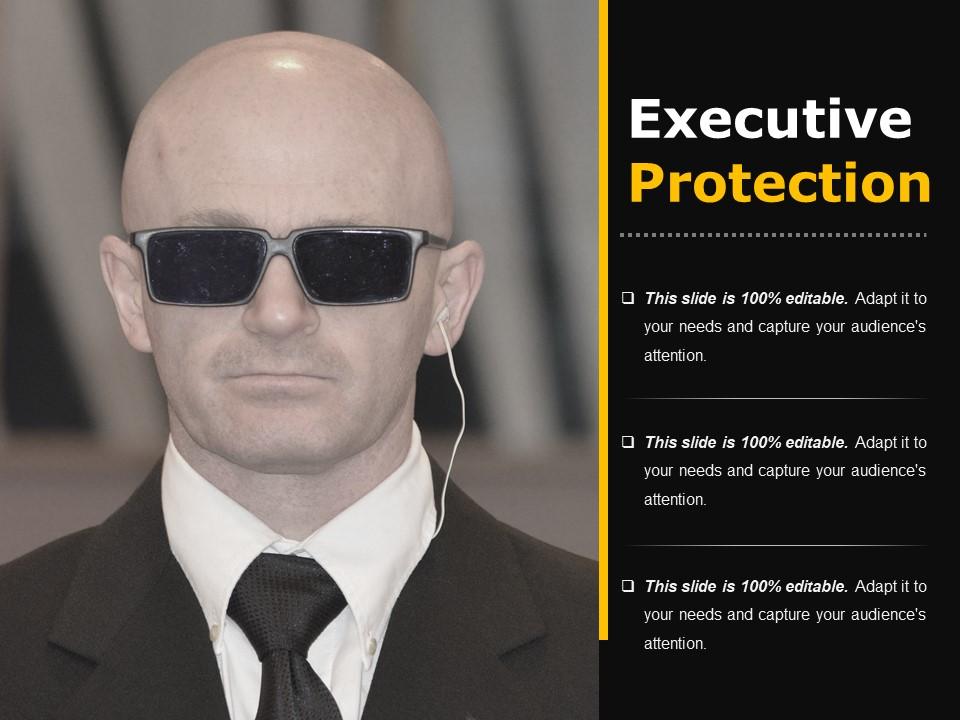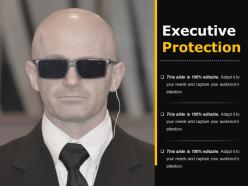
Executive protection

Rating:
80%
Executive protection
Slide 1 of 6
Favourites Favourites

Try Before you Buy Download Free Sample Product

Audience Impress Your
Audience
Editable 100%
Editable
Time Save Hours
of Time
The Biggest Sale is ending soon in
0
0
:
0
0
:
0
0
Rating:
80%
Presenting our Executive Protection PPT template. Easy to edit fonts, color, slide background, graphs, charts. The presentation is compatible with Google slides and all the software. There is no pixelation. You can have access to the content in both widescreen and standard format. The PPT graphics can be conveniently downloaded in Jpeg, PDF, and JPG format.

FAQs for Executive protection

So you're basically playing defense 24/7 - threat assessment and keeping your principal breathing. Most of your time goes into the unglamorous stuff like scouting locations, mapping escape routes, coordinating with other security. Honestly, checking exits and timing drives is where the real work lives. You'll end up managing their calendar too, which sucks because you're constantly the one saying "nope, that venue's a nightmare." Oh, and their schedule becomes your headache from a security angle. Start thinking like someone who wants to hurt them - sounds dark but once that clicks, everything else makes sense.

So here's the deal - HNWIs are all about protecting their lifestyle and family stuff. You're securing multiple houses, keeping kids safe at school, making sure they can enjoy their yacht without paparazzi or whatever. Corporate execs? Totally different beast. They need protection around business travel, office security, threats from pissed off shareholders - that kind of thing. Budget-wise, wealthy families usually want long-term, super discreet arrangements. Corporate protection tends to be more reactive, like when there's a big layoff announcement or something. Oh, and the threat sources are key - personal wealth vs. professional decisions completely changes your approach. That's honestly where I'd start the assessment.

Dude, start with firearms and tactical driving - that's basic stuff you can't skip. Physical fitness and combat training too, but here's what people miss: the soft skills are everything. Threat assessment, situational awareness, emergency medical response. Communication's massive since you're juggling different teams and need to fit into whatever environment your client's in. I'd check out Executive Security International or similar legit programs first. Their basic executive protection course is a good starting point. Then you can specialize based on whether you want corporate types or celebrities or whatever. The variety keeps it interesting honestly.

Dude, cultural sensitivity will absolutely make or break your international EP work. I've watched entire teams get burned because they didn't bother learning basic stuff - wrong clothes, bad greeting protocols, you name it. What seems totally normal back home might scream "outsider" or worse, be straight-up offensive somewhere else. Your advance work becomes so much smoother when you actually get how locals communicate and what sets off red flags. Honestly, some of this should be common sense but you'd be surprised. Before any overseas gig, dig deep into the cultural landscape and make sure everyone on your team knows the do's and don'ts.

Honestly, threat intelligence platforms are where it's at right now. They pull data from tons of sources - social media, dark web, you name it - and actually flag sketchy patterns before things blow up. Way better than just reacting after something happens. GPS tracking and secure comms are obviously basics at this point, but those intelligence systems give you the real advantage. Oh, and make sure whatever platform you pick plays nice with your current security setup. You'll want alerts tailored to your exec's specific risk factors too. That's what separates the decent platforms from the garbage ones.

Start with a solid threat assessment - three main things to cover. First, their public profile and who might have beef with them. Second, daily routines and travel stuff. Third, security weak spots at places they frequent. Honestly, the predictable habits are what get people in trouble - same coffee shop every Tuesday, outdated security codes, that kind of thing. Interview them directly about any weird incidents they've noticed. Then dig into industry risks, geographic threats, the usual landscape stuff. Oh and don't just do this once - you've gotta keep updating it or it's basically useless.

Look, communication in EP is huge - maybe even more than the physical stuff. You're constantly coordinating with your team, briefing clients, dealing with venue staff and cops. One miscommunication can leave gaps in your coverage, which is scary as hell. Your clients are usually VIPs too, so they expect you to sound professional when explaining protocols. Honestly, I've seen good agents mess up just because they couldn't get their point across clearly. Practice your radio work and client briefings. Stay calm, be concise, and don't ramble when things get intense.

So basically you want to buddy up with local cops way before you actually need them. Share intel, coordinate security zones, get a liaison who knows your client's schedule. Trust me, waiting until you land somewhere new to start making friends is a rookie mistake. Work with venue security, airport people, hotel staff - think layers of protection. Having that network already in place is like having extra sets of eyes watching out for trouble. The communication piece is huge too. Real-time updates on threats can save your ass when things go sideways.

Look, it's basically about finding that sweet spot between keeping someone safe and not crossing lines. Privacy matters - you can't just invade their whole life for intel. Don't use more force than you need, and definitely don't let innocent people get caught in the crossfire. Here's the thing that gets tricky though - what if you're protecting someone who's actually kind of a terrible person? That's on you to figure out. Set your boundaries early about what you will and won't do. Document everything so you can look back and ask yourself: am I being proportional here, or am I going overboard for the actual threat level?

Yeah, exec protection isn't just bodyguards anymore. You've got cyber specialists now tracking data breaches and social media threats - honestly, it's crazy how much someone can learn about your principal just from their Instagram posts. Digital footprints are where most attacks start these days. Teams do device sweeps, use encrypted messaging apps, monitor online chatter about the client. Physical security is still huge obviously, but you can't ignore the digital side. I'd start by seeing what info about your principal is already floating around online - might surprise you how exposed they are.

Mix up your daily routine - take different routes, leave at random times. That whole predictability thing makes you an easy target. Lock down your social media hard and stop posting where you are in real time. I swear, some executives basically livestream their entire lives online. Get decent security systems installed at home and work. Brief your family on basic safety stuff too. Oh, and definitely hire a professional security consultant. They'll catch risks you'd never even consider and build you a proper protection plan tailored to your situation.

Honestly, this is where most people mess up - the planning phase. Map out everything from start to finish: your routes, where you're staying, how you're getting around, backup options. Patterns will get you killed, so mix things up. Don't take the same route twice if you can avoid it. Get your advance team to check out locations ahead of time and find safe spots along the way. I know it sounds like overkill, but you'll want to spend way more time on this than feels necessary. Always have that Plan B ready to go.

Get with local cops at least 30 days ahead and do a full venue walkthrough. Multiple security layers work best - perimeter stuff, access control, mix of plainclothes and uniforms. Radio protocols between your team and event staff are clutch. Here's something most people miss - brief the catering crew because they literally see everything that goes down. Map out evacuation routes and have medical ready. Oh, and walk your principal through the whole plan beforehand so they're not stressed about logistics. Communication really makes or breaks these events.

Blend into their world but stay sharp. Dress like you belong, keep natural distances - nobody should think "bodyguard" when they see you. Use earpieces or subtle signals for communication. Honestly, the best agents look more like business partners than security. Position yourself where threats are visible and you can control access - elevators, exits, conversation areas that make sense. Be invisible until needed. Read rooms fast and trust your gut. Oh, and don't follow the same patterns - mix up where you stand so you're not predictable.

Look, building that personal connection is everything in this job. Your client won't listen to a damn thing if they don't trust you first. I learned this the hard way - you've got to really get their personality and daily routine down. Some clients are total control freaks, others are surprisingly chill about security stuff. The teenager comparison is spot-on though! Once you understand how they think and communicate, you can weave protection into their life without them feeling like they're in prison. Listen to what bugs them most about security early on. That's your roadmap right there.

Ratings and Reviews

80% of 100
Review Form
Write a review
Most Relevant Reviews
  1. 80%

    by Dustin Perkins

    Innovative and Colorful designs.
  2. 80%

    by Edgar George

    Great experience, I would definitely use your services further.

2 Item(s)

per page: