Executive Summary Travel Agency Company Profile

Rating:
80%
Executive Summary Travel Agency Company Profile
Slide 1 of 6
Favourites Favourites

Try Before you Buy Download Free Sample Product

Audience Impress Your
Audience
Editable 100%
Editable
Time Save Hours
of Time
The Biggest Sale is ending soon in
0
0
:
0
0
:
0
0
Rating:
80%
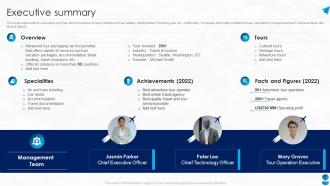
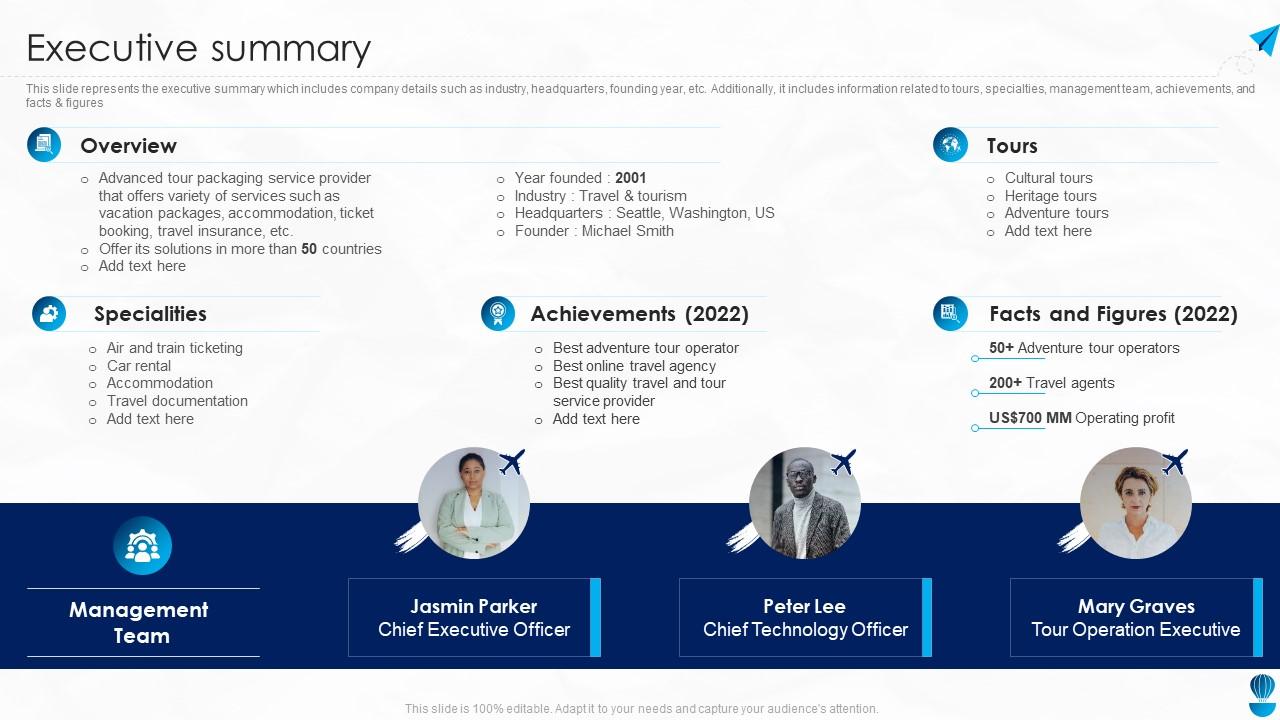
This slide represents the executive summary which includes company details such as industry, headquarters, founding year, etc. Additionally, it includes information related to tours, specialties, management team, achievements, and facts and figures Increase audience engagement and knowledge by dispensing information using Executive Summary Travel Agency Company Profile. This template helps you present information on five stages. You can also present information on Overview, Specialities, Achievements using this PPT design. This layout is completely editable so personaize it now to meet your audiences expectations.
FAQs for Executive Summary Travel

An executive summary should include the problem statement, proposed solution, key benefits, implementation timeline, and expected ROI. These components work together by immediately establishing context, demonstrating value proposition, and outlining actionable next steps, with many organizations finding that well-structured summaries significantly enhance stakeholder buy-in and accelerate decision-making processes.

Visual elements enhance executive summaries by incorporating compelling charts, infographics, key metrics displays, strategic diagrams, and highlight boxes that transform dense text into digestible insights. These design components streamline information processing, emphasize critical findings, and create memorable touchpoints, with many executives finding that visual summaries accelerate decision-making and improve stakeholder engagement significantly.

Common mistakes include excessive length, burying key information, using technical jargon, lacking clear financial projections, and failing to address specific client needs or pain points. These errors undermine proposal effectiveness by overwhelming decision-makers, obscuring value propositions, and demonstrating poor understanding of stakeholder priorities, ultimately reducing win rates and competitive positioning in increasingly crowded markets.

The target audience directly shapes an executive summary's tone, formality level, technical depth, and presentation style, with board members requiring strategic focus while investors need financial emphasis and operational teams prefer detailed implementation insights. Different stakeholders, from venture capitalists to department heads, expect varying communication approaches, with many organizations finding that audience-specific customization significantly enhances engagement, comprehension, and ultimately delivers stronger stakeholder buy-in and strategic alignment.

**INPUT**: What strategies can be employed to ensure the executive summary is concise yet comprehensive? **OUTPUT**: Effective executive summary strategies include prioritizing key findings, using bullet points for critical data, focusing on outcomes rather than processes, and structuring content with clear problem-solution frameworks. These approaches streamline complex information by highlighting strategic insights, quantifiable results, and actionable recommendations, with many executives finding that concise summaries enhance decision-making speed while maintaining comprehensive business intelligence.

An executive summary provides a complete overview of key findings, recommendations, and strategic outcomes, while an introduction simply sets context and outlines what will be covered. The executive summary delivers actionable insights and conclusions upfront, enabling decision-makers to grasp critical business implications immediately, whereas introductions focus on agenda-setting and audience preparation for the detailed content ahead.

A compelling narrative in an executive summary engages stakeholders by presenting the business opportunity as a story with clear challenges, strategic solutions, and transformative outcomes. This storytelling approach connects with decision-makers emotionally while maintaining data-driven credibility, with many organizations finding that narrative-structured summaries enhance stakeholder buy-in, accelerate approval processes, and ultimately deliver stronger investor engagement and strategic alignment.

Data visualization transforms executive summaries by converting complex data into compelling charts, graphs, infographics, and dashboards that immediately communicate key insights and trends. These visual elements enhance stakeholder engagement, accelerate decision-making processes, and strengthen credibility through clear presentation of financial performance, market opportunities, and strategic outcomes, ultimately delivering more persuasive and actionable executive communications.

Executive summaries should typically be one to two pages or 5-10% of the full document's length, with complex business plans requiring longer summaries while investor pitches demand concise versions. Length matters because busy executives, investors, and stakeholders need comprehensive overviews that respect their time constraints, with appropriately sized summaries delivering maximum impact, ensuring key messages aren't buried, and ultimately securing the attention necessary for decision-making and strategic buy-in.

**INPUT**: What techniques can be used to tailor an executive summary for different industries? **OUTPUT**: Industry-specific executive summaries require customized metrics, terminology, regulatory considerations, stakeholder priorities, and sector-relevant case studies that resonate with each audience's unique concerns. Financial services emphasize compliance and risk management, while healthcare focuses on patient outcomes and regulatory standards, with manufacturing highlighting operational efficiency and supply chain optimization, ultimately delivering more compelling and actionable strategic communications. **Word count: 59 words**

Peer feedback improves executive summaries by identifying unclear messaging, strengthening key arguments, and ensuring strategic alignment with organizational objectives. Colleagues from different departments—finance, operations, and marketing—provide diverse perspectives that enhance clarity, highlight missing critical information, and validate that conclusions resonate with various stakeholder needs, ultimately delivering more compelling and comprehensive strategic communications.

Templates for executive summaries deliver consistent formatting, faster document creation, professional presentation standards, reduced writing time, and improved stakeholder comprehension. These structured frameworks streamline complex information synthesis while ensuring critical elements like financial projections, strategic recommendations, and key metrics are prominently featured, ultimately enabling executives to communicate more effectively with investors and decision-makers.

Including a call-to-action in an executive summary transforms passive reading into active engagement by clearly directing stakeholders toward specific next steps, whether requesting funding, approving projects, or scheduling meetings. This strategic approach streamlines decision-making processes, accelerates project timelines, and ultimately delivers measurable outcomes, with many organizations finding that clear directives significantly improve proposal success rates.

Executive summaries should be revisited quarterly and revised whenever significant strategic shifts, market changes, or performance variances occur. Companies experiencing rapid growth or operating in dynamic sectors like technology and healthcare often find that monthly reviews ensure alignment, while more stable industries can maintain effectiveness with bi-annual assessments, ultimately delivering sustained stakeholder confidence.

Successful executive summaries include Tesla's strategic vision documents, Amazon's annual shareholder letters, McKinsey's industry reports, venture capital pitch decks from funded startups, and merger acquisition proposals. These examples demonstrate clarity through concise problem statements, quantified market opportunities, and specific financial projections, with many organizations finding that combining strategic storytelling with data-driven insights ultimately delivers stakeholder engagement and accelerated decision-making processes.

Ratings and Reviews

80% of 100
Review Form
Write a review
Most Relevant Reviews
  1. 80%

    by Wilson Campbell

    Crisp and neat slides. Makes it fun and easier to curate presentations. 
  2. 80%

    by Daren Henry

    Excellent design and quick turnaround.

2 Item(s)

per page: