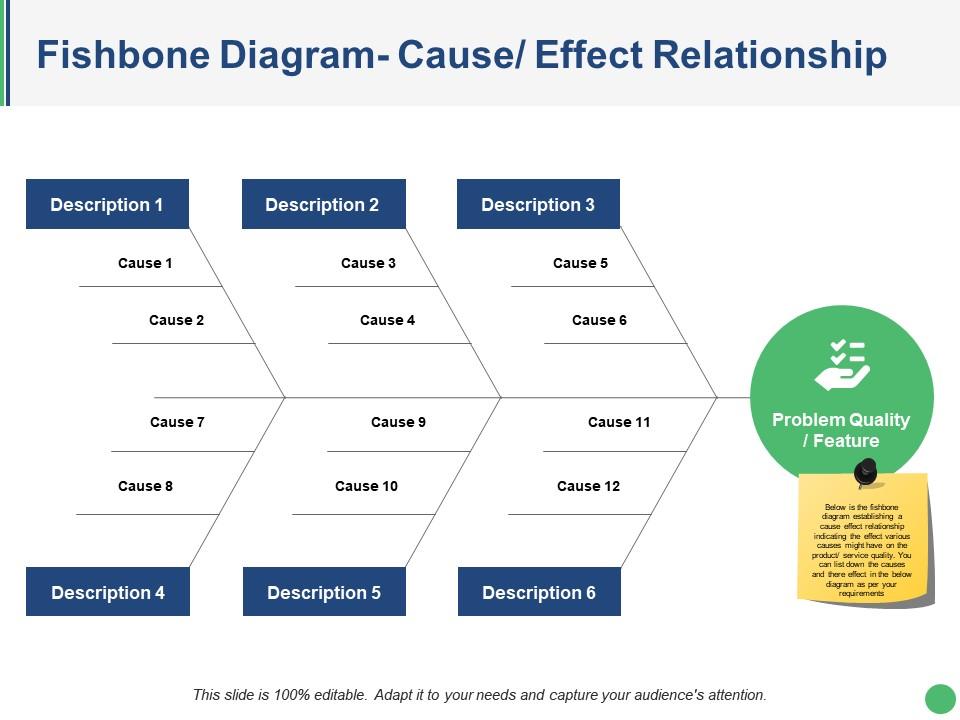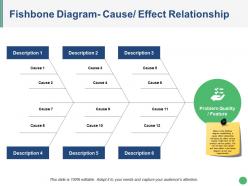
Fishbone diagram cause effect relationship ppt slides download

Rating:
80%
Fishbone diagram cause effect relationship ppt slides download
Slide 1 of 5
Favourites Favourites

Try Before you Buy Download Free Sample Product

Audience Impress Your
Audience
Editable 100%
Editable
Time Save Hours
of Time
The Biggest Sale is ending soon in
0
0
:
0
0
:
0
0
Rating:
80%
Presenting this set of slides with name - Fishbone Diagram Cause Effect Relationship Ppt Slides Download. This is a three stage process. The stages in this process are Problem Quality, Feature, Description, Cause.

People who downloaded this PowerPoint presentation also viewed the following :

FAQs for Fishbone diagram cause effect relationship

The key components of a fishbone diagram include the problem statement (fish head), major cause categories (main bones), subcauses (smaller bones), and the central spine connecting all elements. These components work together by systematically organizing potential root causes into categories like people, processes, materials, and environment, enabling teams across manufacturing, healthcare, and service industries to conduct thorough problem analysis and identify actionable solutions.

A fishbone diagram helps identify root causes by systematically categorizing potential causes into major groups like people, processes, materials, methods, and environment, creating a visual map that prevents overlooking critical factors. This structured approach enables teams to methodically examine each category, facilitating deeper analysis beyond surface symptoms and ultimately leading to more effective, targeted solutions.

Fishbone diagrams are most commonly used in manufacturing, healthcare, automotive, aerospace, and software development industries. These sectors leverage this root cause analysis tool to systematically identify quality issues, process inefficiencies, and operational bottlenecks, with many organizations finding that it streamlines problem-solving while enhancing continuous improvement initiatives across complex workflows.

Manufacturing quality defects present an ideal complex issue for fishbone diagram analysis, involving multiple potential causes across categories like materials, methods, machinery, manpower, measurements, and environment. For instance, automotive manufacturers analyzing paint defects can systematically examine factors such as supplier material quality, application techniques, equipment calibration, operator training, temperature controls, and workspace conditions, ultimately enabling targeted solutions that reduce waste and enhance production efficiency.

Best practices for creating effective fishbone diagrams include defining the problem statement clearly, assembling diverse cross-functional teams, using structured brainstorming sessions, categorizing causes systematically, and validating findings through data analysis. These methodologies enhance root cause analysis by encouraging comprehensive thinking, eliminating bias, and ensuring thorough investigation, with many organizations finding that structured approaches ultimately deliver faster problem resolution and sustainable solutions.

The fishbone diagram facilitates team collaboration by providing a structured visual framework where team members can systematically contribute diverse perspectives, expertise, and insights across different cause categories. This collaborative approach encourages cross-functional input from various departments, ensures comprehensive problem analysis, and creates shared understanding among team members, ultimately delivering more effective solutions and stronger team alignment in problem-solving initiatives.

Common pitfalls include rushing the brainstorming process, focusing on symptoms rather than root causes, allowing dominant voices to overshadow input, and failing to validate findings with data. Teams often create overly complex diagrams or stop at identification without action, with many organizations finding that structured facilitation and systematic cause verification ultimately deliver more accurate problem-solving outcomes.

Fishbone diagrams can be customized by adapting the main categories to industry-specific factors, adjusting cause branches to reflect project workflows, and incorporating relevant terminology and processes. Manufacturing companies might use Machine, Method, Material, Manpower categories, while service industries focus on People, Process, Policy, and Environment, ultimately delivering more targeted root cause analysis and actionable insights.

A facilitator guides the team through structured brainstorming, ensures balanced participation from all members, keeps discussions focused on root causes rather than symptoms, and manages group dynamics to prevent dominant voices from overshadowing quieter contributors. Through skilled questioning techniques, facilitators help teams systematically explore each category, challenge assumptions, and maintain momentum, ultimately ensuring comprehensive analysis while fostering collaborative problem-solving that delivers actionable insights.

Stakeholders can be involved through collaborative brainstorming sessions, cross-functional workshops, and structured interviews where diverse perspectives identify potential cause categories. By including representatives from operations, quality control, management, and customer service teams, organizations enhance problem-solving accuracy and buy-in, with many finding that multi-departmental involvement reveals root causes that single teams often miss.

Digital fishbone diagram tools include Lucidchart, Visio, Creately, SmartDraw, and Miro, along with specialized quality management platforms like Minitab and process improvement software. These platforms streamline root cause analysis by offering templates, collaborative features, and integration capabilities, with many organizations finding that cloud-based solutions enhance team participation and accelerate problem-solving workflows across departments.

The fishbone diagram offers visual cause categorization and collaborative brainstorming capabilities, while tools like 5 Whys provide linear questioning and fault tree analysis delivers quantitative probability assessment. This structured approach enables teams to systematically explore multiple cause categories simultaneously, with many organizations finding that fishbone diagrams enhance group problem-solving sessions and deliver comprehensive root cause identification across diverse operational challenges.

Fishbone diagrams integrate seamlessly with methodologies like Six Sigma, 5 Whys, PDCA cycles, and root cause analysis frameworks, enhancing systematic problem-solving approaches. These strategic combinations enable organizations to identify potential causes through fishbone visualization, then apply statistical analysis or iterative questioning techniques, ultimately delivering more comprehensive solutions and faster resolution times across manufacturing, healthcare, and service industries.

Fishbone diagrams can become overly complex with multiple root causes, may oversimplify interconnected problems, and require significant time investment for thorough analysis. While effective for structured problem-solving, they work best with defined issues rather than ambiguous challenges, with many organizations finding that combining them with other analytical tools delivers more comprehensive insights and actionable solutions.

Fishbone diagram insights lead to actionable solutions by systematically prioritizing root causes, developing targeted interventions for high-impact areas, and creating measurable improvement plans. Through structured analysis, organizations can allocate resources strategically, implement specific corrective measures rather than addressing symptoms, and establish monitoring systems that track progress, ultimately delivering enhanced operational efficiency and sustainable problem resolution.

Ratings and Reviews

80% of 100
Write a review
Most Relevant Reviews
  1. 80%

    by Cristopher Cole

    Use of different colors is good. It's simple and attractive.
  2. 80%

    by Damon Castro

    Great product with effective design. Helped a lot in our corporate presentations. Easy to edit and stunning visuals.

2 Item(s)

per page: