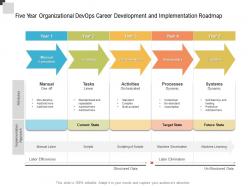
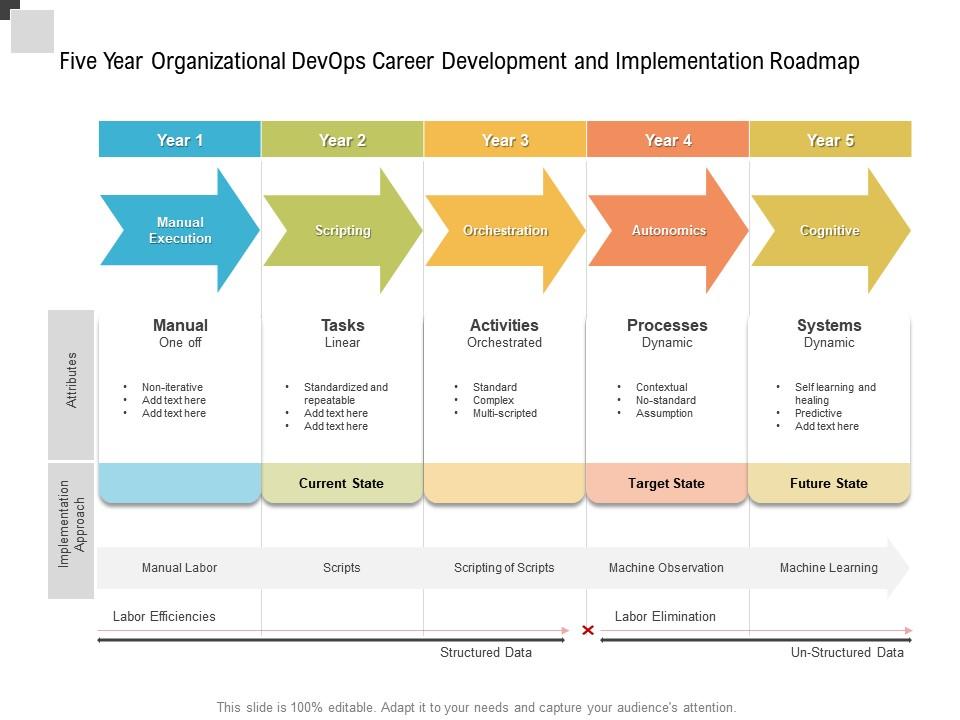
Five year organizational devops career development and implementation roadmap
Try Before you Buy Download Free Sample Product
Audience
Editable
of Time
The success rate of business plans is hugely dependent on the plan of action, and this editable Five Year Organizational Devops Career Development And Implementation Roadmap rightly serves the purpose. Encapsulate all the information related to the project in a well structured manner to obtain maximum efficiency by incorporating our stunning PowerPoint theme. State the critical deliverable, steps involved, time frame, workforce allocation, and lots more in an easy to understand manner by utilizing this pre designed roadmap PowerPoint layout. You can also prioritize your tasks and discuss the problem areas with your colleagues by incorporating this tailor made PPT layout. Empower your work plan by employing this professionally designed PPT theme. Entrepreneurs can download Five Year Organizational Devops Career Development And Implementation Roadmap as a beneficial communication tool that facilitates in collaborating with different tasks and achieve targets.
People who downloaded this PowerPoint presentation also viewed the following :
Five year organizational devops career development and implementation roadmap with all 2 slides:
Give your audience a fulfilling experience. They will find our Five Year Organizational Devops Career Development And Implementation Roadmap elevating.
FAQs for Five year organizational devops career development
Honestly, you're gonna need both technical stuff and people skills. Pick one cloud platform first - AWS or Azure, whatever - and get comfortable there. Docker and Kubernetes are must-haves for containers. Python's probably your best bet for scripting, way more useful than Bash in most cases. CI/CD pipelines are everywhere now, so learn those inside and out. Terraform's the go-to for infrastructure as code. But here's the thing - communication matters just as much since you're constantly dealing with different teams who sometimes hate each other. Oh, and don't sleep on monitoring tools. Start small though, this stuff gets overwhelming fast if you try tackling everything at once.
First, check what you already know - system admin, networking, or scripting stuff will definitely help. Docker and Kubernetes are must-learns, plus CI/CD tools like Jenkins. AWS or Azure too, obviously. Honestly, the learning curve sucks at first but push through it. Try finding small automation projects at your current job - that's basically DevOps mindset right there. Oh, and certs help with the resume thing. Contributing to open source projects is smart for building your portfolio. You'll probably feel overwhelmed initially, but most people do when switching into DevOps.
Look, automation is what separates actual DevOps from just glorified system admin work. Manual stuff kills you with errors and wastes time. CI/CD is your bread and butter - Jenkins, GitLab CI, whatever. Docker and Kubernetes for containers, obviously. Terraform's pretty solid for infrastructure as code, though Ansible works too. Oh, and cloud stuff like CloudFormation if you're in AWS. I'd honestly just pick one tool from each area and get decent at it first. Way better if you can use what your company already has - nothing beats actually breaking things in production to learn. You don't want to be the person still doing deployments by hand.
Dude, cloud platforms totally changed the DevOps game. Traditional infrastructure knowledge isn't enough anymore - you've gotta learn cloud-native services, different deployment models, plus tools like Terraform. AWS/Azure/GCP have so many services it'll make your head spin initially. The fundamentals haven't disappeared though: automation, monitoring, CI/CD pipelines are still crucial. Biggest mindset shift? Think cloud-first for literally everything now. My advice - pick one major provider first. Master their DevOps tools before jumping around. Otherwise you'll just confuse yourself with all the different approaches.
Honestly, you can't escape CI/CD in this field - it's everywhere. Companies expect you to build and fix these pipelines constantly. The whole point is automating how code moves from dev to production without breaking everything. Jenkins is still super common, though GitLab CI and GitHub Actions are way nicer to work with IMO. You'll also need to get comfortable with testing strategies and deployment stuff. My advice? Just build a simple pipeline for some random personal project first. Even basic test automation will teach you tons. Once you get the hang of it, the concepts transfer to literally every job.
Honestly, start with Python and Bash - you'll see them everywhere. Python's killer for automation scripts and API work, while Bash handles all the server admin stuff. Go is blowing up too since Docker and Kubernetes use it (the speed is insane). Node.js pops up in CI/CD pipelines sometimes. But don't try learning everything at once, you'll burn out. I'd grab Python first for scripting, then move to Bash. The rest? You'll naturally pick them up when you need specific tools.
Honestly, soft skills are what make the difference between decent and amazing DevOps engineers. Sure, you can automate deployments all day. But when a dev's code breaks the pipeline and you need to explain why without being a jerk about it? That's where communication matters. Problem-solving during 3am incidents, working with ops teams, explaining technical stuff to managers who don't get it - this happens constantly. DevOps is basically being the translator between dev and ops teams anyway. Oh, and document your work clearly. Practice actually listening in those cross-team meetings instead of just waiting for your turn to talk.
Honestly? Start with one of the big cloud certs - AWS DevOps Engineer, Azure DevOps Solutions, or Google Cloud Professional DevOps Engineer. Those are gold right now. Docker and Kubernetes certs (CKA, CKAD) are super hot too since literally everyone's doing containers. Jenkins, Terraform, Ansible all have their own certs, but real experience trumps certificates sometimes - weird how that works. I'd personally go cloud first though. Gives you the widest base and opens way more doors job-wise.
Microservices will totally change your DevOps game. You're not just managing one big app anymore - now it's like juggling 20+ tiny services that all need to talk to each other and scale on their own. It's honestly pretty chaotic at first, but that's where the money is. You'll need Docker and Kubernetes for sure, plus service mesh stuff and way better monitoring since everything's distributed. The cool thing is companies doing microservices right usually have solid CI/CD already - they kinda have to or everything breaks. I'd start with Docker if you haven't touched containers yet.
Honestly, don't try learning every single tool at once - you'll just burn out and end up knowing nothing well. Start with the basics: automation, CI/CD, monitoring, infrastructure as code. The whole "DevOps engineer" title is kinda BS anyway since it's more about culture than a specific role. Communication matters way more than people think. Pick one cloud platform and actually get good at it. Same with Linux and a scripting language - nail those first. I made the mistake of jumping straight into Kubernetes before I really understood containers... not fun. Master your foundations, then worry about the fancy orchestration stuff.
Dude, networking is HUGE in DevOps - way more than other tech jobs. The community's all about helping each other out, so your connections literally turn into job offers and solutions when you're banging your head against some deployment issue at 2am. DevOps changes so ridiculously fast that staying connected helps you catch new trends before everyone else jumps on them. Join some DevOps Slack groups and hit up local meetups if you can. Twitter and LinkedIn work too - just comment on stuff that actually interests you. Honestly, even small interactions open doors you wouldn't expect.
Honestly, you can't do modern DevOps without containers and orchestration - they're like the foundation of everything now. Docker's where you'll want to start for containerizing your apps. Then there's Kubernetes for orchestration, though heads up - K8s is kind of a pain to learn at first. But once you get it, you can package stuff consistently and deploy anywhere without those "works on my machine" headaches. Your CI/CD gets so much cleaner too since everything behaves the same across environments. Oh, and the auto-scaling based on demand is pretty sweet. Just master Docker first before jumping into the Kubernetes deep end.
Dude, mix some reading with actually getting your hands dirty. I follow DevOps people on Twitter and LinkedIn - yeah Twitter's chaotic but that's where news breaks first. DevOps Weekly newsletter is solid too. Reddit's r/devops has good discussions, same with some Discord servers where people actually share what went wrong lol. Google alerts help for specific tools you're using. Virtual meetups are hit or miss but worth trying. The real magic happens when you break stuff in your own lab though. Reading about Kubernetes won't teach you nearly as much as completely destroying your homelab setup at 2am.
Honestly, just pick GitHub Actions or Jenkins and deploy something simple to AWS first. YAML files are gonna be your worst enemy for like a week, then you'll get it. After that, mess around with Terraform to build some cloud stuff automatically. Docker's pretty straightforward once you do it a few times, then Kubernetes if you're feeling ambitious. Prometheus and Grafana are solid for monitoring. Oh and backup scripts - boring but you'll thank yourself later. Document one project really well instead of half-assing five different ones. Build from there.
Dude, mentorship is such a game-changer in DevOps. The field moves crazy fast and there's so much to learn. A solid mentor will save you from making dumb mistakes and show you shortcuts you'd never figure out alone. They've got war stories from actual production disasters that beat any online course. Plus their connections are gold - way better than just applying to random job postings. I know this sounds obvious but seriously, people with mentors climb the ladder so much faster. Hit up senior engineers at work or check out local DevOps meetups. Those events are usually pretty chill and you'll meet people naturally.
No Reviews