

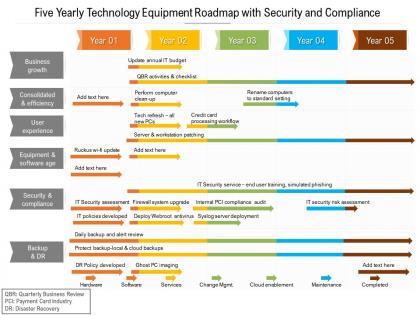
Five yearly technology equipment roadmap with security and compliance




Try Before you Buy Download Free Sample Product
 Impress Your
Audience
 100%
Editable
 Save Hours
of Time


A well thought out action plan makes execution easier and increases the possibility of success significantly. Ensure hitting all the milestones within the deadlines by introducing our fully customizable Five Yearly Technology Equipment Roadmap With Security And Compliance. Streamline the work related information, budget, timeframe, key deliverable, landmarks, and major steps involved, all in one place to give an organized overview of the project by utilizing our PowerPoint theme. Minimize time lag and increase work efficiency by providing insight into the process with our comprehensively researched roadmap PowerPoint layout. Color coding helps in highlighting the process and grabs the attention of the audience. Download our handy Five Yearly Technology Equipment Roadmap With Security And Compliance to identify the possible problem areas in a much shorter time and propose solutions. Have a productive brainstorming session with your workforce by utilizing our action plan visualization tool.
People who downloaded this PowerPoint presentation also viewed the following :
Five yearly technology equipment roadmap with security and compliance with all 2 slides:
Use our Five Yearly Technology Equipment Roadmap With Security And Compliance to effectively help you save your valuable time. They are readymade to fit into any presentation structure.


FAQs for Five yearly technology equipment roadmap with
Honestly, break it down into three chunks: where you are now, where you want to be, and how to get there. First, take a brutal look at your current tech - what's actually working vs what's basically held together with hope and coffee. Then figure out your 12-18 month goals with real numbers you can track. The connecting piece is your roadmap with clear milestones and who needs what when. Oh, and definitely pad your timeline because literally everything takes twice as long as you think. Get your stakeholders involved from the start or you'll be doing this whole exercise again in six months when priorities magically shift.
Look at three main things: business impact, whether you can actually do it, and how urgent it is. Score each project on revenue/savings potential first. Then be real about your team's bandwidth and skills. Dependencies matter too - some stuff just blocks everything else if you don't tackle it first. I throw together a quick effort vs impact chart, but honestly? Leadership's gonna throw curveballs that wreck your nice little matrix anyway. What really matters is being upfront about what you're sacrificing when you pick one thing over another. Get people aligned on that trade-off before the priorities change again next week.
Track delivery stuff first - are you actually shipping what you planned on time? Milestone completion, staying on schedule, that whole thing. But honestly shipping fast is pointless if nobody cares about what you built. So measure business impact too: performance gains, cost savings, how many people actually use the features. I learned this the hard way at my last job - we hit every deadline but users hated the product lol. Monthly reviews work well. Green delivery metrics AND real business value means you're doing it right.
Honestly, just draw actual lines connecting your business goals to tech projects - sounds silly but it works. Way too many roadmaps are basically "wouldn't this be cool?" wishlists that ignore what the company actually needs. Get your business and IT folks in the same room every quarter to hash out priorities. Every big tech spend needs a real business case with numbers you can track against your KPIs. Oh, and don't treat this like some annual ritual - it's gotta be an ongoing thing where you're constantly adjusting based on what's changing.
Look, stakeholder feedback is everything when you're building a tech roadmap. Can't just wing it and hope for the best - trust me on that one. You need input from customers, your internal teams, executives, the whole crew because everyone sees different angles. I've watched so many roadmaps crash and burn because someone thought they had it all figured out without asking around first. Regular check-ins are key too, not just that initial feedback dump. It helps you figure out what to prioritize and catches those nasty surprises before they derail everything.
Quarterly is the bare minimum, but honestly? Every 2-3 months makes way more sense given how crazy fast things change now. Do a major overhaul once a year or whenever your strategy/budget gets flipped upside down. The biggest mistake people make is treating it like some sacred document that never gets touched. Set those calendar reminders or you'll forget - I always do. Each review is basically your chance to pivot before you waste months going the wrong direction. Keep it flexible and actually use the damn thing.
Don't get too granular with stuff that's way out there - like, you're definitely gonna be wrong about what you need 18 months from now anyway. Most companies make these things without actually talking to users or the dev teams who have to build it, which is kinda backwards if you think about it. Roadmaps aren't contracts carved in stone. They should change as you learn new stuff. Oh, and everyone gets distracted by shiny new tech instead of fixing actual problems customers have. Review yours every quarter, keep stakeholders in the loop from the start, and stay flexible.
Honestly, don't just throw every cool new tech onto your roadmap - that's how teams get completely sidetracked. First figure out if it actually solves a real problem you have or opens up something worth chasing. I've seen so many teams waste months on flashy stuff that goes nowhere. Map the promising ones to different roadmap phases based on how ready they are and what risk you can handle. Set up separate "exploration tracks" for the really early-stage stuff so it doesn't mess with your main work. And yeah, review this quarterly because things change ridiculously fast in tech.
So for tech roadmaps, I'd probably start with whatever your team already uses honestly. ProductPlan and Roadmunk are built specifically for this stuff - great visuals, easy sharing with stakeholders. Miro's awesome for collaborative sessions (though I always get distracted making everything look perfect). Visio works fine if you're already in the Microsoft ecosystem. Aha! and ProdPad have tons of features but they're kinda overkill unless you need something really robust. Lucidchart's solid too. My advice? Don't overthink it initially - pick something simple, then switch later when you hit specific problems that need solving.
Look, you gotta bake risk stuff into your roadmap right from the start. For each big milestone, figure out what could go wrong - tech issues, market shifts, resource problems. Then score them on probability and impact. I make a basic risk matrix (nothing crazy fancy) just so you can actually see the major threats at a glance. Your highest-risk stuff needs backup plans and alternative routes. Review this quarterly because things always change. Oh, and honestly? The biggest thing is making it an ongoing team discussion, not some one-off document that sits in a folder somewhere. Keep updating it and actually use it.
Honestly, you've gotta know your crowd first. Executives just want the business impact and timeline - they don't care about your tech stack. But engineers? They need all the nitty-gritty details and dependencies. Always start with WHY this matters before jumping into what you're building. I've watched so many people crash and burn by leading with technical specs instead of value. Use simple timeline charts for leadership, save the detailed Gantt charts for your dev team. Oh, and definitely call out risks upfront - nobody likes surprises later. Make it interactive too, not just you talking at them.
Dude, agile totally changes how you think about roadmaps. You're not stuck planning everything 6 months out anymore - which honestly used to drive me nuts. Break stuff into short sprints so you can actually pivot when users tell you something's garbage. Your roadmap becomes this living thing that shifts every few weeks instead of some massive document gathering dust. I'd say nail down your next 2-3 sprints, keep medium-term goals loose, and don't stress about anything past 6 months. Way better than the old waterfall days where you'd build something nobody wanted.
So first thing - audit your current tech stack against what's actually happening right now. Cloud infrastructure is obviously still dominating everything. AI integration is everywhere (yeah I know, everyone won't shut up about it, but it's legit changing how businesses work). Cybersecurity's evolving fast too. Edge computing helps with speed issues, and honestly sustainable tech practices aren't just nice-to-have anymore - they're becoming mandatory. Oh, and remote tools plus low-code platforms are huge for letting regular people build stuff without developers. Just prioritize based on your budget and goals.
Don't lock yourself into some rigid 3-year plan - huge mistake I made early on. Do quarterly market scans instead where you're checking customer feedback, what competitors are up to, tech trends, all that stuff. Keep your planning cycles shorter with regular checkpoints to pivot if needed. Oh and here's what really saved me - always leave like 20-30% of your dev capacity open so you can jump on unexpected opportunities. Your roadmap should basically be a living doc that changes with market signals. Way better than pretending you can predict everything upfront.
You need people who can juggle tech stuff and big picture thinking. Project management skills are non-negotiable, plus folks who work well across different teams. Data analysis is key - honestly, you'll drown in metrics otherwise. Communication matters more than you'd think since you're constantly translating between sales and engineering (they might as well speak different languages). Look for adaptable people who won't freak out when priorities change overnight. Oh, and someone who can turn business needs into actual technical solutions. I'd start by figuring out what skills your current team is missing, then tackle the biggest gaps first.
-
Informative design.