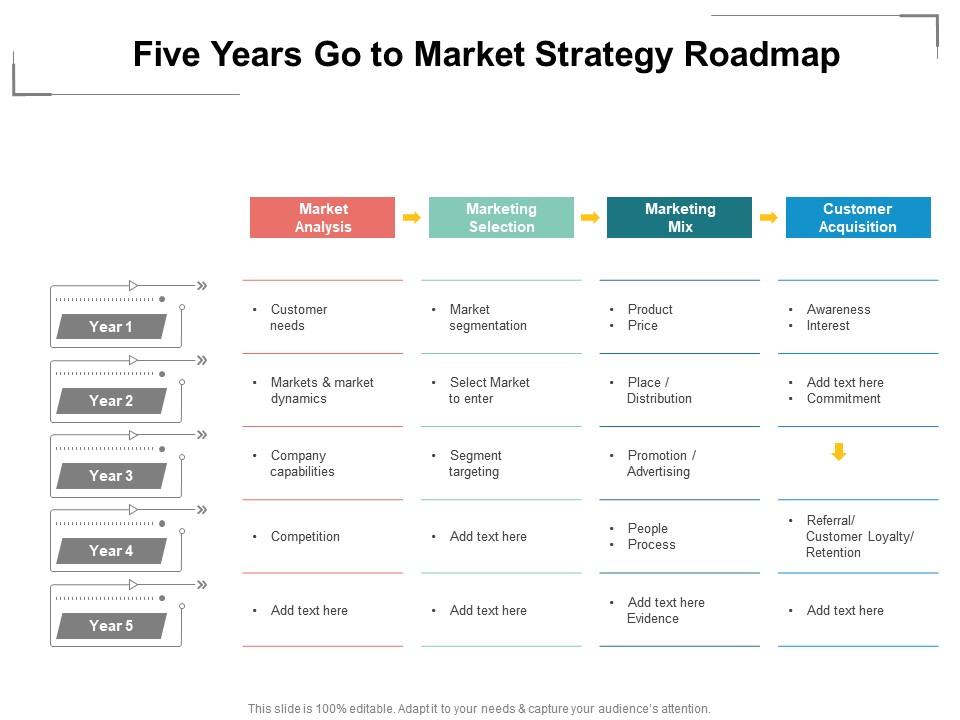
Five years go to market strategy roadmap

Five years go to market strategy roadmap
Slide 1 of 2

or

Favourites Favourites

Try Before you Buy Download Free Sample Product

Audience Impress Your
Audience
Editable 100%
Editable
Time Save Hours
of Time
The Biggest Sale is ending soon in
0
0
:
0
0
:
0
0
Presenting Five Years Go To Market Strategy Roadmap PowerPoint slide. This PPT theme is available in both 4,3 and 16,9 aspect ratios. This PowerPoint template is customizable so you can modify the font size, font type, color, and shapes as per your requirements. This PPT presentation is Google Slides compatible hence it is easily accessible. You can download and save this PowerPoint layout in different formats like PDF, PNG, and JPG.

FAQs for Five years go to

Key components include target market identification, value proposition development, pricing strategy, distribution channels, marketing campaigns, and sales enablement processes. These elements work together by aligning product positioning with customer needs, optimizing channel partnerships, and streamlining sales workflows, with many organizations finding that strategic integration ultimately delivers faster market penetration and sustainable competitive advantage.

Market segmentation influences go-to-market strategy by enabling targeted messaging, optimized resource allocation, and precise channel selection for each customer group. Through strategic segmentation, organizations can tailor pricing models, customize product positioning, and streamline sales approaches, with many companies finding that segmented strategies deliver higher conversion rates and ultimately enhance competitive advantage in increasingly diverse markets.

Customer persona development serves as the foundation for go-to-market strategy by defining target demographics, pain points, buying behaviors, communication preferences, and decision-making processes. These detailed profiles enable organizations to tailor messaging, select optimal channels, and align product positioning with customer needs, ultimately delivering more targeted campaigns and higher conversion rates across diverse market segments.

Businesses can align marketing and sales teams through shared revenue goals, integrated CRM systems, unified customer personas, collaborative content creation, and regular cross-functional meetings. This strategic coordination enables consistent messaging across touchpoints, streamlined lead handoffs, and improved conversion rates, with many organizations finding that aligned teams deliver 36% higher customer retention and faster market penetration.

Key metrics include customer acquisition cost (CAC), lifetime value (LTV), conversion rates, time-to-market, market penetration rates, and revenue growth trajectories. These indicators enable organizations to optimize resource allocation, refine targeting approaches, and accelerate scaling efforts, with many companies finding that tracking these metrics simultaneously delivers enhanced operational efficiency and sustainable competitive advantage.

Competitive analysis informs go-to-market strategy by revealing market gaps, pricing benchmarks, messaging opportunities, and customer pain points competitors aren't addressing effectively. Through comprehensive competitor research, businesses can identify underserved segments, differentiate their value propositions, and position offerings strategically, with many organizations finding that competitive insights enable faster market entry and stronger customer acquisition strategies.

Common pitfalls include insufficient market research, unclear value propositions, misaligned pricing strategies, inadequate sales enablement, and poor cross-functional coordination between marketing, sales, and product teams. These missteps often result in missed revenue targets, extended sales cycles, and competitive disadvantage, with many organizations finding that comprehensive planning and stakeholder alignment ultimately streamlines market entry and accelerates customer acquisition.

Companies should prioritize target markets by evaluating market size, competitive landscape, customer acquisition costs, regulatory requirements, and internal capabilities to serve each segment effectively. This strategic assessment enables businesses to focus resources on high-potential opportunities first, with many organizations finding that starting with underserved niches or existing customer expansions delivers faster revenue growth and competitive advantage.

Go-to-market validation methods include pilot programs, A/B testing, customer interviews, market surveys, and beta launches with select user groups. These approaches enable organizations to refine messaging, pricing, and distribution channels while minimizing risk, with many companies finding that systematic validation reduces launch costs and accelerates market penetration.

Leveraging partnerships enhances go-to-market strategies by expanding market reach, accelerating customer acquisition, and reducing entry costs through established distribution channels and shared resources. Strategic alliances with complementary businesses, technology providers, and industry influencers enable companies to access new customer segments, enhance credibility, and deliver comprehensive solutions, ultimately shortening sales cycles while maximizing market penetration.

B2B go-to-market strategies emphasize relationship building, longer sales cycles, account-based marketing, and direct sales teams, while B2C approaches focus on mass marketing, emotional appeals, and shorter conversion paths. B2B markets require detailed product demonstrations and stakeholder consensus, whereas B2C leverages social media, influencer partnerships, and impulse purchasing, ultimately delivering targeted engagement versus broad reach optimization.

An agile approach enhances go-to-market strategy development by enabling rapid iteration, continuous customer feedback integration, and flexible resource allocation based on real market responses. This methodology allows companies to test messaging, refine target segments, and adjust pricing models incrementally, with many organizations finding that agile frameworks reduce time-to-market while minimizing risks through data-driven pivots.

Best practices for creating a compelling value proposition include identifying specific customer pain points, quantifying measurable benefits, differentiating from competitors, using clear language, and aligning with target market needs. These elements work together by establishing credibility through concrete outcomes, resonating with decision-makers' priorities, and ultimately delivering faster sales cycles and higher conversion rates across diverse market segments.

Businesses adapt their go-to-market strategy through continuous market monitoring, flexible pricing models, diversified channel partnerships, and agile product positioning based on emerging customer needs. These adaptive approaches enable organizations to pivot messaging, reallocate resources, and adjust distribution methods, with many companies finding that responsive strategies deliver sustained competitive advantage in increasingly dynamic markets.

Customer feedback serves as the critical intelligence for optimizing messaging, pricing, product features, distribution channels, and target audience segments after launch. Through direct surveys, usage analytics, and support interactions, companies can identify market gaps, refine value propositions, and adjust positioning strategies, with many organizations finding that iterative feedback loops ultimately deliver stronger market penetration and competitive advantage.

Ratings and Reviews

0% of 100
Review Form
Write a review
Most Relevant Reviews

No Reviews