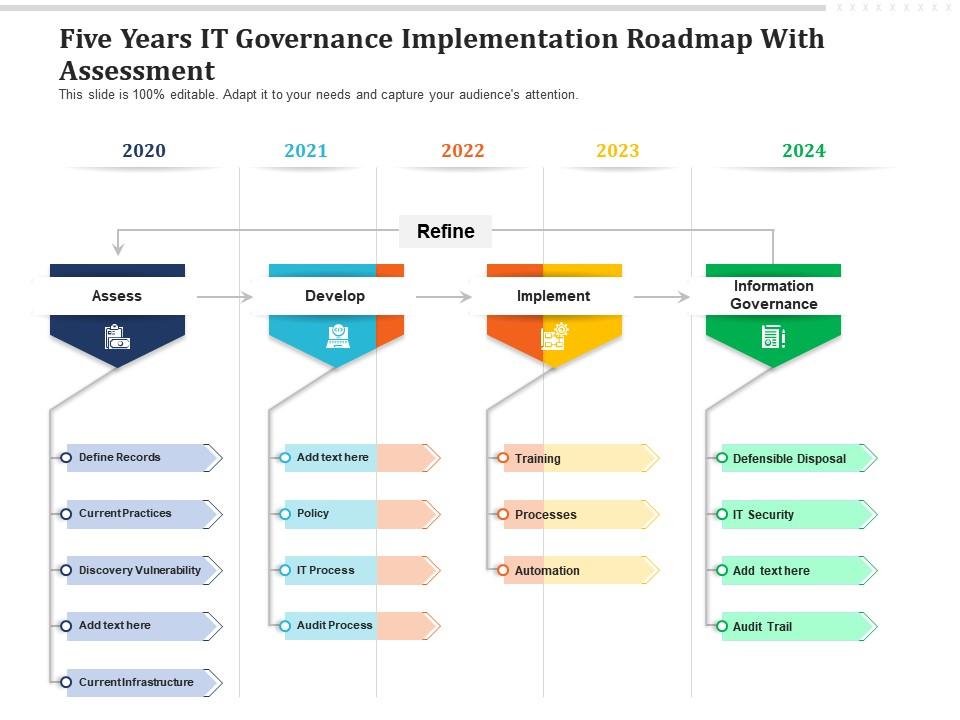
Five years it governance implementation roadmap with assessment

Five years it governance implementation roadmap with assessment
Slide 1 of 2

or

Favourites Favourites

Try Before you Buy Download Free Sample Product

Audience Impress Your
Audience
Editable 100%
Editable
Time Save Hours
of Time
The Biggest Sale is ending soon in
0
0
:
0
0
:
0
0
Presenting Five Years IT Governance Implementation Roadmap With Assessment PowerPoint Template. This PPT presentation is Google Slides compatible hence it is easily accessible. You can download and save this PowerPoint layout in different formats like PDF, PNG, and JPG. This PPT theme is available in both 4,3 and 16,9 aspect ratios. This PowerPoint template is customizable so you can modify the font size, font type, color, and shapes as per your requirements.

FAQs for Five years it governance implementation

Key components of an effective IT governance framework include strategic alignment mechanisms, risk management protocols, performance measurement systems, resource optimization processes, and stakeholder accountability structures. These components work together by ensuring IT investments support business objectives, minimizing operational risks, and delivering measurable value, with many organizations finding that integrated governance frameworks enhance decision-making speed and competitive positioning.

Organizations align IT governance with business objectives by establishing clear IT strategies that directly support company goals, creating cross-functional governance committees with business and IT leaders, implementing performance metrics that measure IT's contribution to business outcomes, and ensuring regular communication between IT and executive teams. This strategic alignment enables faster decision-making, improved resource allocation, and enhanced competitive advantage, with many companies finding that integrated governance frameworks ultimately deliver better customer experiences and operational efficiency.

Stakeholder engagement ensures IT governance roadmaps align with business objectives, regulatory requirements, and operational needs across all organizational levels. Through collaborative workshops, feedback sessions, and cross-functional committees, organizations build consensus, identify potential risks, and secure buy-in from executives, IT teams, and end-users, ultimately delivering more comprehensive governance frameworks and smoother implementation processes.

Organizations can measure IT governance success through key performance indicators like project delivery rates, budget adherence, system uptime, compliance scores, and stakeholder satisfaction metrics. These measurements enable strategic alignment assessment, with many enterprises finding that regular governance audits, cost-benefit analyses, and risk mitigation tracking ultimately deliver improved operational efficiency and competitive advantage.

When drafting an IT governance policy, best practices include establishing clear roles and responsibilities, defining decision-making frameworks, implementing risk management protocols, ensuring regulatory compliance alignment, and creating performance measurement criteria. These elements work together by providing organizational structure, accountability mechanisms, and strategic oversight, with many enterprises finding that comprehensive policies ultimately enhance operational efficiency while reducing technology-related risks and costs.

Regulatory compliance significantly shapes IT governance strategies by requiring structured frameworks for data protection, audit trails, and risk management protocols. Financial services and healthcare organizations increasingly integrate compliance requirements into their governance models, establishing automated monitoring systems and documentation processes that streamline regulatory reporting while enhancing operational transparency and reducing compliance costs.

IT governance mitigates technology investment risks through structured decision-making frameworks, comprehensive risk assessment protocols, standardized evaluation criteria, and continuous monitoring mechanisms. These governance practices enable organizations to avoid costly project failures, ensure regulatory compliance, and optimize resource allocation, with many enterprises finding that systematic oversight reduces investment risks by up to 40% while enhancing strategic alignment.

Tools and technologies that aid in implementing an IT governance roadmap include governance, risk, and compliance (GRC) platforms, IT service management (ITSM) solutions, project portfolio management (PPM) tools, enterprise architecture software, and automated monitoring dashboards. These technologies streamline governance processes by enhancing visibility, automating compliance reporting, and enabling real-time risk assessment, with many organizations finding that integrated platforms significantly reduce administrative overhead while improving strategic alignment.

Organizations ensure continuous improvement in IT governance by implementing regular performance assessments, establishing feedback loops with stakeholders, and conducting periodic reviews of policies and procedures. Through automated monitoring tools and governance dashboards, companies across industries like financial services and healthcare can track compliance metrics, identify process gaps, and adapt to evolving regulatory requirements, ultimately delivering enhanced operational efficiency and strategic alignment.

Effective IT governance metrics include compliance rates, system uptime percentages, security incident frequency, budget variance tracking, and project delivery timelines. These measurements enable organizations to monitor operational efficiency, risk management effectiveness, and strategic alignment, with many enterprises finding that combining financial metrics with performance indicators delivers comprehensive visibility into governance maturity and competitive positioning.

Cybersecurity integration transforms IT governance by embedding risk assessment, compliance frameworks, and threat management into strategic decision-making processes. Through comprehensive security policies, organizations enhance data protection, regulatory compliance, and operational resilience, while streamlining incident response capabilities, ultimately delivering reduced vulnerabilities and stronger stakeholder confidence in an increasingly complex digital landscape.

Organizations typically face challenges including lack of executive support, resistance to change from staff, unclear roles and responsibilities, inadequate communication between IT and business units, and insufficient resources for implementation. These obstacles often result in fragmented decision-making, inconsistent policy enforcement, and delayed digital initiatives, with many companies finding that early stakeholder engagement and phased implementation approaches help overcome initial resistance while building sustainable governance structures.

A maturity model enhances IT governance by providing structured assessment frameworks, benchmarking capabilities, performance metrics, and incremental improvement pathways that organizations can follow systematically. Through these models, companies evaluate current governance effectiveness, identify capability gaps, and implement strategic enhancements across risk management, compliance, and resource allocation, ultimately delivering improved operational efficiency and competitive advantage.

Emerging technologies like cloud computing, AI, DevOps, and edge computing challenge traditional IT governance through faster deployment cycles, distributed architectures, and increased automation requirements. These technologies necessitate more agile governance frameworks, cross-functional collaboration, and real-time risk assessment capabilities, with many organizations finding that traditional hierarchical approval processes must evolve toward dynamic, outcome-focused governance models.

Organizations can tailor IT governance for agile methodologies by implementing lightweight oversight frameworks, establishing cross-functional steering committees, adopting iterative approval processes, and creating flexible risk assessment protocols. These approaches streamline decision-making through rapid feedback loops, continuous stakeholder engagement, and adaptive compliance monitoring, with many enterprises finding that this strategic combination ultimately delivers faster innovation cycles while maintaining regulatory oversight.

Ratings and Reviews

0% of 100
Review Form
Write a review
Most Relevant Reviews

No Reviews