Flowchart To Build Competitive Sales Strategy
Try Before you Buy Download Free Sample Product
Audience
Editable
of Time
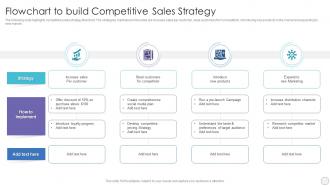
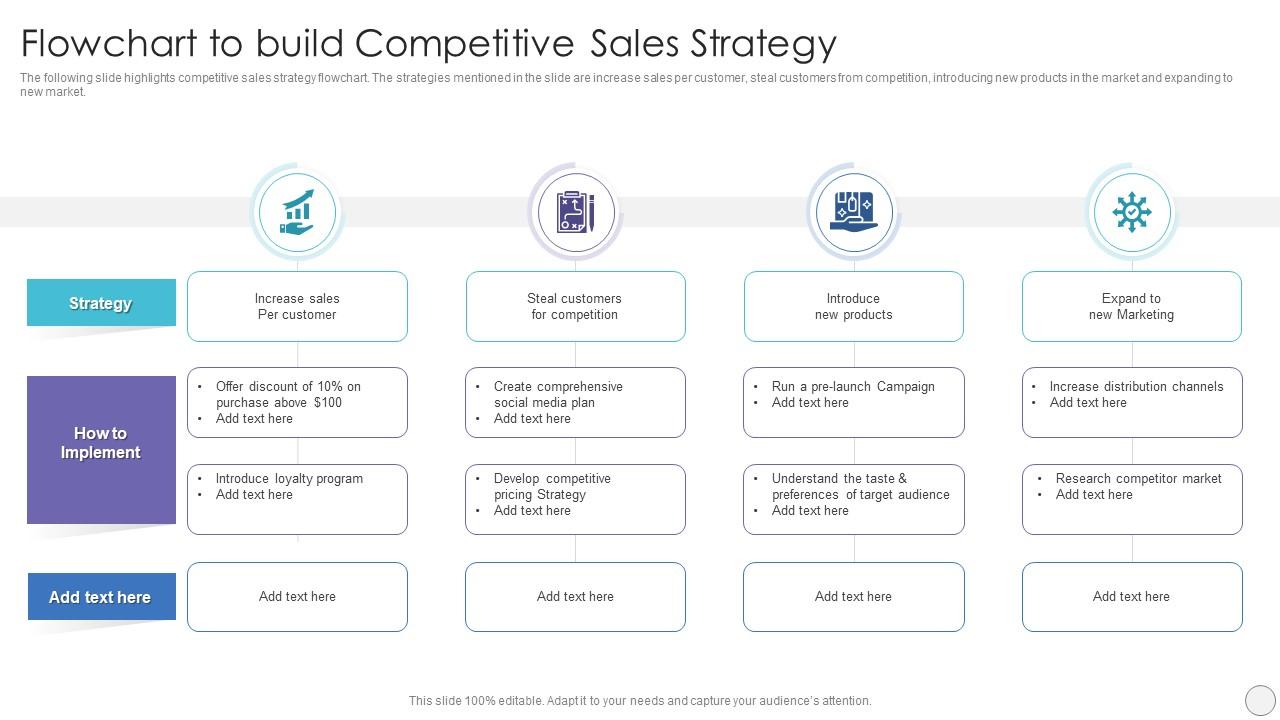
The following slide highlights competitive sales strategy flowchart. The strategies mentioned in the slide are increase sales per customer, steal customers from competition, introducing new products in the market and expanding to new market.
People who downloaded this PowerPoint presentation also viewed the following :
Flowchart To Build Competitive Sales Strategy with all 6 slides:
Use our Flowchart To Build Competitive Sales Strategy to effectively help you save your valuable time. They are readymade to fit into any presentation structure.
FAQs for Flowchart To Build
Key components include comprehensive competitor analysis, differentiated value propositions, strategic pricing frameworks, targeted market positioning, and adaptive sales methodologies. These elements work together by identifying market gaps, highlighting unique advantages, and enabling sales teams to articulate superior value, with many organizations finding that this strategic combination ultimately delivers higher conversion rates and sustainable competitive advantage.
Market research enhances competitive sales strategy by identifying customer pain points, analyzing competitor weaknesses, and revealing untapped market segments. Through comprehensive data analysis, sales teams can tailor their messaging, optimize pricing strategies, and prioritize high-value prospects, ultimately delivering more targeted pitches and shorter sales cycles while gaining significant competitive advantage.
Customer segmentation enables targeted sales approaches by dividing markets into distinct groups based on demographics, behavior, needs, and purchasing patterns, allowing for personalized messaging and resource allocation. This strategic segmentation enhances conversion rates and customer lifetime value, with companies in retail, financial services, and technology finding that tailored approaches deliver significantly higher ROI than broad-based strategies.
Sales teams can leverage USPs by clearly articulating differentiated value propositions, conducting thorough competitive analysis, training representatives on positioning advantages, and customizing messaging for specific client pain points. Through strategic presentation techniques and competitive battlecards, organizations enhance win rates, shorten sales cycles, and command premium pricing, with many finding that well-defined USPs ultimately deliver sustained competitive advantage.
Competitive analysis strategies include market research, SWOT analysis, customer feedback analysis, financial benchmarking, and social media monitoring. These approaches enable businesses to assess competitors' pricing models, product offerings, and customer service capabilities, while identifying market gaps and positioning opportunities, ultimately delivering strategic insights that enhance competitive advantage and inform more effective sales strategies.
Alignment between sales and marketing teams is crucial in competitive sales contexts, enabling unified messaging, coordinated lead nurturing, and shared competitive intelligence. This strategic collaboration streamlines prospect engagement, accelerates deal cycles, and maximizes conversion rates, with organizations finding that synchronized teams deliver significantly higher revenue growth and competitive advantage.
Key metrics include win rates against specific competitors, competitive displacement rates, deal velocity in contested opportunities, average deal size in competitive scenarios, and customer acquisition costs when facing competition. These measurements enable sales teams to identify which competitive positioning tactics, pricing strategies, and value propositions deliver the strongest results, ultimately helping organizations refine their approach and secure more victories in increasingly contested markets.
Technology and data analytics enhance competitive sales tactics by providing real-time competitor insights, predictive customer behavior modeling, and automated lead scoring systems. Through AI-powered platforms, sales teams streamline prospect identification, personalize outreach strategies, and optimize pricing decisions, with many organizations finding that these data-driven approaches ultimately deliver faster conversion rates and significantly improved win rates.
Common pitfalls include underestimating competitor capabilities, focusing solely on price competition, neglecting customer relationship building, inadequate market research, and reactive rather than proactive positioning. These strategic missteps often result from insufficient competitive intelligence and narrow tactical thinking, with successful organizations finding that comprehensive market analysis, differentiated value propositions, and customer-centric approaches ultimately deliver sustainable competitive advantage.
Companies can adapt their sales strategy by conducting thorough competitor analysis, differentiating value propositions, adjusting pricing models, and enhancing customer relationship management systems. Through strategic repositioning and targeted messaging, organizations streamline their competitive response while strengthening client retention, with many finding that proactive market monitoring and agile sales processes ultimately deliver sustained competitive advantage.
**INPUT**: What techniques can be used to train sales teams on competitive selling? **OUTPUT**: Competitive selling training techniques include role-playing exercises, battlecard development, objection handling workshops, competitive analysis sessions, and win-loss reviews. These methods enhance sales performance by building product knowledge, improving messaging precision, and developing counter-strategies, with many organizations finding that structured competitive training ultimately delivers higher win rates and stronger customer relationships.
Understanding buyer personas enhances competitive positioning by enabling targeted messaging, personalized value propositions, and strategic differentiation based on specific customer pain points, preferences, and decision-making processes. Sales teams leverage these insights to anticipate objections, customize presentations, and position solutions more effectively than competitors, with many organizations finding that persona-driven approaches significantly increase conversion rates and customer acquisition.
Pricing strategy significantly shapes competitive positioning by influencing market perception, customer acquisition costs, and profit margins across different segments. Strategic pricing enables companies to differentiate through value-based approaches, penetration tactics, or premium positioning, with many organizations finding that dynamic pricing models help them respond to competitor moves while maintaining profitability and market share.
Storytelling enhances competitive sales strategy by creating emotional connections, simplifying complex value propositions, and differentiating offerings through memorable narratives. Sales teams leverage customer success stories, transformation journeys, and problem-resolution scenarios to build trust and credibility, with many organizations finding that well-crafted stories significantly accelerate deal closure and strengthen client relationships.
Customer feedback shapes competitive sales strategy by revealing market gaps, highlighting competitor weaknesses, identifying unmet needs, and exposing price sensitivity patterns. Through systematic feedback analysis, organizations can refine their value propositions, adjust pricing strategies, and enhance service delivery, with many sales teams finding that customer insights ultimately drive higher conversion rates and stronger competitive positioning.
-
Best Representation of topics, really appreciable.
-
The presentations are very helpful. I am always able to get appropriate templates for the different topics related to my profession.