Food composition analysis ppt powerpoint presentation inspiration background

Food composition analysis ppt powerpoint presentation inspiration background
Slide 1 of 2
Favourites Favourites

Try Before you Buy Download Free Sample Product

Audience Impress Your
Audience
Editable 100%
Editable
Time Save Hours
of Time
The Biggest Sale is ending soon in
0
0
:
0
0
:
0
0
Presenting this set of slides with name Food Composition Analysis Ppt Powerpoint Presentation Inspiration Background. The topics discussed in these slides are Food Composition Analysis. This is a completely editable PowerPoint presentation and is available for immediate download. Download now and impress your audience.

People who downloaded this PowerPoint presentation also viewed the following :

Content of this Powerpoint Presentation

Description:

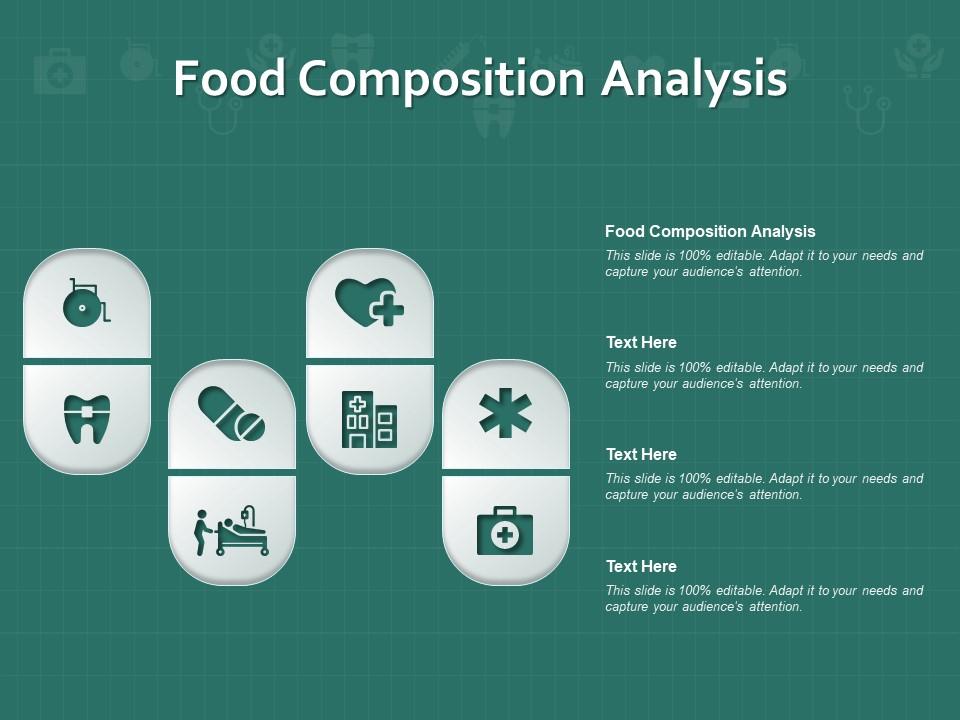
The image features a PowerPoint slide titled "Food Composition Analysis" with a thematic background that suggests a scientific or analytical setting, possibly in a laboratory context. The slide contains six capsule-shaped icons, each with a distinct symbol, suggesting different aspects of food analysis:

1. A microscope, symbolizing the examination of food at a microscopic level, possibly for pathogens or micro-nutrient content.

2. A heart with a plus sign, indicating health benefits or nutritional value analysis.

3. A dental icon, which may relate to food's impact on dental health.

4. A capsule pill, representing the analysis of food supplements or nutraceuticals.

5. Hospital building with a cross, suggesting food's role in healthcare or hospital dietetics.

6.  A person on a treadmill inside the capsule, could symbolize the study of food's impact on physical fitness and exercise.

Use Cases:

Such slides can be essential tools in a variety of industries for conveying complex information about food and health:

1. Food Science:

Use: Presenting nutritional analysis findings.

Presenter: Food Scientist.

Audience: Researchers, and industry professionals.

2. Healthcare:

Use: Discussing diet's role in patient care.

Presenter: Clinical Dietitian.

Audience: Medical staff, patients.

3. Education:

Use: Teaching about nutrition and food science.

Presenter: Educator.

Audience: Students, faculty.

4. Pharmaceutical:

Use: Explaining the development of nutraceuticals.

Presenter: R&D Specialist.

Audience: Stakeholders, regulatory bodies.

5. Fitness and Wellness:

Use: Integrating diet plans with fitness programs.

Presenter: Fitness Coach.

Audience: Clients, and health enthusiasts.

6. Food Manufacturing:

Use: Analyzing food additives and ingredients.

Presenter: Quality Assurance Manager.

Audience: Production team, quality controllers.

7. Public Health:

Use: Advocating for healthy eating habits.

Presenter: Public Health Official.

Audience: Community groups, policymakers.

FAQs for Food composition analysis ppt powerpoint

So there's a few main approaches you'll run into. Proximate analysis covers your basics - protein, fat, carbs, that stuff. Chromatography's great for separating out specific compounds, spectroscopy helps identify molecules. Mass spectrometry is probably the biggest one though, it's kind of taken over as the go-to for detailed analysis. There's still wet chemistry methods for things like vitamin C (old school but works), plus NIR spectroscopy if you need quick screening. Honestly depends what you're after and how much you wanna spend. I'd figure out exactly which nutrients you need first, then pick your method from there.

So basically, whatever's actually in your food becomes your nutrition label - that's where all those numbers come from. You'll need to test for protein, fat, carbs, calories, sodium, all that stuff to meet FDA rules. Here's the annoying part though: change even one tiny ingredient and you might have to retest everything and redo your labels. Such a hassle when you're still figuring out your recipe. Oh, and if you want to make any health claims? Your test results better match up perfectly. My advice - get that composition analysis done upfront and keep good records. Trust me, it beats scrambling later when regulators start asking questions.

So it's basically your safety net for catching nasty stuff before it hits shelves - heavy metals, pesticide residues, pathogens, allergens, all that fun stuff. The chemistry behind food labels is actually pretty cool when you think about it. This data helps you figure out where your critical control points are for HACCP and whether you're hitting regulatory limits. Honestly, without testing you're just guessing about safety risks, which is terrifying. I'd start with your riskiest ingredients first since you can't test everything at once.

So food composition data is basically what makes dietary guidelines actually work - without it, nutritionists would just be guessing about vitamin C levels in oranges or protein in beans. Pretty crucial stuff. Having precise nutrient data lets experts set realistic daily values and serving sizes that make sense. It also helps spot where populations aren't getting enough nutrients, plus guidelines can adapt when food processing changes (which happens more than you'd think). You should definitely check if you're using updated composition databases for any nutrition work - the old ones can be way off sometimes.

So lab methods are super precise and catch way more nutrients, but you're looking at weeks of waiting and serious cash. Field testing though? You get instant results with portable analyzers and test kits. Less accurate, sure, but honestly perfect for quick decisions or basic quality checks. I'd go lab for anything research-heavy or compliance stuff - you kinda have to. Day-to-day monitoring though? Field methods will save your sanity and budget. It's really just that classic speed vs accuracy thing.

SPSS and R are pretty much the standard for stats work. For nutrient databases, check out USDA's FoodData Central or ESHA's Food Processor - both solid options. SAS is great if your company has deep pockets, but honestly? Excel handles basic analysis just fine, and anyone who says otherwise is being pretentious. Python with pandas gets useful once you're dealing with messier data manipulation stuff. I'd say start with whatever you already know how to use, then level up when your projects actually need it. No point learning R if you're just doing simple comparisons, you know?

Dude, get composition analysis done ASAP when you're tweaking recipes. Seriously saves you from expensive screw-ups later. You'll see exactly what happens when you swap ingredients - like how it changes nutrition, texture, all that stuff. Super helpful for hitting specific targets too, like cutting sodium without killing the taste (which honestly is harder than it sounds). Plus it keeps you compliant with regulations. I learned this the hard way on a project last year. Run tests early and often - way cheaper than redoing entire production batches because something didn't work out right.

Processing basically wrecks most of the good stuff in food. Heat kills off vitamin C and B vitamins, while refining strips out fiber and minerals - it's honestly pretty depressing when you think about it. They usually dump in extra sodium and sugar too. Your proteins get denatured and fats oxidize. But okay, some processing actually helps - pasteurization stops you from getting sick, and weirdly some treatments make minerals easier to absorb. When I'm checking processed foods, I always compare them to the original ingredients. Makes the nutrient losses way more obvious.

So basically you're matching food composition data with what people actually eat. When someone logs "chicken breast" in their food diary, you use nutrient databases to figure out the real vitamin and mineral intake. Super tedious honestly, but that's how we spot nutritional gaps in different groups. USDA's FoodData Central is your go-to database - though you'll want to account for regional differences since a tomato in California isn't the same as one in Florida, nutritionally speaking. It's pretty straightforward once you get the hang of it.

Ugh, it's such a mess honestly. Different countries use totally different methods for testing and even define food categories differently. Labs have varying equipment, some sample seasonally while others don't, and the data quality is all over the place. Plus certain regions track weird nutrients that others completely ignore - like specific phytochemicals or whatever. The food coding systems are inconsistent too, which makes comparing anything a nightmare. I'd stick with USDA or EFSA databases since they're more reliable. Just make sure you document which version you're using for your analysis.

So basically what you taste comes down to the actual stuff in your food. Sugars give you sweetness, duh. But proteins create those savory umami flavors, and fats carry all the good aroma compounds that hit your nose. Water content is huge for texture too - nobody wants soggy crackers, right? The ratios matter most though. Like ice cream needs that perfect fat-to-sugar balance or it'll either taste icy or way too sweet. I learned this the hard way making gelato once. When you're developing recipes, just work backwards from the flavors you want to the specific ingredients that'll get you there.

Honestly, the biggest headaches are gonna be around data accuracy and how people use your findings later. Document everything about your methods and limitations - super important. If you've got industry funding, just be totally upfront about it in your papers. Supplement companies love cherry-picking data to mislead people, so don't give them ammo with sloppy work. Also worth thinking about food waste during your research (seems minor but adds up). Oh and sampling methods - be transparent there too. Conflicts of interest will bite you later if you're not honest upfront.

So basically, those little microbes are messing with your food samples the whole time you're trying to test them. They're breaking down proteins, changing fatty acid levels, even shifting the pH - it's like they're running their own science experiment alongside yours. Super annoying, honestly. This gets really tricky with fermented stuff or anything that's been sitting around for a while. You'll want to test samples right away if possible, or freeze them to basically put the microbes on pause. Otherwise your results won't mean much since the bugs have already changed everything.

Phytochemical analysis is basically how you figure out what makes functional foods actually work. You're identifying the specific compounds that give health benefits - like those flavonoids in blueberries or polyphenols in green tea that everyone talks about. It shows you exactly which molecules are doing the heavy lifting for antioxidant or anti-inflammatory effects. Pretty cool stuff, honestly. This data helps validate health claims and optimize processing so you don't destroy the good compounds. You can even use it for breeding better crops. I'd start with whatever phytochemical classes matter most for your specific application - no point analyzing everything if you're targeting something particular.

So basically, you test ingredients from different suppliers to see who's actually giving you quality stuff. Compare protein levels, nutrients, contaminants - the whole deal. Honestly, some suppliers will surprise you (not always in a good way). Once you've got the data, stick with whoever's consistent and ditch the sketchy ones. Seasonal changes mess with quality too, so factor that into your ordering schedule. Oh, and lock in the good suppliers with longer contracts before someone else snatches them up. Start with your top three - you'll figure out real quick who deserves your business.

Ratings and Reviews

0% of 100
Write a review
Most Relevant Reviews

No Reviews