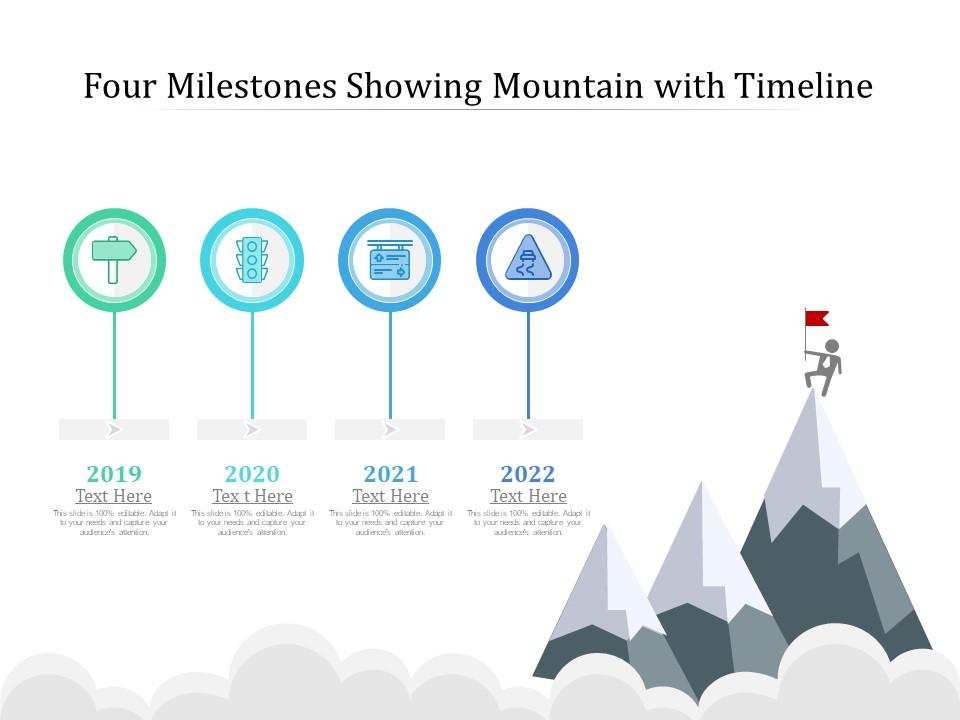
Four milestones showing mountain with timeline
Try Before you Buy Download Free Sample Product
Audience
Editable
of Time
Guide folks to go about it correctly with our Four Milestones Showing Mountain With Timeline. Curb bad habits in their infancy.
People who downloaded this PowerPoint presentation also viewed the following :
Four milestones showing mountain with timeline with all 2 slides:
Display a fine balance with our Four Milestones Showing Mountain With Timeline. Decide after considering all arguments.
FAQs for Four milestones showing
Honestly, just focus on four big checkpoints: kicking off the project, wrapping up your planning phase, starting execution, and closing everything out. I always treat these like mandatory pit stops - kinda annoying but you'll thank yourself later. Each one's your chance to make sure everyone's still on the same page about what you're building and when. Set up actual review meetings with your team and stakeholders at each milestone. Trust me, it beats having someone pop up three weeks before launch saying "wait, this isn't what I wanted." Better to catch that stuff early and adjust course.
Work backwards from your deadline - seriously, it's a game changer for seeing everything you need to do. Break it into four chunks: research/content gathering, rough outline, actual slides, then rehearsal plus revisions. I literally always mess this up, but give yourself way more time for revisions than you think you'll need. Make each milestone super specific so you can actually cross it off your list. Pick real dates and block them in your calendar right now. Oh, and don't make them vague like "make progress" - that's useless. You'll thank yourself later when you're not scrambling at 2am.
Okay so milestones are like your story's skeleton - they connect everything and keep people following along. I learned this the hard way after rambling through way too many presentations lol. You want each one building off the last, creating this flow toward your big point. Short ones work better than long ones, honestly. When your audience can see how the pieces connect? That's when they actually get it. I always map out my four milestones first, then worry about filling in the details later. Trust me, it's so much easier than trying to organize everything at once.
Each industry sets milestones differently based on what actually matters for them. Tech focuses on product launches and user growth. Manufacturing? Production capacity and quality stuff. Healthcare and finance are drowning in compliance milestones - honestly makes sense though given how regulated they are. Retail builds everything around seasons and inventory cycles. You'll want milestones that match what drives success in your space, not just generic business stuff. Check what your biggest competitors track and what regulators obsess over. That's your starting point.
Honestly, I'd just start with Trello or Notion - both are solid for tracking stuff visually and you can make separate boards for each milestone. Asana's another option if you want more bells and whistles for project management. But real talk? Even a basic spreadsheet works fine if you're not feeling the fancy apps. I've seen people overthink this and pick some elaborate system they never touch again after two weeks. Pick whatever you'll actually stick with. Just make sure you can quickly see where you stand and set up some reminders so you don't forget to update it.
Honestly, I'd check every 2 weeks during active phases. Monthly works too, but you'll catch problems faster with bi-weekly reviews. Fast sprints or lots of dependencies? Go weekly for sure. The real trick is making sure your milestones actually match what's happening - scope creep is sneaky like that. Don't be the person who waits until they're already behind to fix milestone 2, you know? I always set a recurring calendar thing and treat it like any other meeting I can't skip. Works way better than trying to remember on your own.
Don't make your milestones super vague like "introduce topic" - that tells you nothing. Get specific about what you're actually covering. I've seen so many people cram way too much between checkpoints and lose everyone halfway through. Keep them flexible though! If something's bombing, you need wiggle room to pivot. Timing gets overlooked constantly but it's huge for not running over. Short sentences work better than long rambling ones. Build in buffer time and honestly? Always have a plan B ready if you need to cut stuff and jump ahead.
Honestly, visuals are a game-changer for milestone presentations. People get it so much faster when they can actually see your progress instead of just listening to you talk. Timelines are my go-to - way better than boring bullet points. Progress bars work too, or those simple before/after shots that show the journey. Charts are perfect if you've got numbers to show off. Each milestone should probably get its own visual (don't overthink it though). Flowcharts help with process stuff. Match the visual to whatever you're trying to show and people will catch on to the big picture way quicker.
Pick 2-3 KPIs per milestone that actually matter for what you're building. Early on? Focus on basics like user adoption or system uptime. Growth phase gets more interesting - track monthly active users or conversion rates. Later milestones should measure efficiency stuff like customer acquisition costs or retention. The trick is getting everyone to agree on the numbers beforehand. Otherwise you'll have those awkward conversations later where half the team thinks you crushed it and the other half's like "wait, what were we even measuring?" Been there. Your industry probably has some standard metrics, but honestly just pick ones that tell you if you're actually moving the needle.
So here's what I've learned from way too many project meetings - you gotta match what you're asking stakeholders to do with where you actually are in the project. First milestone? Get them defining what success looks like and nailing down scope. Trust me, their buy-in here saves you from those brutal "wait, that's not what we wanted" moments later. Milestone 2 is your check-in time - updates plus surfacing any issues before they blow up. Third one gets interesting because you're reality-checking everything together (honestly, this is where poor expectation management comes back to bite you). Final milestone should cover sign-offs, what went wrong/right, and what happens next. Don't just give status updates though - be crystal clear about what you actually need from them each time.
Think of milestones like checkpoints in a video game - your audience gets that little satisfaction hit when you reach each one. People zone out after about 10 minutes if they don't know where you're headed or how much is left. Four milestones work perfectly because they give predictable breaks to process stuff and refocus. I always announce them clearly: "Alright, that's milestone one done, now we're moving to..." Sounds cheesy but it genuinely keeps people tuned in. Without them? You'll lose half your audience halfway through, guaranteed.
Oh man, this is so true from experience. Different cultures view milestones totally differently - some want quick wins, others are all about the long game. I bombed a presentation in Tokyo last year because I focused too much on individual achievements, which came off super selfish in their collectivist culture. Research your audience beforehand (sounds obvious but you'd be surprised how many people skip this). Mix in both team and individual milestones to play it safe. The metrics you spotlight can make or break how your message lands.
Definitely make those wins visible to everyone! Share them in team meetings or company Slack - honestly, even a simple email works. I always bring donuts or something because food just makes everything better lol. Connect it back to your bigger goals so people get why it matters. Here's the key though - call out specific people who crushed it, not just "thanks everyone" generic stuff. Also use the moment to figure out what's working well. It builds momentum for whatever you're tackling next. Celebrating properly is honestly underrated.
For personal development presentations, try organizing around four milestones: where you started, challenges you hit, what you actually learned, and what's next. Honestly, this beats watching someone ramble for 20 minutes with no direction. Set your baseline first - like where your skills were initially. Then walk through the obstacles that forced you to grow. Highlight specific insights you gained (not just vague "I learned patience" stuff). Finish with future goals. Makes the whole thing feel real instead of abstract, plus your audience gets concrete takeaways for their own development.
Work backwards from your main goal - what does your audience actually need to grasp at each step? Think of it like building blocks where each milestone sets up the next one. I'm weirdly obsessed with sketching this stuff out on paper first because seeing the flow visually just clicks better for me. Each milestone needs a real purpose, not just arbitrary checkpoints. Here's my litmus test: if someone walked away remembering only those key moments, would they still get your core message? That usually tells you if you've nailed it or not.
No Reviews