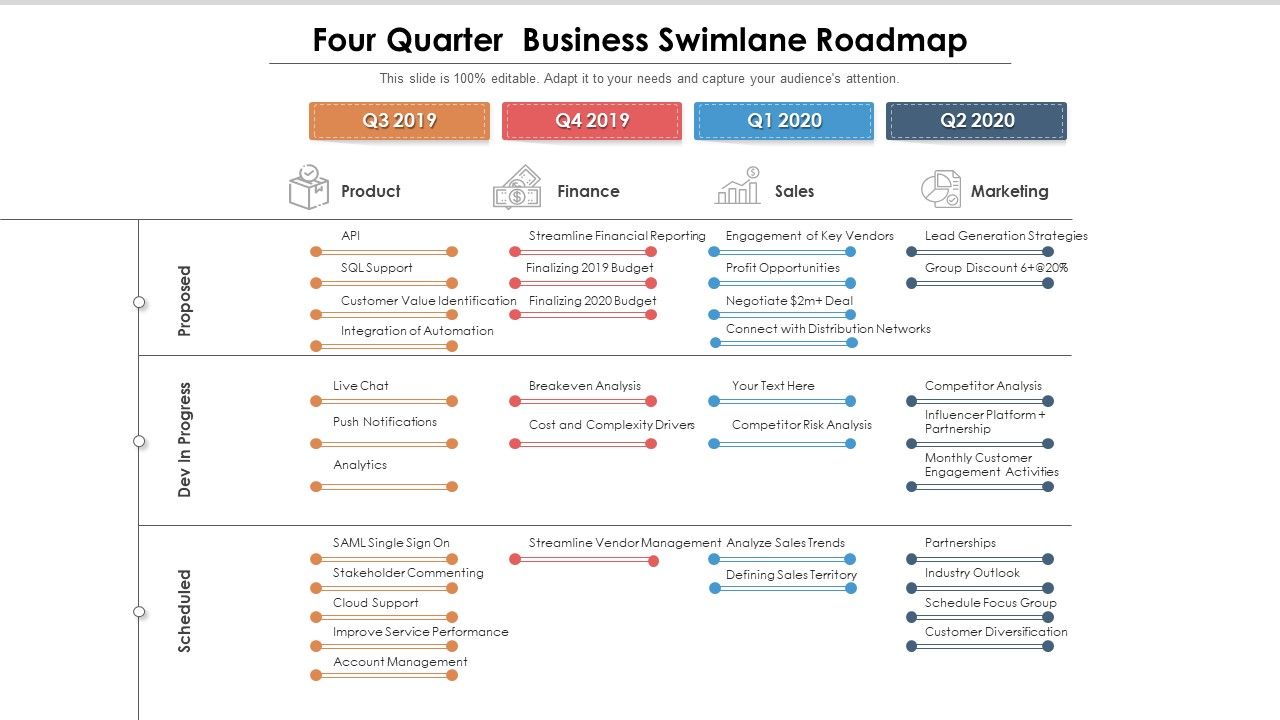
Four quarter business swimlane roadmap
Try Before you Buy Download Free Sample Product
Audience
Editable
of Time
The success rate of business plans is hugely dependent on the plan of action, and this editable Four Quarter Business Swimlane Roadmap rightly serves the purpose. Encapsulate all the information related to the project in a well structured manner to obtain maximum efficiency by incorporating our stunning PowerPoint theme. State the critical deliverable, steps involved, time frame, workforce allocation, and lots more in an easy to understand manner by utilizing this pre designed roadmap PowerPoint layout. You can also prioritize your tasks and discuss the problem areas with your colleagues by incorporating this tailor made PPT layout. Empower your work plan by employing this professionally designed PPT theme. Entrepreneurs can download Four Quarter Business Swimlane Roadmap as a beneficial communication tool that facilitates in collaborating with different tasks and achieve targets.
People who downloaded this PowerPoint presentation also viewed the following :
Four quarter business swimlane roadmap with all 2 slides:
Give your audience a fulfilling experience. They will find our Four Quarter Business Swimlane Roadmap elevating.
FAQs for Four quarter
Oh, swimlane roadmaps are pretty neat! Basically you split your product roadmap into horizontal lanes - like one for each team or product area. Way better than regular roadmaps because you can actually see who owns what at a glance. It's like if a timeline and org chart had a baby, haha. The lanes make spotting problems super obvious - dependencies, resource fights, that kind of mess. Honestly they're a lifesaver when you've got multiple teams working on stuff. Your stakeholders will thank you too since they won't have to guess which team is handling what initiative.
First thing - figure out your swimlanes (teams, departments, whatever makes sense) and make sure everyone gets which lane they're in. Dependencies are where everything usually goes sideways, so map those out first. Build in extra time for when teams need to coordinate - it always takes longer than you think. Each task needs one person who owns it, even if others help out. That's non-negotiable honestly. Review it every couple weeks because stuff will definitely change. Oh, and make it visible to everyone involved. Nobody should be guessing who's responsible for what or when things are due.
Honestly, the biggest win is everyone knows exactly who owns what and when stuff's due. No more confusion about responsibilities. Dependencies become super obvious when you can see everything in separate lanes - way better than those chaotic timeline charts where everything's mashed together. Your teammates can just scan their own lane to see what's coming up next. Leadership gets the full picture of how everything connects too, which they love. Oh and start with your main teams as swimlanes, then map out their projects from there.
Honestly, swimlane roadmaps are a game changer for getting teams to actually work together. Each team gets their own lane on the same timeline, so you can see exactly when you're waiting on someone else's stuff or when they need yours. No more of those awkward Slack messages asking where things stand – though let's be real, there will always be some of those. Teams start coordinating way better because the visual makes it impossible to ignore how everything connects. Stakeholders finally get it too, which is huge. I'd start with just 2-3 teams to see how it goes before expanding.
Okay so swimlane roadmaps are perfect when you've got multiple teams that need to stay in sync but aren't exactly working on the same stuff. Like product launches - engineering's doing their thing, marketing's doing theirs, sales has their timeline. Everyone's moving in parallel but needs to hit certain points together. Digital transformations are another good one. IT, ops, customer success all have different pieces. Also anything with outside dependencies - partnerships, regulatory stuff where you're waiting on other people. Honestly? The "who's supposed to be doing what again" confusion just disappears. Well, mostly. If timing between teams actually matters for your project, that's where I'd start.
Oh totally! They actually work better with agile than the old waterfall approach, honestly. Just flip your timeframe to sprints instead of those crazy long-term projections. Keep the swimlanes loose - maybe one per team or epic, whatever makes sense. The trick is updating it constantly. Like after every retro or sprint review. Don't get married to anything past your next couple sprints though - that defeats the whole agile thing. It's pretty clutch for seeing how different teams' work connects, which gets messy fast when everyone's moving in parallel. Way more useful than I initially thought it'd be.
Oh man, don't cram every tiny detail into those lanes - I learned that the hard way. Group similar teams together instead of giving everyone their own row. Timelines are where people really mess up though. Everyone gets way too optimistic about delivery dates and then the whole thing falls apart. Your stakeholders won't care about super granular stuff anyway. Keep updating it regularly or it just becomes expensive wall art. Simple question: does each lane actually help your audience? If not, ditch it. Realistic dates will save you so much headache later.
Dude, visual elements are game-changers for swimlane roadmaps. Color coding different project phases, adding milestone icons, progress bars - it all helps people actually understand what's happening instead of staring at walls of text. I swear I've watched 2-hour meetings turn into focused 30-minute discussions just because someone threw in the right visuals. Keep your colors consistent across projects so everyone's on the same page. Oh, and timeline markers are clutch for showing priorities. Dependencies become obvious when you can see them instead of hunting through paragraphs.
For swimlane roadmaps, I'd go with Lucidchart or Miro first. Both have solid templates and the collaboration stuff actually works smoothly. Visio's decent if you're already using Microsoft everything, but honestly feels pretty outdated now. ProductPlan and Roadmunk are more product-focused - might be too much depending what you're doing. PowerPoint works too if you just need something fast. Oh, and Miro has a free version that's pretty generous, so you can mess around with their swimlane templates without paying anything. That's probably where I'd start.
Honestly, quarterly works for most people, but it really depends on your space. Tech moves crazy fast - like if you're doing fintech stuff, you might need monthly check-ins just to keep up. More traditional industries? You can probably get away with every six months. Watch out for big changes though - new priorities, budget shifts, market weirdness. That stuff will mess up your timeline fast. I always set a calendar reminder because otherwise I'll totally forget. Even just 30 minutes to make sure you're not completely off track helps. Don't stress about making it perfect - these things change constantly anyway.
Look, stakeholder feedback is what stops your swimlane roadmap from becoming total garbage. Different teams know stuff you don't - dependencies, realistic timelines, all that messy reality. I've watched so many roadmaps completely fall apart because someone skipped this step. Getting their input helps you spot blind spots and figure out if your assumptions actually make sense. Don't just ask once and call it done though - priorities change constantly and you want this thing to stay useful. Plus, honestly? People are way more likely to buy in when they've had a say in building it.
Honestly, swimlane roadmaps are amazing for spotting bottlenecks. Picture your workflow split into horizontal lanes - suddenly you can see exactly where one team's drowning while another's twiddling their thumbs. That overloaded lane? There's your problem. Plus you'll catch all those annoying handoff delays between teams that usually fly under the radar. The whole visual thing just makes inefficiencies pop out way better than some boring timeline would. I'd definitely map what you're doing now first - can't fix what you can't see, right? Works every time.
Yeah definitely! Swimlane roadmaps play nice with basically any PM framework you're already using. Works awesome with Agile - you can show sprints across different teams. Waterfall projects too, for visualizing how phases depend on each other. SAFe teams eat this stuff up, honestly. Just map your framework's stages to the swimlane rows (could be teams, products, whatever). You can drop them right into Jira, Monday, or just beef up your current process. My advice? Pick one small project first to try it out - way less overwhelming than going all-in immediately.
Honestly, swimlane roadmaps are game-changers for accountability. Everyone gets their own lane with specific stuff they're responsible for – no more confusion about who's doing what. You can spot problems immediately when someone's drowning or falling behind. The visual aspect is huge too; people actually care more when their work is right there for everyone to see. I've found updating them weekly works best, maybe during your regular team check-ins? Creates this nice rhythm where people naturally want to show progress. It's way better than those messy shared docs where everything gets buried.
Here's what I'd do - figure out your KPIs for each swimlane first. Pick metrics that actually matter for what you're building: delivery times, budget stuff, quality scores, user adoption, whatever fits. Monthly check-ins work way better than quarterly (learned that the hard way). You want both the quick wins you can measure fast - like team velocity - and the bigger picture stuff that takes longer to show up, like customer happiness or revenue. Oh, and definitely build some kind of simple dashboard so everyone can see what's happening without digging through spreadsheets. Makes course corrections so much easier when things inevitably go sideways.
No Reviews