Four Steps In Career Planning And Development

Rating:
90%
Four Steps In Career Planning And Development
Slide 1 of 6

or

Favourites Favourites

Try Before you Buy Download Free Sample Product

Audience Impress Your
Audience
Editable 100%
Editable
Time Save Hours
of Time
The Biggest Sale is ending soon in
0
0
:
0
0
:
0
0
Rating:
90%
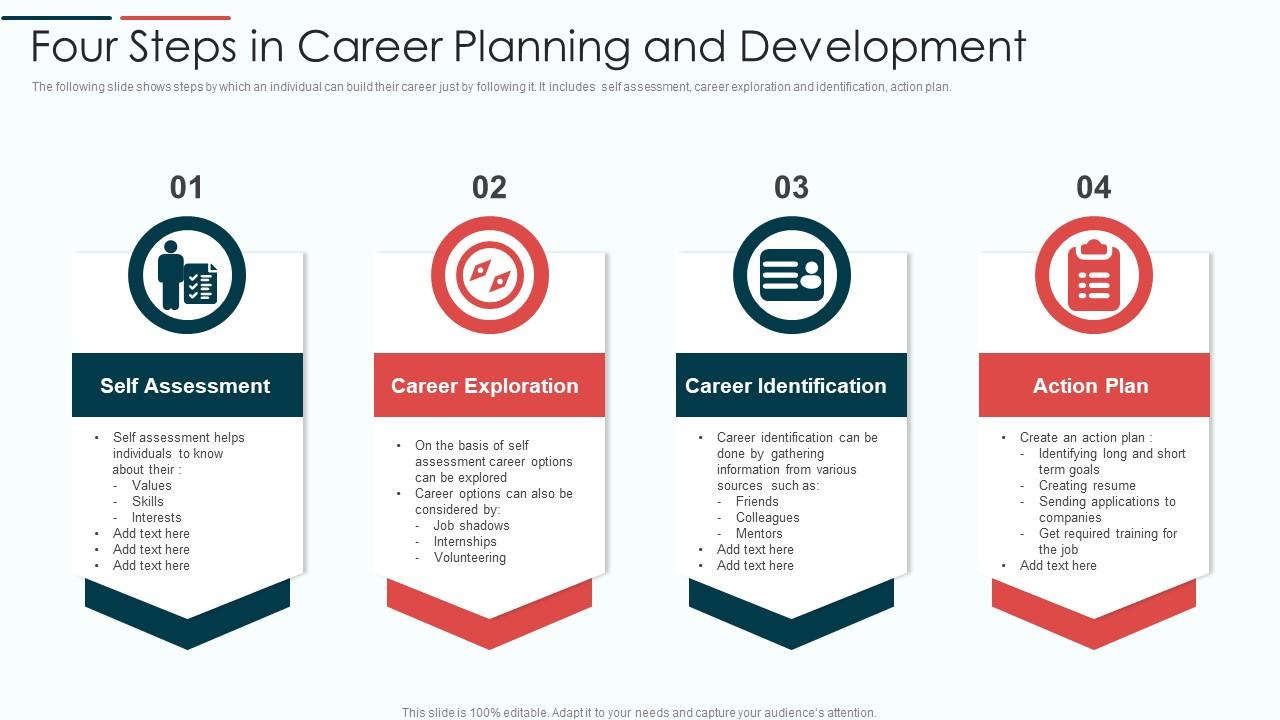
The following slide shows steps by which an individual can build their career just by following it. It includes self assessment, career exploration and identification, action plan. Introducing our premium set of slides with Four Steps In Career Planning And Development. Ellicudate the four stages and present information using this PPT slide. This is a completely adaptable PowerPoint template design that can be used to interpret topics like Self Assessment, Career Exploration, Action Plan. So download instantly and tailor it with your information.

FAQs for Four Steps In Career

Individuals can identify career goals through self-assessment of skills and interests, researching industry trends, conducting informational interviews, and exploring different roles through internships or shadowing. This strategic approach enables professionals to align personal strengths with market opportunities, ultimately delivering clearer career direction and enhanced job satisfaction across various sectors.

Evaluating skills and interests involves conducting self-assessments, seeking feedback from colleagues and mentors, analyzing past achievements, and exploring personality tests like Myers-Briggs or StrengthsFinder. This strategic combination enables professionals to identify patterns in their work preferences, technical capabilities, and natural talents, ultimately delivering clearer career direction and enhanced job satisfaction across diverse industries.

Networking plays a pivotal role in career planning by providing access to hidden job opportunities, industry insights, mentorship guidance, and professional recommendations. Through strategic relationship building, professionals unlock career advancement pathways, gain market intelligence about emerging roles, and develop valuable connections that facilitate transitions, with many finding that strong networks accelerate career progression significantly.

Market trends significantly influence career choices by revealing emerging opportunities, shifting skill demands, and evolving industry landscapes that guide strategic professional development. Through analyzing growth sectors like renewable energy, cybersecurity, and digital healthcare, professionals can align their expertise with expanding markets, while declining industries signal needs for reskilling or transitional planning, ultimately delivering competitive advantage and long-term career sustainability.

Common career planning mistakes include lacking clear goals, insufficient market research, overlooking skill gaps, avoiding networking, and failing to adapt plans regularly. Many professionals find that neglecting industry trends, underestimating required experience, and pursuing opportunities without strategic alignment ultimately limit advancement potential and competitive positioning in increasingly dynamic employment markets.

**INPUT**: What tools and resources are available for creating a personalized career development plan? **OUTPUT**: Career development tools include skills assessment platforms, mentorship programs, professional networking sites, industry certifications, and goal-tracking applications. These resources streamline career planning by identifying strengths, connecting professionals with guidance opportunities, and mapping strategic pathways, with many organizations finding that structured development approaches ultimately deliver enhanced employee retention and accelerated professional growth. **Word count: 54 words**

Mentorship significantly shapes career trajectory by providing strategic guidance, expanding professional networks, and accelerating skill development through experienced insights. Through meaningful mentor relationships, professionals gain access to industry knowledge, navigate complex workplace dynamics, and identify advancement opportunities more effectively, with many finding that mentorship ultimately delivers faster career progression and enhanced leadership capabilities.

Continuous learning significantly enhances long-term career success by expanding skill sets, increasing adaptability to industry changes, improving problem-solving capabilities, and positioning professionals for advancement opportunities. Through upskilling and reskilling initiatives, professionals across sectors like technology, healthcare, and finance maintain competitive advantages, command higher salaries, and navigate career transitions more effectively, ultimately delivering sustained professional growth.

Transitioning into a new industry or role requires strategic skill mapping, targeted networking, and gradual exposure through project work, informational interviews, and industry research. Professionals often succeed by leveraging transferable skills, pursuing relevant certifications, and securing bridge roles that combine current expertise with new industry knowledge, ultimately delivering career growth and expanded opportunities.

Career planning success can be measured through goal achievement rates, skill development progress, salary growth trajectories, network expansion, and alignment between personal values and professional roles. These metrics enable professionals to track advancement across industries like consulting, healthcare, and technology, while identifying areas for strategic adjustment, ultimately delivering enhanced job satisfaction, accelerated promotions, and sustainable career growth.

Emotional intelligence significantly impacts career planning by enhancing self-awareness, relationship management, decision-making under pressure, and leadership capabilities. Professionals with strong EQ navigate workplace dynamics more effectively, build strategic networks, and adapt to organizational changes, with many finding that these skills become increasingly critical for senior roles, ultimately delivering sustained career advancement and competitive positioning.

Individuals can leverage social media for career advancement by building professional networks, showcasing expertise through content creation, engaging with industry leaders, and discovering job opportunities through platform algorithms. LinkedIn enables professional branding and networking, while Twitter and Instagram allow thought leadership demonstration, with many professionals finding that consistent, strategic social media presence significantly enhances visibility and opens doors to career opportunities.

Key indicators of future growth fields include increasing demand for specialized skills, emerging technological applications, demographic shifts creating new needs, regulatory changes opening opportunities, and sustained investment flows. Industries like renewable energy, healthcare technology, and data analytics demonstrate these patterns, with organizations finding that early positioning in expanding sectors delivers competitive advantage and enhanced career stability.

Work-life balance integrates into career planning by evaluating role flexibility, growth trajectories that align with personal priorities, and company cultures that support wellbeing. Strategic career decisions increasingly consider remote work options, advancement timelines, and organizational values, with many professionals finding that prioritizing balance early enhances long-term satisfaction and sustainable performance.

Pursuing certifications and additional education delivers enhanced credibility, expanded skill sets, increased earning potential, broader career opportunities, and stronger professional networks. These credentials enable professionals to stay competitive in rapidly evolving industries, with many organizations finding that certified employees demonstrate greater expertise, command higher salaries, and advance more quickly into leadership roles.

Ratings and Reviews

90% of 100
Review Form
Write a review
Most Relevant Reviews
  1. 100%

    by Cory Reynolds

    One-stop solution for all presentation needs. Great products with easy customization. 
  2. 80%

    by Charlie Jackson

    “Love it! I was able to grab an exciting proposal because of SlideTeam.”

2 Item(s)

per page: