Framework For Social And Democratic Change Leadership
Try Before you Buy Download Free Sample Product
Audience
Editable
of Time
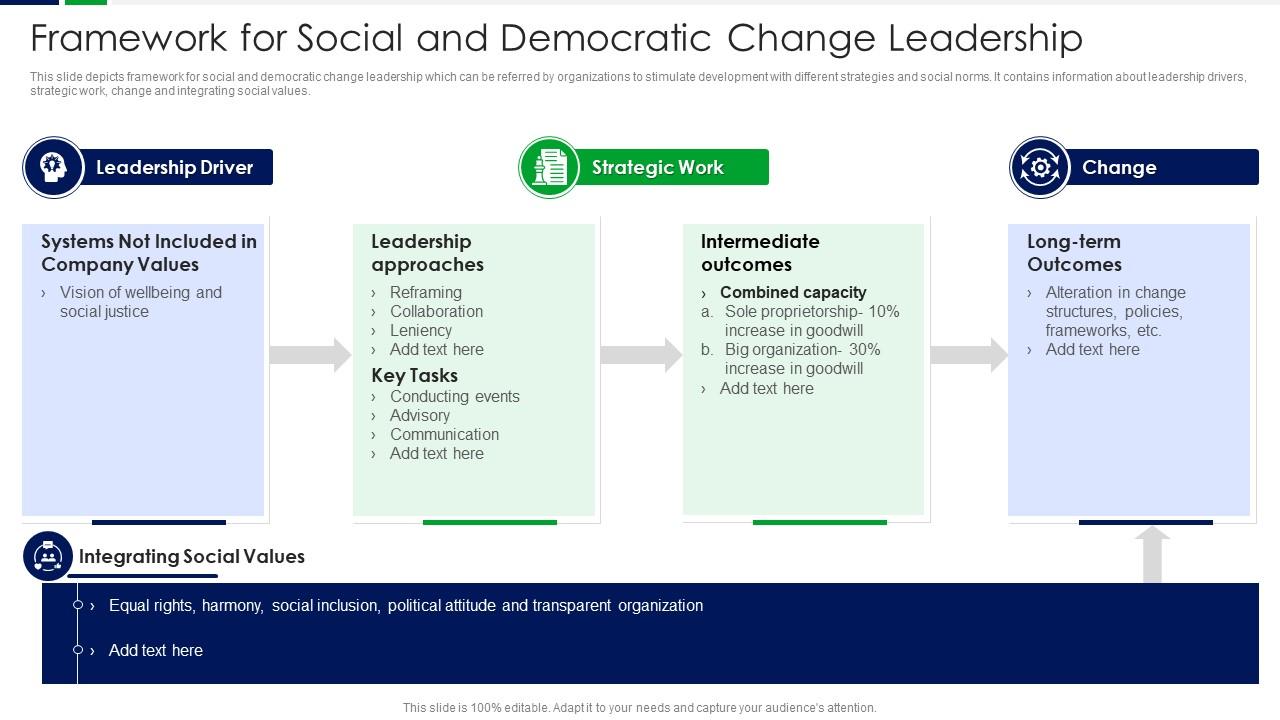
This slide depicts framework for social and democratic change leadership which can be referred by organizations to stimulate development with different strategies and social norms. It contains information about leadership drivers, strategic work, change and integrating social values.
People who downloaded this PowerPoint presentation also viewed the following :
Framework For Social And Democratic Change Leadership with all 6 slides:
Use our Framework For Social And Democratic Change Leadership to effectively help you save your valuable time. They are readymade to fit into any presentation structure.
FAQs for Framework For Social And
Effective leadership frameworks include vision setting, strategic communication, decision-making processes, team development capabilities, and performance management systems. These components work together by aligning organizational goals with individual growth, fostering accountability through clear expectations, and enabling scalable leadership development, with many organizations finding that structured frameworks significantly enhance operational efficiency and competitive advantage.
Different leadership styles significantly influence team performance through varying approaches to communication, decision-making, and motivation, with transformational leaders often driving innovation while democratic leaders enhance collaboration and autocratic leaders providing clear direction during crises. These diverse approaches enable organizations to adapt their management strategies based on team needs and business objectives, with many companies finding that flexible leadership styles ultimately deliver improved productivity, employee engagement, and competitive advantage.
Emotional intelligence enables effective leadership by enhancing self-awareness, empathy, social skills, and relationship management across diverse teams and organizational challenges. Leaders with strong emotional intelligence create more collaborative workplace cultures, make better decisions under pressure, and drive higher employee engagement, with many organizations finding that emotionally intelligent leaders deliver superior business outcomes and team performance.
Leaders adapt their framework by conducting cultural assessments, incorporating diverse perspectives into decision-making processes, and customizing communication styles to match organizational values. This involves adjusting leadership approaches based on cultural dimensions like hierarchy preferences, collaboration styles, and change tolerance, with many organizations finding that flexible frameworks ultimately enhance employee engagement, cross-cultural effectiveness, and organizational performance.
Leadership effectiveness metrics include employee engagement scores, retention rates, team productivity measures, 360-degree feedback results, and goal achievement percentages. These assessment tools work together by providing comprehensive insights into leader impact, with many organizations finding that combining quantitative performance data with qualitative feedback delivers the most accurate evaluation of leadership success.
A leadership framework facilitates better decision-making by establishing clear accountability structures, standardized evaluation processes, and consistent communication protocols across all organizational levels. Through systematic approaches like RACI matrices and decision trees, teams streamline complex choices, reduce analysis paralysis, and ensure stakeholder alignment, ultimately delivering faster consensus-building and more strategic outcomes that enhance operational efficiency.
Common challenges in implementing a leadership framework include resistance to change, inconsistent communication, lack of executive buy-in, insufficient training resources, and unclear performance metrics. These obstacles often emerge when organizations underestimate cultural adaptation requirements, with many companies finding that gradual rollouts across departments, combined with continuous feedback mechanisms, ultimately deliver stronger adoption rates and sustainable leadership development outcomes.
A leadership framework supports employee engagement and retention by establishing clear communication channels, consistent feedback mechanisms, transparent career development paths, and recognition systems that align individual goals with organizational objectives. Through structured leadership approaches, companies create trust-based environments where employees feel valued and supported, ultimately reducing turnover rates and enhancing workplace satisfaction across all organizational levels.
Innovative practices to enhance leadership frameworks include design thinking methodologies, reverse mentoring programs, cross-functional leadership rotations, data-driven performance analytics, and AI-powered leadership assessments. These approaches revolutionize traditional leadership development by fostering creative problem-solving, leveraging diverse perspectives, and delivering measurable outcomes, with many organizations finding that strategic combinations of these practices accelerate leadership effectiveness and competitive advantage.
Technology integrates into modern leadership frameworks through data analytics for decision-making, AI-powered performance management systems, digital collaboration platforms, and automated workflow optimization tools. These technologies enhance leadership effectiveness by providing real-time insights, streamlining team coordination, and enabling data-driven strategic planning, with many organizations finding that leaders can focus more on vision and relationship-building while delivering measurable operational improvements.
A leadership framework promotes diversity and inclusion by establishing clear accountability metrics, implementing bias-free recruitment processes, creating mentorship programs for underrepresented groups, and fostering inclusive decision-making structures. These strategic approaches enable organizations to build diverse talent pipelines, enhance innovation through varied perspectives, and ultimately deliver better business outcomes, with many companies finding that inclusive leadership frameworks significantly improve employee engagement and market competitiveness.
Feedback mechanisms can be embedded through regular one-on-one sessions, 360-degree reviews, peer evaluations, anonymous suggestion systems, and structured performance discussions at predetermined intervals. These systems streamline leadership development by enhancing self-awareness, accelerating skill improvement, and strengthening team relationships, with many organizations finding that consistent feedback loops ultimately deliver higher employee engagement and improved organizational performance.
**INPUT**: What is the relationship between a leadership framework and organizational agility? **OUTPUT**: Leadership frameworks directly enable organizational agility by establishing clear decision-making processes, empowering distributed leadership, and creating adaptive communication channels that respond quickly to market changes. Through structured yet flexible approaches, organizations streamline strategic pivots, enhance cross-functional collaboration, and accelerate innovation cycles, with many companies finding that robust frameworks ultimately deliver faster market responsiveness and sustainable competitive advantage. [Word count: 60]
Mentorship and coaching serve as foundational development pillars within comprehensive leadership frameworks, providing personalized guidance, skill enhancement, and strategic perspective building. These approaches accelerate leadership growth by fostering self-awareness, decision-making capabilities, and emotional intelligence, with many organizations finding that structured mentoring programs significantly improve leadership pipeline strength and retention rates.
Flexible leadership frameworks deliver sustained organizational resilience, enhanced employee engagement, improved decision-making speed, better talent retention, and stronger competitive positioning across changing market conditions. These adaptive approaches enable companies to navigate disruptions while maintaining operational efficiency, with many organizations finding that flexibility ultimately drives innovation, reduces turnover costs, and accelerates strategic responses to emerging opportunities.
-
Attractive design and informative presentation.
-
I never had to worry about creating a business presentation from scratch. SlideTeam offered me professional, ready-made, and editable presentations that would have taken ages to design.