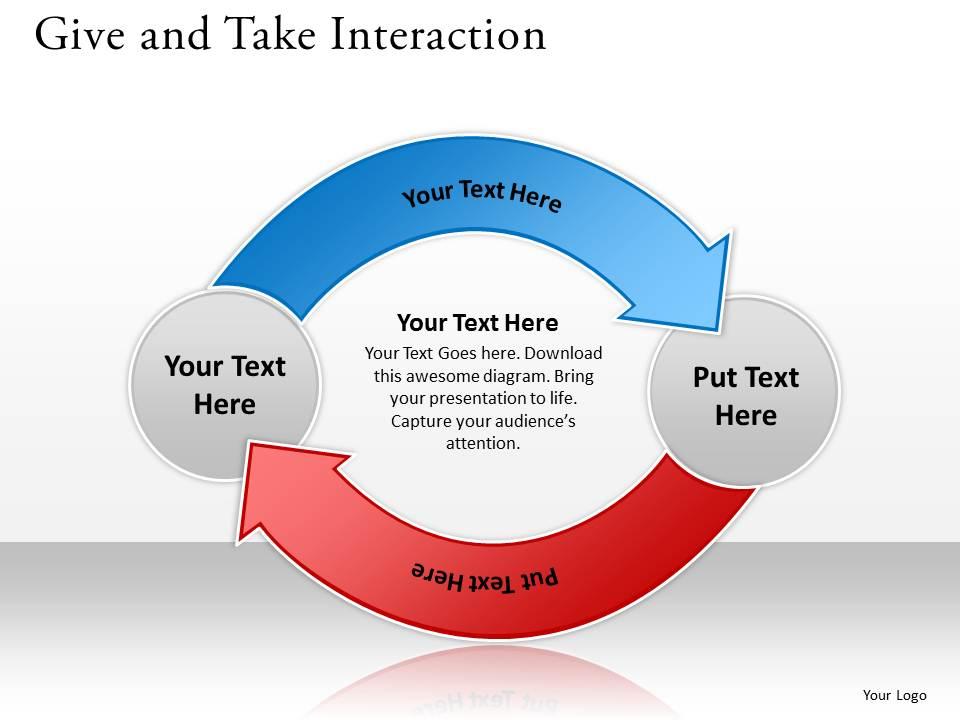
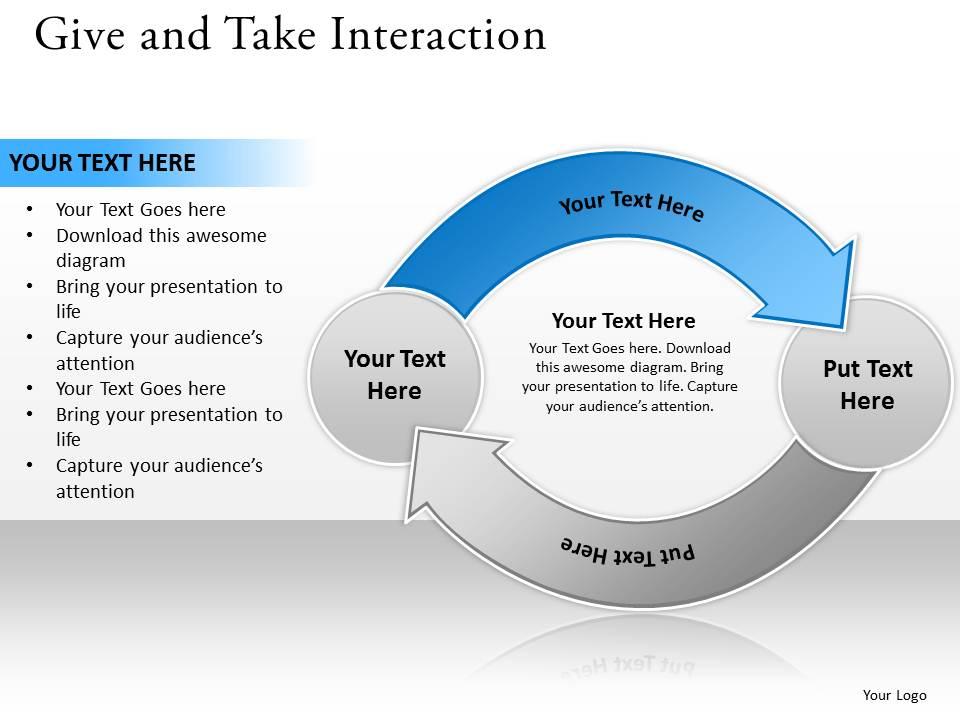
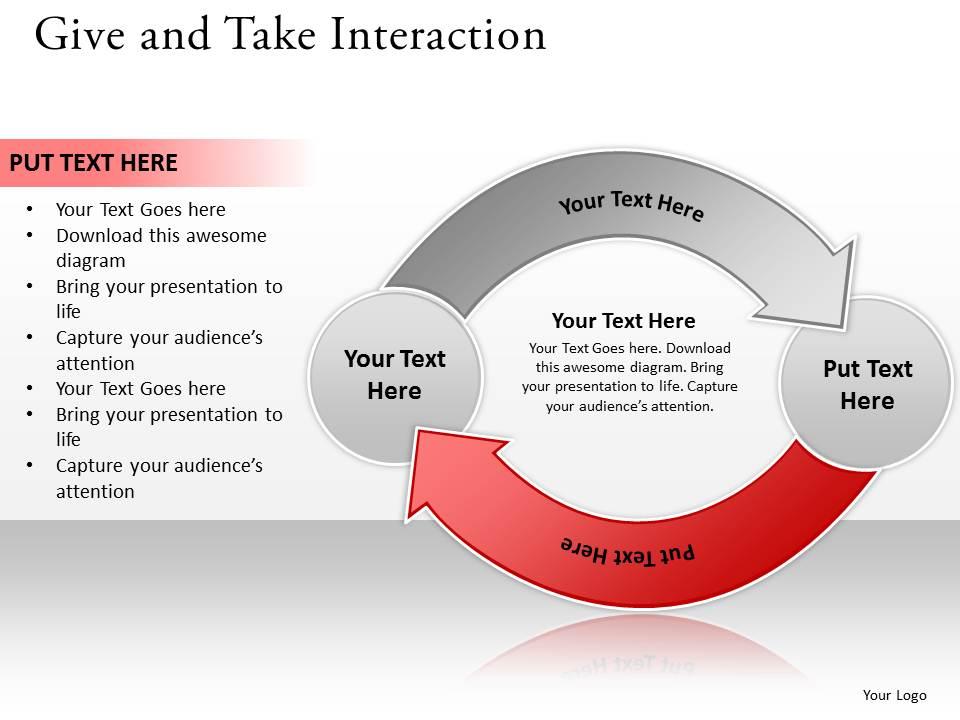
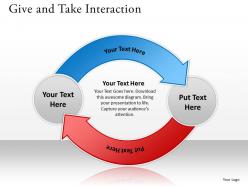
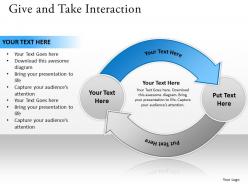
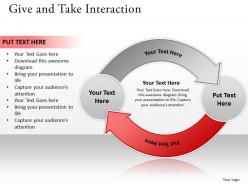
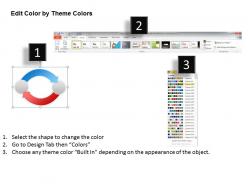
Give and take interaction ppt slides 12
Try Before you Buy Download Free Sample Product
Audience
Editable
of Time
Let us help your next presentation succeed. Thousands of styles of Give And Take Interaction Ppt Slides 12 are waiting to be incorporated into your projects.
People who downloaded this PowerPoint presentation also viewed the following :
Give and take interaction ppt slides 12 with all 7 slides:
Our Give And Take Interaction Ppt Slides 12 are as good as they come. Like your thoughts they are second to none.
FAQs for Give and take interaction
Effective give and take interactions in professional settings rely on active listening, mutual respect, collaborative problem-solving, clear communication, and strategic compromise. These principles enhance workplace relationships by building trust, fostering innovation, and streamlining decision-making processes, with many organizations finding that balanced exchanges ultimately deliver improved team performance and sustainable competitive advantage.
Give and take interactions enhance team collaboration by fostering open dialogue, encouraging diverse perspectives, building mutual trust, and creating psychological safety for idea sharing. Through reciprocal communication, teams leverage collective knowledge, cross-pollinate innovative solutions, and generate breakthrough concepts, with many organizations finding that balanced exchange ultimately delivers higher engagement, faster problem-solving, and sustained creative momentum.
Active listening serves as the foundation for successful give and take interactions by ensuring participants fully understand each other's needs, concerns, and perspectives before responding or negotiating. Through attentive listening, empathetic responses, and thoughtful questioning, professionals in sectors like healthcare, consulting, and financial services build trust and identify mutually beneficial solutions, ultimately delivering stronger partnerships and more sustainable business relationships.
Cultural differences significantly impact give and take exchanges through varying communication styles, reciprocity timelines, relationship hierarchies, and trust-building approaches. For example, while Western businesses often expect immediate reciprocity in negotiations, many Asian cultures emphasize long-term relationship building, with organizations finding that understanding these cultural nuances ultimately enhances global partnerships and competitive advantage.
Strategies include establishing clear expectations, maintaining transparent communication, documenting contributions, creating structured feedback systems, and implementing recognition programs. These approaches enhance reciprocity by building trust, encouraging accountability, and ensuring balanced exchanges, with many organizations finding that formal reciprocity frameworks ultimately deliver stronger partnerships, improved collaboration, and sustained mutual benefit across all stakeholder relationships.
Feedback can be effectively integrated through regular check-ins, structured evaluation sessions, transparent communication channels, and real-time response mechanisms. These approaches streamline workplace interactions by encouraging continuous improvement, building trust through transparency, and creating accountability frameworks, with many organizations finding that systematic feedback integration ultimately delivers enhanced team performance and stronger collaborative relationships.
Common barriers to effective give and take interactions include power imbalances, communication breakdowns, trust deficits, cultural misunderstandings, and conflicting priorities within organizations. These challenges can be overcome by establishing clear communication protocols, fostering psychological safety, implementing structured feedback systems, and promoting collaborative leadership approaches, with many companies finding that regular team-building initiatives and transparent goal-setting ultimately enhance mutual respect and productive exchanges.
Emotional intelligence enhances give and take interactions by improving empathy, active listening, and conflict resolution skills, enabling individuals to better understand others' needs and motivations. Through enhanced self-awareness and social perception, organizations streamline negotiations, build stronger partnerships, and facilitate more productive collaborations, with many finding that emotionally intelligent teams deliver superior outcomes and sustainable relationships.
Give and take dynamics significantly enhance conflict resolution by fostering mutual understanding, encouraging collaborative problem-solving, and creating balanced compromise opportunities where all parties feel heard. Through strategic reciprocity, teams navigate disputes more effectively, with many organizations finding that structured give and take processes reduce resolution time, improve workplace relationships, and ultimately deliver stronger team cohesion and productivity.
Give and take interactions can be measured through reciprocity ratios, response quality scores, engagement frequency metrics, outcome achievement rates, and participant satisfaction surveys. These assessment methods enable organizations to track collaborative effectiveness by analyzing contribution balance, knowledge transfer success, and mutual benefit realization, with many teams finding that regular measurement ultimately enhances strategic partnerships and operational efficiency.
Fostering a culture of give and take delivers enhanced employee engagement, improved collaboration, reduced turnover, stronger innovation capabilities, and increased organizational resilience. These workplace dynamics streamline knowledge sharing, accelerate problem-solving across departments, and ultimately create competitive advantages, with many organizations finding that reciprocal cultures significantly boost both productivity and employee satisfaction.
Technology facilitates give and take interactions in remote teams through collaborative platforms, real-time communication tools, digital whiteboards, project management systems, and video conferencing solutions. These technologies streamline feedback exchange, knowledge sharing, and collaborative decision-making by enabling seamless document collaboration, instant messaging, and virtual brainstorming sessions, ultimately delivering enhanced team cohesion and productivity across distributed workforces.
Give and take interactions that drive innovation include cross-industry partnerships, open-source development communities, customer co-creation initiatives, academic-industry collaborations, and strategic supplier relationships. These collaborative approaches accelerate breakthrough solutions by combining diverse expertise, sharing resources, and pooling knowledge, with many organizations finding that reciprocal innovation partnerships deliver faster time-to-market and competitive advantages.
Leaders can model give and take behaviors by actively sharing knowledge, providing mentorship, and seeking input from team members, while establishing recognition systems that reward collaborative contributions. Through regular feedback sessions, cross-functional projects, and transparent resource sharing, organizations create cultures where reciprocal behavior thrives, ultimately delivering enhanced team cohesion, improved problem-solving capabilities, and sustainable competitive advantage.
Give and take interactions significantly enhance employee satisfaction and retention by fostering mutual respect, trust, and collaborative workplace relationships. When organizations cultivate reciprocal exchanges between managers and team members, employees experience greater engagement, recognition, and professional development opportunities, ultimately reducing turnover rates and strengthening organizational loyalty across departments.
-
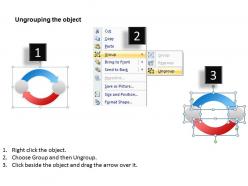
Easy to edit slides with easy to understand instructions.
-
Top Quality presentations that are easily editable.