Go to market strategy powerpoint presentation templates
Try Before you Buy Download Free Sample Product
Audience
Editable
of Time
Figure out how to build a firm financial base with our Go To Market Strategy Powerpoint Presentation Templates. It helps address economic challenges.
People who downloaded this PowerPoint presentation also viewed the following :
Content of this Powerpoint Presentation
Go-to-market (GTM) is a definite strategy or means by which any company popularizes its product using a launching team, product price, value proposition, tactics, etc. It's a technique that yields beneficial results and requires essential teamwork and strategic implementation.
Consider Uber, for instance. Its founders noticed an opportunity in the transportation industry where it could insert an effective means of offering rides using smartphones. Their research led them to target cities that often lacked proper taxi services in terms of reliability or efficiency and thus establish an indispensable taxi service that stretches beyond commuting today.
Uber's triumph is credited to the sound execution of an elaborate go-to-market strategy preparation focusing on technological evolution, buyer-centricity, and expandability. Subsequently, their success resulted from consumer-oriented decisions, established their fit in the market, and emphasized the consumer's voice in all stages as they expanded.
Similarly, you too can identify a business opportunity to anchor onto and implement a tactical Go-to-market strategy to get results. Our presentation template will assist you in creating that strategy and presenting it to your team so they understand their roles and responsibilities.
Use our Product Launch KPIs template to measure the success of go-to-market strategies.
Template: Go-To-Market Strategy

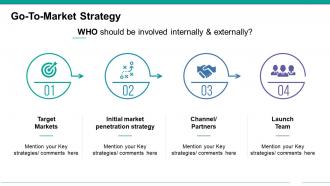
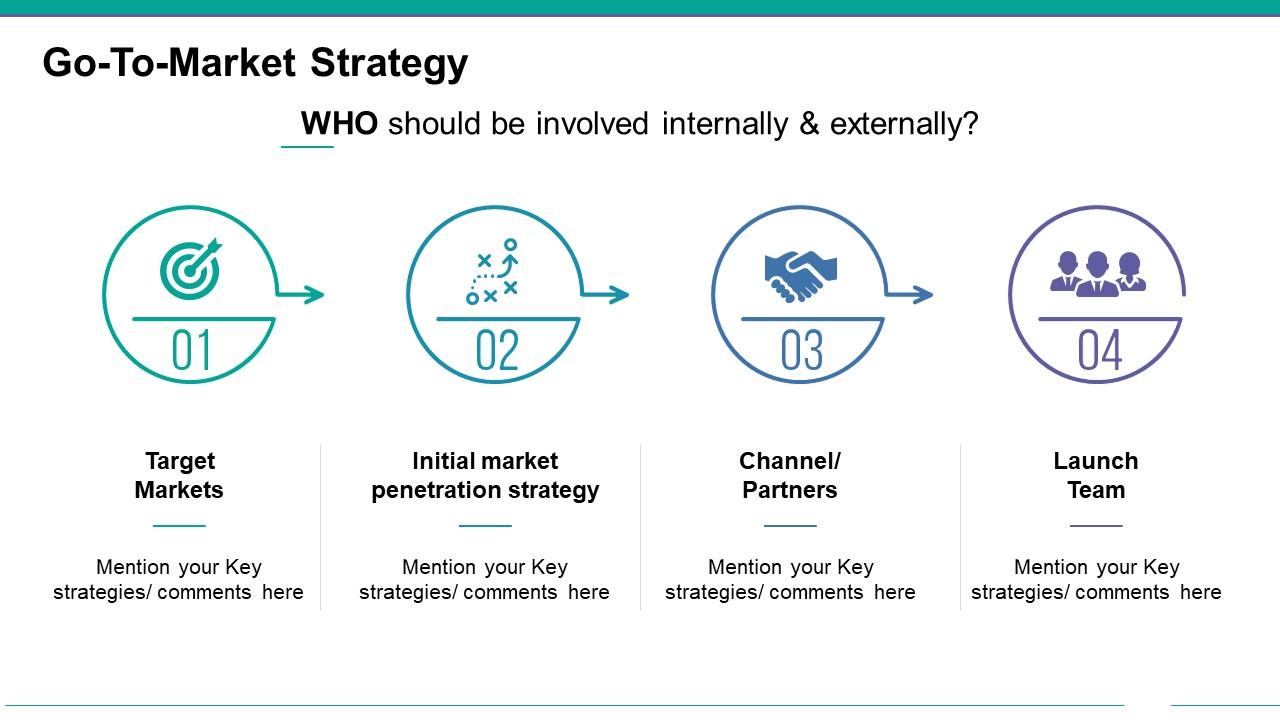
A go-to-market strategy is an action plan that specifies how a company fulfills the demands of the target customer, helping it achieve competitive advantages. In this PPT Layout, you'll get the structure in which you can put your marketing plan to explain it to your team. This PPT Template provides a chart to bifurcate the target markets, market penetration strategy, channel/partners, and launch team. With this presentation design, you can strategically plan how to sell your products and services in the market.
CONCLUSION
A step-by-step plan for the proper launch of a new product is necessary for expanding the product's market, which our PPT Slide can guide you with. A dynamic marketplace especially requires staying flexible and adaptive, which calls for continuous evaluation and adaptation of the Go-To-Market (GTM) strategy. Our expert-designed PPT templates will take care of this aspect for you by helping you increase product sales and profits, promote the brand, and enhance customer fidelity. You'd quickly achieve business goals and gain a competitive advantage with the expert presentation service provider by your side.
Go to market strategy powerpoint presentation templates with all 5 slides:
Get the group to act cohesively with our Go To Market Strategy Powerpoint Presentation Templates. Identify common aspirations they have.
FAQs for Go to market strategy
You need four main things: who you're selling to, how you're different from competitors, your pricing, and where you'll sell it. Most people totally skip figuring out their audience first - huge mistake. Also map out your messaging so it actually connects with your market, plus have a launch plan with real goals you can track. Oh, and don't forget the sales process and marketing tactics. Seriously though, start with nailing down your ideal customer. Everything else gets way easier once you've got that locked down, and you won't be spinning your wheels later wondering why nothing's working.
Honestly, ditch the "everyone needs this" mindset right away - that's marketing suicide. Instead, get crazy specific about your actual customers. Look at the few you have and find patterns: what jobs do they have? Company size? What keeps them up at night? Create detailed personas, then go validate by talking to real people. Survey them, creep their LinkedIn (we all do it), join their groups. I know it sounds backwards, but going super niche first makes everything easier. You'll own that small space before expanding. Way better than drowning in a massive market where nobody notices you exist.
Honestly, market research is everything. Skip it and you're basically throwing darts blindfolded. It shows you who your actual customers are, how they shop, what words get them to buy. Plus pricing, which channels to focus on - all that stuff flows from understanding your market first. Customer interviews are gold, even if they're awkward at first. I can't tell you how many startups I've watched burn through cash on Facebook ads or whatever because they never figured out where their people actually hang out. Do competitive analysis too before you launch anything. Trust me on this one.
Honestly, start by really digging into what your competitors suck at - don't just assume you know. Then figure out what actually sets you apart (and no, "better quality" doesn't count since literally everyone says that). Most people skip the research phase which is dumb. What specific value do you bring that they can't match? Could be your pricing, how you handle customers, or some feature they don't have. Once you've nailed down that difference, make sure it shows up everywhere - your website, sales stuff, all of it. Consistency matters here.
Focus on the basics first - CAC, conversion rates, and lifetime value. MRR growth is obviously huge too. Time to first value tells you if people actually get your product quickly. Here's the thing though - metrics can become a total rabbit hole. I've seen founders obsess over dashboards instead of talking to customers. Track maybe 6-7 core ones that match your business model. Don't ignore the softer stuff either. Brand awareness and customer satisfaction scores matter, even if they're harder to measure. The real win is connecting early signals (like quality traffic) to revenue down the line. Review weekly, not daily.
Dude, partnerships are seriously clutch for launches. You basically get instant access to their customers and built-in trust. Think co-marketing with businesses that complement yours, or getting retail stores to feature your stuff. Influencers work great too if their followers actually match your target market. I'd probably start with fitness apps partnering with gyms - that just makes sense, right? The trick is making sure both sides win something real from it, otherwise people lose interest super quick. Make a list of like 10 potential partners and pitch them something concrete they'd actually want.
Honestly, most people rush to launch without knowing who they're actually selling to. Don't try being everything to everyone - that's a fast track to nowhere. Sales cycles? Yeah, they're gonna be way longer than you expect, especially B2B stuff. Oh and here's something that drives me crazy - when marketing and sales teams aren't saying the same thing to prospects. Total mess. Competitive research gets half-assed too often. My take? Pick one tiny segment first. Get that messaging tight, win some deals, then think about expanding. Way easier than trying to boil the ocean from day one.
Look at what competitors charge first, then figure out your costs and what customers will actually pay. Most people way overthink pricing and just freeze up - don't be that person. Are you positioning as premium, middle of the road, or budget? Once you know that, pick a price you can defend. You can always test different amounts through small launches before rolling out everywhere. Go aggressive if you want market share fast, or price high if you've got something nobody else has. Honestly though? Just pick something reasonable based on your research and adjust when real customers start giving you feedback.
Honestly, digital marketing is a game-changer for your go-to-market plan. You can target exactly who you want through SEO, paid ads, social media - no more throwing money at random billboards hoping someone cares. Real-time data is where it gets fun though. You'll see what's working instantly and can pivot fast when something tanks. I'm weirdly obsessed with watching conversion metrics update throughout the day. Test different messages, tweak campaigns based on actual user behavior. My advice? Pick one or two channels first, see what converts, then scale from there.
Honestly, I'd start by diving deep into each market's regulations and what locals actually want - don't just assume your domestic strategy will work everywhere. We made that mistake early on! Survey potential customers or run focus groups to test if your value prop even makes sense there. The marketing channels that crush it here might be totally useless in Germany or Japan. Partner with local distributors if you can, or hire someone who gets the cultural nuances. Oh, and budget way more time and money than you think - international stuff always takes longer. Test small batches first, then scale whatever's actually working.
Honestly, just stick to three big things and you'll be fine. Don't lie about what your product actually does - overselling always bites you in the ass later. Your pricing shouldn't screw over people who can't afford it or put up weird barriers. Data stuff is huge right now too, so be upfront about what you're collecting and why. I mean, with all these privacy laws popping up everywhere, transparency isn't just nice - it's basically required. Simple test: would you be cool with someone using your exact strategy on you?
Stories should be everywhere in your go-to-market, not just slapped on ads. Start with why you even built this - what problem actually kept you awake at 3am? Then grab customer stories showing real transformation. Yeah, cost savings are nice, but I want the human stuff. Before/after narratives hit different, honestly. Put these stories in sales decks, demos, your website - basically everywhere. The trick is making people see themselves in it. Oh, and test one customer story across three channels this week. You'll be surprised which one lands best.
Honestly, start simple and pick one tool per area. Google Analytics is solid for tracking website stuff, and HubSpot's great for leads. Salesforce handles sales tracking well, though Pipedrive's easier if you're just starting out. User behavior is where Mixpanel really shines - I spend way too much time in those dashboards sometimes. Don't sleep on feedback tools like Intercom either. The temptation is to grab everything at once, but trust me, you'll just overwhelm yourself. Pick your biggest pain point first and build from there.
Dude, customer feedback is pure gold for your GTM strategy. Most people just ignore it though, which is crazy. Your strategy might look amazing on paper, but if customers aren't biting, you gotta change course fast. They'll tell you if your messaging sucks, which channels actually work, and what you think you're selling vs. what they're actually getting. I've watched teams burn through months on strategies that sounded brilliant internally but completely flopped with real users. Get those feedback loops going early and actually listen - trust me, it'll save you tons of time and money down the road.
Dude, sales training can make or break your whole go-to-market thing. Your reps need to really get your value prop and know exactly who they're targeting - otherwise they'll just be winging it with prospects. I've watched companies crush their messaging but then their sales team has no clue how to actually sell it. Pretty frustrating honestly. Without good training, they can't qualify leads properly or handle pushback when it comes up. Make sure they understand the competitive landscape too. Oh and keep updating their training based on what you're hearing from actual customers - that feedback is gold.
-
Unique design & color.
-
Good research work and creative work done on every template.