Goodwill valuations ppt powerpoint presentation file background image cpb

Goodwill valuations ppt powerpoint presentation file background image cpb
Slide 1 of 5
Favourites Favourites

Try Before you Buy Download Free Sample Product

Audience Impress Your
Audience
Editable 100%
Editable
Time Save Hours
of Time
The Biggest Sale is ending soon in
0
0
:
0
0
:
0
0
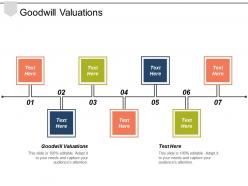
Presenting this set of slides with name - Goodwill Valuations Ppt Powerpoint Presentation File Background Image Cpb. This is an editable seven stages graphic that deals with topics like Goodwill Valuations to help convey your message better graphically. This product is a premium product available for immediate download, and is 100 percent editable in Powerpoint. Download this now and use it in your presentations to impress your audience.

People who downloaded this PowerPoint presentation also viewed the following :

Content of this Powerpoint Presentation

Description:

The image displays a PowerPoint slide titled "Goodwill Valuations," which is typically used to present the process or steps involved in valuing goodwill in a business context. Goodwill is an intangible asset that arises when a company acquires another for more than the fair value of its net assets. The slide features seven boxes with "Text Here" placeholders, numbered from 01 to 07, indicating the sequence of steps or key points in the valuation process. Each box is a different color, which can help to distinguish between the stages or topics.

The timeline format with connecting lines suggests a progression or workflow, possibly outlining the methodology or considerations taken during the valuation of goodwill. The note at the bottom reiterates that the slide is fully customizable, allowing users to adapt the content to specific needs and to engage the audience effectively.

Use Cases:

This slide can be used in various industries to explain complex processes or methodologies, such as valuation, audit, or strategic planning:

1. Finance:

Use: Explaining the valuation of intangible assets.

Presenter: Financial Analyst.

Audience: Investors, company executives.

2. Accounting:

Use: Teaching about goodwill in mergers and acquisitions.

Presenter: Accounting Instructor.

Audience: Accounting students, professionals.

3. Consulting:

Use: Advising on business valuations during consulting projects.

Presenter: Management Consultant.

Audience: Business owners, corporate clients.

4. Legal:

Use: Outlining legal considerations in business transactions.

Presenter: Corporate Lawyer.

Audience: Clients, legal students.

5. Education:

Use: Academic presentations on business valuation models.

Presenter: Professor.

Audience: Business students, academic peers.

6. Technology:

Use: Demonstrating the valuation of tech startups.

Presenter: Venture Capitalist.

Audience: Entrepreneurs, tech professionals.

7. Real Estate:

Use: Valuing property management companies.

Presenter: Real Estate Appraiser.

Audience: Property investors, real estate agents.

FAQs for Goodwill valuations ppt powerpoint presentation file

Common goodwill valuation methodologies in M&A include the purchase price allocation method, discounted cash flow analysis, market-based comparables, relief-from-royalty approaches, and excess earnings methods. These approaches work together by isolating identifiable assets, calculating future cash flows, and benchmarking against industry transactions, with many investment banks finding that combining multiple methodologies delivers more accurate valuations and reduces acquisition risk.

Economic conditions significantly influence goodwill valuations through interest rates, market volatility, credit availability, and industry-specific performance metrics. During economic uncertainty, acquirers often apply higher discount rates and more conservative projections, while favorable conditions enable premium valuations, with many investment firms finding that strategic timing ultimately delivers enhanced acquisition value and competitive positioning.

Brand strength significantly influences goodwill valuation by determining customer loyalty, market positioning, pricing power, and competitive differentiation capabilities. Strong brands like Apple or Coca-Cola command premium valuations because they generate sustainable revenue streams, reduce customer acquisition costs, and create market barriers, with many acquirers finding that established brand equity justifies higher purchase price multiples.

Accountants differentiate by recognizing that purchased goodwill appears on balance sheets when companies acquire other businesses at prices exceeding tangible net assets, while inherent goodwill represents internally developed value like brand reputation, customer loyalty, and operational expertise that cannot be recorded under accounting standards. This distinction ensures financial transparency, with purchased goodwill requiring annual impairment testing and inherent goodwill remaining unrecognized until monetized through acquisition transactions.

Private companies present greater goodwill valuation challenges through limited market data, less standardized reporting, restricted access to financial information, and fewer comparable transactions for benchmarking purposes. While public companies benefit from market-based valuations and regulatory transparency, private entities require more subjective approaches like discounted cash flows and industry multiples, with many valuation professionals finding that private company assessments demand significantly more judgment and specialized expertise.

Businesses must assess goodwill for impairment annually, with additional testing required when triggering events occur, such as significant market changes, declining performance, or strategic shifts. Many organizations integrate these assessments into quarterly financial reviews, enabling faster identification of impairment indicators and more accurate financial reporting, ultimately delivering enhanced transparency and stronger stakeholder confidence.

Financial performance significantly impacts goodwill valuation through revenue growth, profitability margins, cash flow generation, and overall business sustainability metrics. Strong financial performance in sectors like technology, healthcare, and retail enhances goodwill values by demonstrating the acquired intangible assets' ability to generate future economic benefits, ultimately delivering higher acquisition premiums and strategic competitive advantages.

Intangible assets significantly influence goodwill calculations by reducing the excess purchase price allocated to goodwill, as identifiable intangibles like patents, customer relationships, and brand value must be separately recognized and valued. During acquisitions, companies systematically identify and measure these assets using income, market, or cost approaches, with any remaining purchase price premium becoming goodwill, ultimately delivering more accurate financial reporting and strategic asset management.

IFRS and GAAP present both convergent and divergent approaches to goodwill accounting, with IFRS requiring annual impairment testing while GAAP allows optional qualitative assessments for private companies and annual testing for public entities. These frameworks significantly influence valuation methodologies, financial reporting transparency, and strategic decision-making, with many multinational corporations finding that navigating both standards enhances global compliance while streamlining acquisition strategies.

Customer relationship changes significantly impact goodwill valuation through customer retention rates, satisfaction scores, brand loyalty metrics, and market positioning strength. These factors directly influence future cash flows and competitive advantages, with many organizations finding that deteriorating customer relationships, lost contracts, or reduced market share can substantially decrease goodwill values during impairment testing.

Competitive landscape significantly affects goodwill valuation by influencing intangible asset premiums, market positioning strength, and future earnings potential through brand recognition and customer loyalty assessments. Companies operating in highly competitive sectors like retail or technology often see goodwill adjustments based on market share sustainability, with valuators increasingly incorporating competitive moats and differentiation factors into their assessments.

Analyzing goodwill in rapidly evolving technological industries requires evaluating customer retention rates, brand adaptability, intellectual property portfolios, competitive positioning, and the sustainability of technological advantages. Financial institutions and tech companies increasingly focus on workforce expertise, innovation pipelines, and strategic partnerships, with many finding that traditional valuation metrics must be adjusted to reflect accelerated obsolescence risks and shorter competitive cycles.

Tax regulations significantly influence goodwill valuation by establishing deductibility rules, amortization schedules, and impairment recognition criteria that directly impact financial reporting and tax liability calculations. These regulations create strategic considerations for organizations, with many companies finding that proper alignment between book and tax treatments enables enhanced cash flow management, optimized tax planning strategies, and ultimately delivers competitive advantages through improved resource allocation.

Common goodwill valuation pitfalls include inadequate documentation, overestimating synergies, ignoring market volatility, relying on outdated comparable transactions, and underestimating integration risks. These oversights can significantly impact acquisition outcomes, with many organizations finding that thorough due diligence, realistic synergy assessments, and comprehensive market analysis ultimately deliver more accurate valuations and better strategic decisions.

Goodwill valuation in distressed situations requires specialized approaches including discounted cash flow analysis with distressed multiples, liquidation value assessments, and market-based comparisons from similar distressed transactions. Bankruptcy courts and creditors increasingly rely on independent valuations that factor in operational disruptions, customer attrition, and fire-sale conditions, ultimately delivering more realistic asset recovery projections for stakeholders.

Ratings and Reviews

0% of 100
Write a review
Most Relevant Reviews

No Reviews