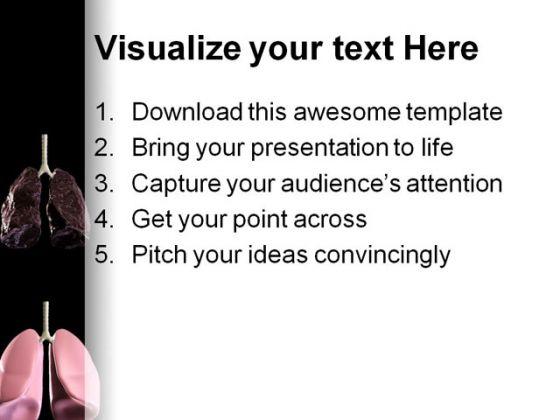
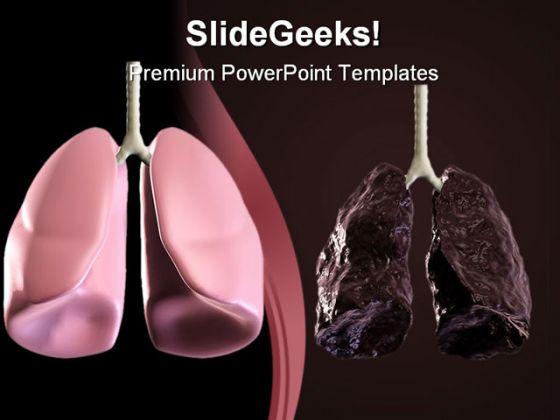
Healthy and bad lung medical powerpoint backgrounds and templates 1210
Try Before you Buy Download Free Sample Product
Audience
Editable
of Time
Confront their fears with our Healthy And Bad Lung Medical PowerPoint Backgrounds And Templates 1210. Erase all the anxiety in the minds of your team.
People who downloaded this PowerPoint presentation also viewed the following :
Healthy and bad lung medical powerpoint backgrounds and templates 1210 with all 3 slides:
Experience excellence with our Healthy And Bad Lung Medical PowerPoint Backgrounds And Templates 1210. They will take your breath away.
FAQs for Healthy and bad lung medical powerpoint backgrounds
Key indicators of healthy lung function include normal oxygen saturation levels (95-100%), optimal lung capacity measurements, clear chest X-ray imaging, efficient gas exchange rates, and proper respiratory patterns. These metrics enable healthcare professionals to assess patient wellness, track treatment progress, and communicate diagnostic findings effectively, with many medical institutions finding that visual presentations enhance patient understanding and clinical outcomes.
Visuals enhance understanding of lung diseases by providing clear anatomical comparisons, illustrating disease progression stages, and showcasing diagnostic imaging like X-rays and CT scans. Through detailed cross-sections, color-coded pathology markers, and before-and-after treatment scenarios, medical professionals can effectively communicate complex respiratory conditions to patients and colleagues, ultimately improving diagnosis accuracy and treatment compliance.
**INPUT**: What types of diagrams are most effective for illustrating the anatomy of the lungs? **OUTPUT**: Effective lung anatomy diagrams include cross-sectional views, bronchial tree illustrations, alveolar detail maps, comparative healthy versus diseased presentations, and layered anatomical breakdowns. These visual approaches streamline medical education by highlighting structural relationships, demonstrating airflow patterns, and showcasing pathological changes, with healthcare institutions finding that multi-perspective presentations enhance patient understanding and clinical communication.
Infographics can effectively illustrate smoking's impact on lung health by combining visual comparisons of healthy versus diseased lungs, statistical data on disease progression, and timeline representations of damage development. These visual tools enable healthcare professionals, educators, and organizations to communicate complex medical information through clear diagrams, color-coded severity scales, and compelling data visualizations, ultimately delivering more impactful patient education and smoking cessation messaging.
A slide discussing common lung diseases should include disease names with brief definitions, key symptoms and risk factors, visual comparisons between healthy and diseased lung tissue, and prevalence statistics. These elements enhance understanding by providing comprehensive context, clear visual differentiation, and relevant data, with many medical professionals finding that combining clinical information with compelling visuals delivers better patient education and improved health outcomes.
An effective PowerPoint template conveys lung health prevention through clear visual contrasts between healthy and damaged lungs, infographics highlighting key preventative actions like smoking cessation and air quality management, and step-by-step lifestyle recommendations. These design elements enhance audience understanding by combining medical accuracy with accessible visuals, ultimately delivering educational content that motivates behavioral change and promotes proactive health management across diverse healthcare settings.
Green and blue color schemes effectively represent healthy lungs, symbolizing vitality, oxygen, and wellness, while red, orange, and dark gray palettes convey unhealthy conditions like inflammation, infection, and disease. These contrasting approaches enable medical professionals to create clear visual distinctions in presentations, with many healthcare institutions finding that strategic color coding enhances patient comprehension and educational outcomes.
Animations enhance lung function presentations by visualizing airflow patterns, oxygen exchange mechanisms, and respiratory cycles through dynamic movement and sequencing. These visual demonstrations help audiences grasp complex physiological processes like alveolar gas exchange and bronchial dilation, with medical educators and healthcare professionals finding that animated sequences significantly improve patient understanding and clinical training effectiveness.
A slide on lung capacity and ventilation measurements should include tidal volume, vital capacity, functional residual capacity, forced expiratory volume, and peak flow rates, along with normal reference ranges and clinical significance indicators. These measurements enable healthcare professionals to assess respiratory function, diagnose conditions like asthma or COPD, and monitor treatment progress, ultimately delivering more precise patient care and improved clinical outcomes.
Data visualization tools can be integrated into PowerPoint templates through embedded charts, interactive dashboards, real-world case studies, and dynamic infographics that transform complex lung health statistics into compelling visual narratives. These integrations enable healthcare professionals, researchers, and public health organizations to streamline patient education, enhance diagnostic presentations, and deliver more impactful health awareness campaigns, ultimately improving communication outcomes and patient understanding.
Creating lung disease presentations requires balancing medical accuracy with patient sensitivity, ensuring data privacy compliance, avoiding stigmatization of smoking-related conditions, and presenting information accessibly without causing undue alarm. These presentations should emphasize hope alongside medical realities, include diverse patient perspectives, and focus on prevention and treatment options, with healthcare professionals finding that ethical approaches ultimately enhance patient trust, engagement, and treatment outcomes.
Case studies within lung health PowerPoint templates are most effective when structured with clear patient background, diagnostic imaging comparisons, treatment progression timelines, and measurable outcomes. These presentations work best through visual storytelling that combines X-rays or CT scans with concise clinical narratives, enabling medical professionals to demonstrate treatment efficacy while enhancing educational impact for colleagues and patients alike.
Lung transplant presentation templates should include patient evaluation criteria, surgical procedure details, post-operative care protocols, immunosuppression management, and long-term outcome tracking sections. These comprehensive modules enable medical teams to streamline complex transplant workflows, enhance patient education processes, and improve clinical outcomes, with many transplant centers finding that structured presentation frameworks ultimately deliver more consistent patient care and better surgical success rates.
Templates can be tailored by adjusting complexity levels, terminology, and visual emphasis to match audience expertise and needs. For medical professionals, presentations include detailed anatomical diagrams, clinical data, and technical terminology, while patient-focused templates emphasize simplified visuals, everyday language, and actionable health guidance, ultimately enhancing communication effectiveness across healthcare settings.
Videos significantly enhance lung pathology presentations by providing dynamic visualizations of breathing mechanics, disease progression, and treatment outcomes that static images cannot convey. Through animated respiratory cycles and real-time diagnostic footage, medical professionals can demonstrate complex pathological processes like COPD progression or pneumonia development, ultimately delivering more comprehensive patient education and improved clinical understanding across healthcare institutions.
-
Excellent Designs.
-
Amazing product with appealing content and design.