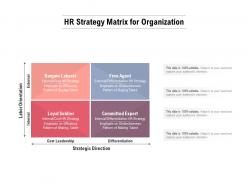
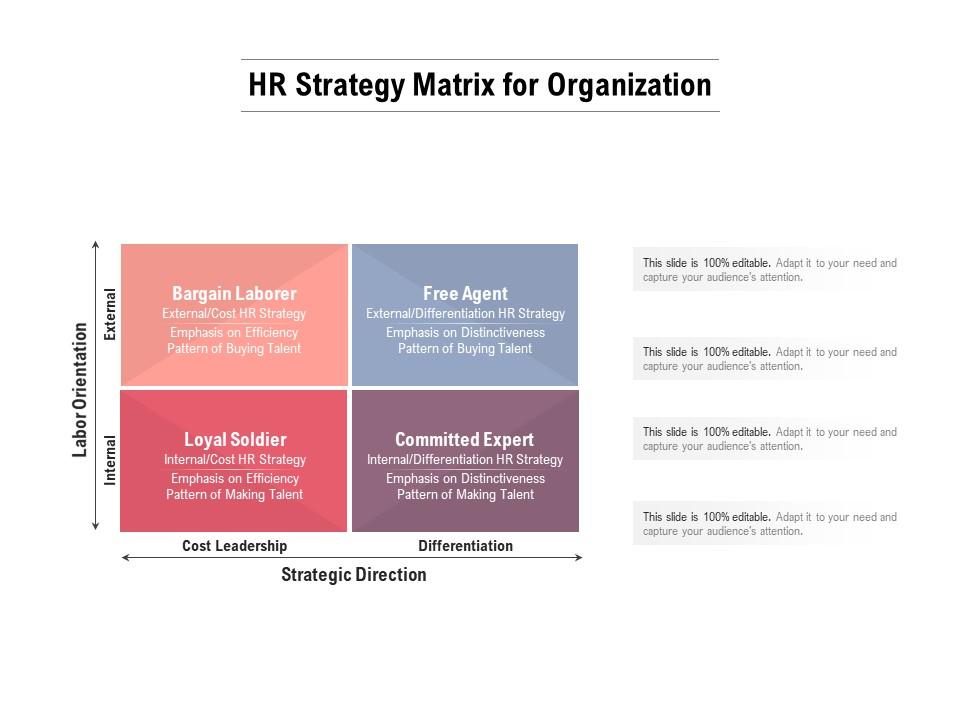
Hr strategy matrix for organization
Try Before you Buy Download Free Sample Product
Audience
Editable
of Time
Fulfillment happens with our HR Strategy Matrix For Organization. You will feel greatly enriched.
People who downloaded this PowerPoint presentation also viewed the following :
Hr strategy matrix for organization with all 5 slides:
Our HR Strategy Matrix For Organization cause it to happen. You will acquire a grand flourish.
FAQs for Hr strategy
So the HR Strategy Matrix is this 2x2 grid where you plot employees based on how valuable they are strategically and whether their skills are rare. Pretty smart actually - instead of treating everyone the same, you get four different buckets that need totally different approaches. Your star developers obviously need way more investment than, say, reception staff (no offense to receptionists). Traditional HR is more cookie-cutter across the board. This thing lets you tailor comp, training, everything based on real impact. Honestly worth trying - just map your team and see what jumps out.
Okay so for your HR Strategy Matrix, you definitely need four main pieces. Map your business goals against HR initiatives first - that's your foundation right there. Then add talent gaps so you know what skills you're missing. Resource allocation is huge too (budget, people, time) because honestly, what's the point of a strategy if you can't fund it? Track measurable outcomes for everything. Oh and don't forget to show how your HR programs connect to each other - some depend on others to work. I'd start simple with a 2x2 grid. You can always make it fancier later once you see what works.
So basically you map your current HR stuff against what your business actually needs - super eye-opening honestly! Plot your talent management, pay structures, all that against real strategic goals. You'll probably find (like I did) that we do so much out of habit rather than purpose. Start with the high-impact areas first. Recruitment's usually a big one, plus performance management and leadership development. The whole point is spotting where things don't align and figuring out what needs fixing vs complete do-overs. Run through this with your leadership team every quarter or so. Keeps everyone on the same page instead of just winging it.
Think of employee engagement as your HR reality check - it shows whether all your other strategies are actually hitting the mark. Track those scores regularly because they'll point you toward what's broken and what's working. High engagement? Your talent stuff is probably on track. Low scores mean something's off and you need to change direction fast. Honestly, most companies just throw these metrics into some dashboard and forget about them, which is totally pointless. Use the data to shuffle your priorities around - that's where the real value lives. It's basically your canary in the coal mine for HR strategy.
So this HR Strategy Matrix thing is actually pretty useful - you basically plot your talent stuff on a grid showing impact vs effort. Works great for succession planning, recruiting, all that. Leadership loves the visual aspect too, which honestly surprised me at first. Instead of just randomly throwing money at programs, you can see which workforce investments will actually help hit your goals vs the fluff that sounds nice but doesn't do much. I'd map out your biggest talent headaches and see where they fall. Makes those workforce planning meetings way more productive.
Match your metrics to whatever quadrant you're tackling. High-impact urgent stuff? Track retention rates, time-to-hire, engagement scores - you'll get quick feedback on what's actually moving the needle. Honestly, too many people get obsessed with numbers that look good but don't mean much. Strategic long-term initiatives need different tracking: leadership pipeline strength, skill gaps, internal mobility rates. Cost-per-hire and training ROI matter across everything though. Oh, and don't overwhelm yourself - pick maybe 3-4 solid metrics per quadrant first. You can always add more once you've got good baseline data coming in consistently.
So the HR Strategy Matrix basically maps your D&I stuff against different employee groups and business goals. No more random diversity programs that may or may not work. You can actually see which groups need help and where your inclusion gaps are biggest. Honestly, the visual layout is kind of a game-changer - I was surprised how much it clarified things. Track progress with real data instead of just guessing what's effective. Start by plotting what you're already doing on the matrix. You'll immediately see if you're wasting money somewhere or completely missing other areas.
Yeah, totally! Small businesses can nail this even better than big companies, honestly. You don't need all the fancy departmental stuff - just map your main people needs against what you're trying to accomplish. Like "hire two developers" or "fix our messy onboarding." Keep it real simple. Try a basic 2x2 grid: urgent vs important on one side, current vs future needs on the other. Throw your top 5-7 HR priorities on there and work through them one by one. The clarity is pretty amazing once you see everything laid out like that. Plus you can change direction fast if something's not working - that's your advantage over the corporate giants.
Honestly, data's gonna be your biggest headache - your systems probably don't sync up, so good luck figuring out who's actually performing well. Manager bias is real too, and leadership might push back on spending money for development stuff. Plus keeping everything current when people switch roles? Ugh. I'd say test it with just one department first. Work through the mess there, then expand once you've got proof it's not a total disaster. Way easier than trying to fix problems across the whole company at once.
Honestly, tech makes this whole HR matrix thing so much easier. Instead of manually tracking everything, you can set up analytics platforms to pull real-time data on performance, engagement, turnover - all that stuff. Dashboards are a game changer because you'll actually see trends as they happen rather than digging through those quarterly reports everyone ignores. AI tools can even predict when you might have talent gaps coming up, which is pretty cool. Don't overthink it though - start with whatever system you've got, even if it's just a decent Excel setup.
Okay so first thing - executives want the big picture stuff while managers need the nitty-gritty details. Don't just throw a bunch of boxes at people (seriously, instant snooze fest). Use actual examples and diagrams that tell a story. Make the sessions interactive so teams can jump in with questions about their specific situations. Oh, and definitely create those simple one-page references they can actually use later. The whole thing falls apart if people can't see how it connects to what they're doing every day. Follow up regularly to check if it's actually working or just collecting dust.
Your HR matrix definitely needs regular updates - remote work skills and AI stuff have totally changed what "high potential" even means. I'd say review it quarterly since things move so fast now. We're basically rebuilding our talent frameworks every few months at this point, which is exhausting but necessary. Adding new dimensions like digital skills gaps or gig worker integration helps too. The trick is making your matrix flexible enough to pivot when the next big thing hits. Five years ago nobody cared about remote collaboration skills, now it's make-or-break for most roles.
So basically, the HR Strategy Matrix helps you get your people stuff actually working together instead of having random policies all over the place. Your compensation, training, performance reviews - when they're all pointing in the same direction, employees actually get how they fit in and where they're headed. Honestly, most companies are just throwing HR practices at the wall and hoping something sticks. This gives you a roadmap to spot where you're sending mixed signals or missing chances to build the culture you want. I'd start by using it to audit what you're already doing - you'll probably find some gaps that explain why people keep leaving.
So Google's probably the best example - they map different hiring strategies to whatever phase they're in (startup mode, scaling, optimizing, etc). Microsoft completely overhauled their performance reviews using this matrix thing, ditching those awful stack rankings. Netflix ties their whole culture matrix directly to how they pay people, which honestly makes total sense. Oh and here's what's smart: all these companies started with just one piece of the matrix first. They didn't go crazy trying to do everything at once. Once they could show it actually worked, then they expanded to the full thing.
Honestly, you've gotta bake this stuff right into your calendar or it'll never happen. I do quarterly deep dives plus monthly check-ins on the big metrics. Track the early warning signs like engagement scores AND the after-the-fact stuff like retention rates. Here's what most people miss though - your frontline managers see problems way before HR does. They're in the trenches daily, so actually listen to them. Oh, and don't fall in love with your original plan. Business changes, your strategy should too. Set up some basic dashboard to watch your numbers, but here's the kicker - you've gotta actually USE that data to pivot, not just stare at pretty charts.
No Reviews