HR Talent Management Key Metrics Dashboard Bi For Human Resource Management
Try Before you Buy Download Free Sample Product
Audience
Editable
of Time
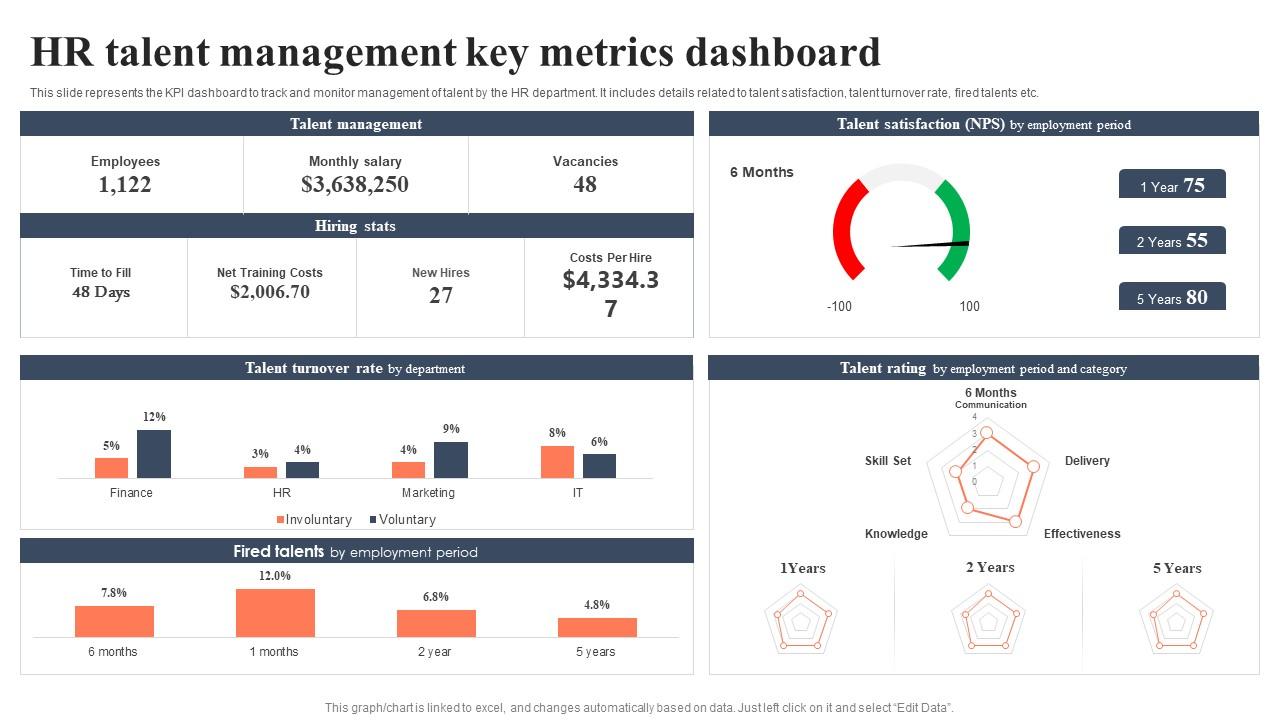
This slide represents the KPI dashboard to track and monitor management of talent by the HR department. It includes details related to talent satisfaction, talent turnover rate, fired talents etc.
People who downloaded this PowerPoint presentation also viewed the following :
HR Talent Management Key Metrics Dashboard Bi For Human Resource Management with all 7 slides:
Use our HR Talent Management Key Metrics Dashboard Bi For Human Resource Management to effectively help you save your valuable time. They are readymade to fit into any presentation structure.
FAQs for HR Talent Management Key Metrics Dashboard Bi For
Oh man, there's a bunch but don't try to track everything at once. Start with turnover rate and time-to-fill - those are your bread and butter. Employee engagement scores matter too, but honestly the C-suite will ask about cost-per-hire before anything else, so have that ready. Internal promotion rates are solid for showing you're developing people. I'd also watch retention specifically for your top performers since losing them is brutal. Performance ratings and training ROI are good additions once you get the basics down. Seriously though, pick like 3-4 to start or you'll drown in data.
Track both the numbers and the feels, you know? Monthly pulse surveys work great for job satisfaction and manager stuff, but don't spam people with them. Also watch your retention rates and how many people actually get promoted internally. Honestly, the best intel comes from regular one-on-ones where managers aren't just going through the motions. Participation in mentoring programs tells you a lot too. Here's the thing though - collecting data is pointless if you're not gonna act on it. Make changes based on what you're hearing and tell people what you're doing about their feedback.
So predictive analytics helps you figure out which candidates will actually work out before you hire them. Instead of just crossing your fingers and hoping, you can look at what made your best employees successful - their backgrounds, how they interviewed, even weird stuff like how they filled out applications. Honestly, the ROI on this is insane when you think about how much bad hires cost. You'll want to start tracking patterns in your top performers first. Then score new candidates against that data. It's way better than gut feelings, and your hiring quality will definitely improve once you get the hang of it.
Okay so basically divide employees who stayed by your total headcount over whatever timeframe you're looking at. Then break it down by department, role level, all that stuff to see where the patterns are. Definitely track voluntary vs involuntary turnover separately - voluntary is what you actually need to worry about. Exit interviews help you figure out the "why" behind people leaving. Oh and here's something most people miss - calculate retention for your top performers specifically because honestly, losing them stings way more than average employees. Use all this to spot which managers or teams are bleeding people, then you can target fixes like better onboarding or career development.
Track internal promotion rates first - that's your golden metric right there. Also grab retention data comparing people who did development programs vs those who didn't. Skill assessments before/after training work well too. Employee engagement scores for participants are solid, though honestly I sometimes wonder how accurate those surveys really are. Performance ratings can show direct job impact. Time-to-competency is useful but kinda hard to measure consistently across different roles. Start with promotions and retention since they're easiest to pull from HR and leadership loves seeing that ROI.
So here's the thing - D&I metrics actually make your talent game way stronger. You're casting a wider net for candidates and keeping people around longer when they feel included. Track stuff like diverse hiring, pay gaps, and those inclusion surveys to see if you're really pulling talent from everywhere (not just the same old networks). Honestly, diverse teams just crush it compared to homogeneous ones when it comes to solving problems. The trick is connecting your D&I numbers to real business stuff like engagement scores and turnover. That way you can prove to the higher-ups that inclusive practices aren't just nice to have - they actually deliver better talent results.
Track quality of hire first - like, are your LinkedIn people actually outperforming the job board crowd? Time-to-fill matters too since some sources are way faster. Cost-per-hire is honestly where I'd focus most of my energy because budgets are tight everywhere. Retention by source tells you everything though - Indeed candidates bailing after 6 months? That's your answer right there. Conversion rates through each stage help too. Just throw it all in a basic spreadsheet and check monthly. You'll start seeing which sources are actually worth your time pretty quickly.
Look, investing in good talent management actually saves you serious money - like thousands per employee. I've seen turnover drop 20-40% with decent onboarding and career development stuff. Replacement costs are insane though, usually 50-200% of someone's salary. The initial investment feels brutal, but honestly? The math works out pretty quick. You should probably track your voluntary turnover and cost-per-hire every quarter, then compare that against what you're spending on talent programs. That's really the only way to know if this stuff is actually working for you.
Okay so performance metrics are basically your GPS for talent development - they tell you where everyone actually stands vs where they need to go. Track stuff like goal completion, skill growth, feedback quality. That way you can spot who's ready for bigger challenges or who needs extra help. Without this data you're literally just winging it, which seems crazy when you're dropping real money on development programs. Use what you learn to build personalized plans instead of generic training that nobody cares about. Honestly just pick 2-3 metrics that actually move the needle for your team.
Honestly, start with SHRM or Deloitte's annual reports - they break down turnover rates and engagement scores by industry size. LinkedIn Talent Insights has decent data too, though you'll need to hunt around a bit. HR conferences are where people actually spill the real numbers, which is way more helpful than sanitized reports. Just make sure you're not comparing a tech startup to like, a manufacturing plant - totally different beasts. Focus on maybe 3-5 metrics that actually matter to your situation and track those consistently. The key is finding companies that look similar to yours, not just grabbing random benchmarks.
Look, succession planning metrics basically show if your company can handle losing key people without falling apart. Track stuff like how deep your leadership pipeline is and how fast you fill important roles. Companies that nail this see way better revenue growth - like 2.3x better, which is crazy good. You'll spot talent gaps early instead of panicking when someone quits. Honestly, most places are terrible at this. Start by figuring out which critical roles don't have backup people ready to step in. Time-to-fill data is gold too.
Honestly, start simple - just pick 2-3 things to measure like engagement and how people feel about their managers. Don't go crazy with surveys or people will ignore them. The biggest mistake I see? Companies collect feedback then do nothing with it, which pisses everyone off. Actually tell people what you're changing based on their input. Track how your feedback scores connect to who's staying vs. leaving - that's where you'll see if it's working. Oh, and train your managers to actually use the feedback they get. That's honestly more important than the surveys themselves.
So talent metrics are basically your cheat sheet for not making terrible hiring decisions. Track stuff like how long positions stay open, which departments are bleeding people, and what skills you're missing. The magic happens when you notice patterns - like realizing all your star employees share certain traits that you can screen for. Honestly, most companies overthink this part. Pick maybe 3-4 metrics that actually matter to your business goals and just stick with them. You'll start seeing where to focus training budgets and which roles desperately need backup plans.
Check out BambooHR or Workday first - they'll automatically track your turnover and hiring metrics without you doing much work. If you need fancier visuals, Tableau makes dashboards that honestly look way more impressive than they should in meetings. For recruiting stuff, Greenhouse is solid. Culture Amp handles the employee satisfaction surveys pretty well too. But real talk? Don't go crazy buying new software right away. Start with whatever system you're already using and see what data you can actually pull from it first. You might be surprised what's already there.
Honestly, talent mobility is a game changer for keeping people around. Companies with good internal movement programs usually see retention jump 20-30%. Makes sense though - nobody wants to feel stuck in their role forever. Skills development happens way faster too when people get diverse experiences across different teams or departments. I've watched this play out at a few places I've worked, and the difference is pretty obvious. You just gotta track it properly - not just how many people move around, but whether those moves actually help performance. Otherwise you're just shuffling people for no reason.
-
The PPT layout is great and it has an effective design that helps in presenting corporate presentations. It's easy to edit and the stunning visuals make it an absolute steal!Â
-
Thank you for offering such fantastic custom design services. The team is really helpful and innovative. In a very short time, I received my personalized template.