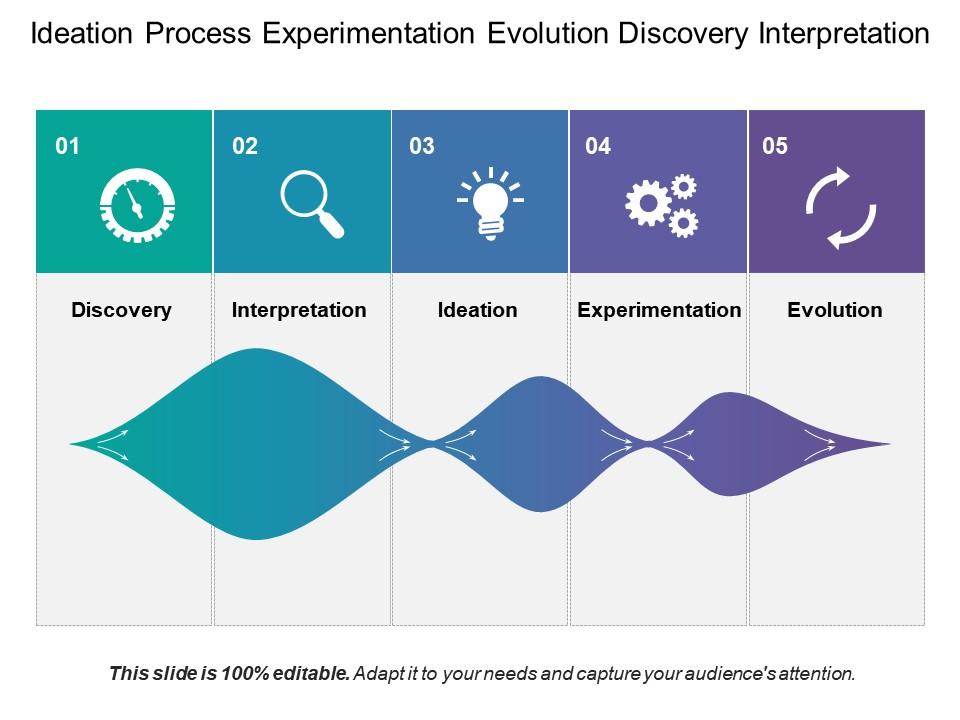
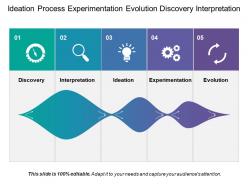
Ideation process experimentation evolution discovery interpretation
Try Before you Buy Download Free Sample Product
Audience
Editable
of Time
Introducing our ideation process experimentation evolution discovery interpretation PPT template to help you generate ideas and solutions through various sessions, including sketching, prototyping, brainstorming, brainwriting, and more. This innovation process PPT slideshow promotes the generation of multiple ideas that your team can filter and cut down to the best, most innovative ones to inspire fresh and better design solutions and products. SlideTeam has designed this ideation principle PPT theme to promote initiatives to challenge set assumptions, think outside the box, and explore uncharted territories. This PPT serves as a conventional step between comprehending your users’ problems and coming up with solutions. If implemented properly, our ideation process steps PPT layout will help you stumble upon unprecedented solutions that your team has been missing. Grab this PPT and make it your own. It is a deal far too good to lose. Get our ideation process experimentation PPT set. Download it now.
People who downloaded this PowerPoint presentation also viewed the following :
Ideation process experimentation evolution discovery interpretation with all 5 slides:
Give folks the freedom to flourish with our Ideation Process Experimentation Evolution Discovery Interpretation. They create a haven of excellence.
FAQs for Ideation process experimentation
Key steps in the ideation process include defining your core message, understanding audience needs, brainstorming supporting concepts, organizing content hierarchically, and selecting compelling visual metaphors. Through strategic ideation, presenters streamline complex information, enhance audience engagement, and deliver memorable experiences, with many organizations finding that structured creative processes ultimately accelerate decision-making and strengthen stakeholder buy-in.
Brainstorming techniques enhance ideation by encouraging diverse perspectives, removing creative barriers, and generating multiple concept variations through structured methods like mind mapping, rapid-fire sessions, and collaborative workshops. These approaches enable teams to explore unconventional angles, build upon each other's ideas, and identify compelling presentation narratives, ultimately delivering more engaging content and strategic messaging that resonates with target audiences.
Audience feedback serves as a critical validation and refinement tool during ideation, helping teams assess feasibility, identify blind spots, and prioritize concepts based on real user needs and market demand. Through surveys, focus groups, and prototype testing, organizations can iterate ideas more strategically, reducing development risks while ensuring final solutions resonate with target markets, ultimately delivering higher adoption rates and competitive advantage.
Visual aids enhance ideation in presentation design by facilitating brainstorming, organizing complex concepts, enabling rapid iteration, and fostering collaborative input from team members. Through mind mapping, wireframing, and storyboarding techniques, design teams streamline creative workflows, visualize abstract ideas more effectively, and accelerate decision-making processes, ultimately delivering more cohesive and impactful presentations.
Tools that facilitate collaborative ideation for presentations include Miro, Mural, Figma, Microsoft Whiteboard, and Conceptboard, along with integrated platforms like Slack and Microsoft Teams. These digital collaboration platforms streamline brainstorming by enabling real-time visual mapping, synchronized editing, and seamless file sharing, with many creative teams finding that these tools significantly enhance productivity and deliver more innovative presentation outcomes.
Differentiating between good and bad ideas requires evaluating feasibility, market potential, resource requirements, and alignment with strategic objectives through structured frameworks like SWOT analysis or scoring matrices. Teams can streamline this process by testing concepts against criteria such as customer demand, implementation complexity, and competitive advantage, with many organizations finding that early prototype validation and stakeholder feedback ultimately deliver clearer direction.
Techniques to overcome creative blocks include mind mapping, brainstorming with diverse teams, changing physical environments, setting time constraints, and using prompting questions or analogies. These methods stimulate different thinking pathways by encouraging free association, leveraging varied perspectives, and breaking routine patterns, with many organizations finding that structured creativity sessions and cross-functional collaboration ultimately deliver breakthrough innovations and competitive advantages.
Market research informs presentation ideation by revealing audience pain points, industry trends, competitor gaps, and emerging opportunities that shape compelling content strategies. Through surveys, focus groups, and analytics data, presenters can identify specific messaging frameworks, relevant case studies, and persuasive arguments that resonate with target stakeholders, ultimately delivering more impactful and audience-centered presentations.
Best practices for organizing ideation ideas include categorizing by feasibility and impact, using affinity mapping to group related concepts, establishing clear evaluation criteria, and implementing scoring matrices for objective comparison. Through digital collaboration tools and structured frameworks, teams streamline idea selection by assessing resource requirements, timeline considerations, and strategic alignment, ultimately delivering focused innovation pipelines that enhance competitive advantage.
Storytelling principles can be integrated into ideation by structuring ideas around narrative arcs, identifying audience pain points as conflicts, and developing solutions as resolutions with clear character journeys. This approach helps teams generate more compelling concepts by considering emotional engagement, logical flow, and memorable messaging, with many organizations finding that story-driven ideation produces presentations that resonate more deeply with stakeholders and drive stronger decision-making outcomes.
Diversity of thought in ideation brings together varied perspectives, experiences, and cognitive approaches, significantly expanding the range of creative solutions and reducing blind spots. Teams with diverse backgrounds, expertise, and thinking styles generate more innovative concepts, challenge assumptions more effectively, and identify opportunities that homogeneous groups often miss, ultimately delivering stronger competitive advantage.
Ideation workshops foster innovation in presentation design by encouraging collaborative brainstorming, breaking conventional thinking patterns, and generating diverse creative concepts through structured exercises. These sessions enable teams to explore unconventional visual narratives, experiment with interactive elements, and develop audience-centric approaches, ultimately delivering more engaging presentations and competitive advantages in communication strategies.
Ideation success metrics include idea quantity, quality scores, feasibility assessments, novelty ratings, and implementation potential evaluations. Organizations typically measure conversion rates from concept to prototype, stakeholder engagement levels, and time-to-market improvements, with many companies finding that balanced scorecards combining creativity metrics with business viability indicators deliver the most actionable insights.
The ideation process adapts by prioritizing audience-specific objectives, content depth, engagement strategies, and desired outcomes for each presentation type. Sales pitches emphasize persuasive narratives, competitive advantages, and ROI demonstrations, while educational seminars focus on comprehensive knowledge transfer, interactive learning elements, and skill development, with many organizations finding that tailored ideation approaches significantly enhance audience engagement and presentation effectiveness.
Common pitfalls in ideation include groupthink, premature evaluation, dominant personalities overshadowing quieter voices, fixation on familiar solutions, and insufficient diversity in perspectives. These challenges can be avoided by establishing clear ground rules, using structured brainstorming techniques, encouraging individual preparation before group sessions, and implementing anonymous contribution methods, ultimately delivering more innovative solutions and enhanced creative outcomes.
-
Unique design & color.
-
Design layout is very impressive.