Internal analysis of company for strategic management
Try Before you Buy Download Free Sample Product
Audience
Editable
of Time
Our Internal Analysis Of Company For Strategic Management are topically designed to provide an attractive backdrop to any subject. Use them to look like a presentation pro.
People who downloaded this PowerPoint presentation also viewed the following :
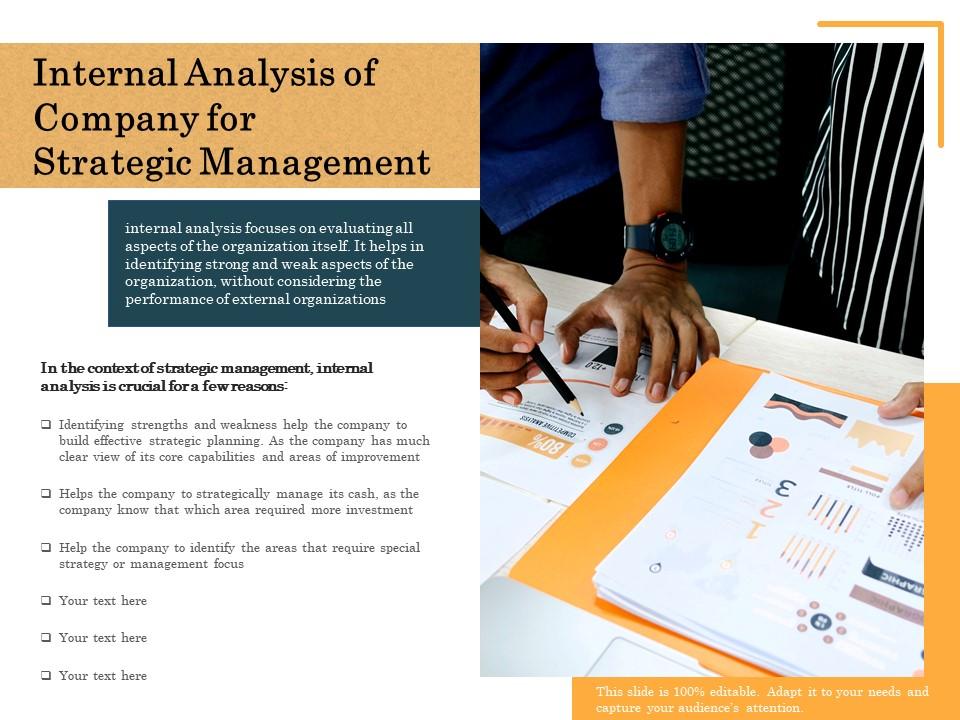
Internal analysis of company for strategic management with all 2 slides:
Use our Internal Analysis Of Company For Strategic Management to effectively help you save your valuable time. They are readymade to fit into any presentation structure.
FAQs for Internal analysis of company
Key components of an effective internal analysis include resource assessment, capability evaluation, performance metrics review, organizational structure analysis, and cultural assessment. These elements work together by identifying competitive advantages, highlighting operational inefficiencies, and revealing strategic opportunities, with many organizations finding that comprehensive internal analysis ultimately delivers improved resource allocation and enhanced decision-making capabilities.
SWOT analysis integrates into internal assessments by systematically evaluating strengths, weaknesses, opportunities, and threats within existing organizational frameworks, performance metrics, and resource allocation processes. This strategic combination enables companies to align internal capabilities with market opportunities, identify operational gaps requiring attention, and develop data-driven strategic decisions, with many organizations finding enhanced competitive positioning and resource optimization.
**INPUT**: What tools and frameworks are best suited for conducting a comprehensive internal analysis? **OUTPUT**: Comprehensive internal analysis tools include SWOT analysis, value chain analysis, resource-based view assessment, financial ratio analysis, and organizational capability audits. These frameworks enable organizations to systematically evaluate operational efficiency, competitive positioning, and strategic resources, with many companies finding that combining multiple approaches delivers deeper insights and clearer pathways for sustainable competitive advantage. [Word count: 55 words]
Organizational culture significantly influences internal analysis outcomes by shaping employee participation, data transparency, and willingness to acknowledge weaknesses alongside strengths. In companies with open, collaborative cultures, internal assessments yield more accurate insights and actionable recommendations, while hierarchical or defensive cultures may limit honest evaluation, ultimately affecting strategic decision-making and competitive positioning.
Companies should focus on financial performance ratios, operational efficiency measures, customer satisfaction scores, employee engagement levels, and market share indicators when evaluating internal capabilities. These metrics enable organizations to identify competitive advantages, streamline resource allocation, and enhance strategic decision-making, with many businesses finding that regular internal assessments ultimately deliver improved operational performance and sustainable growth.
Employee feedback can be effectively incorporated through structured surveys, focus groups, exit interviews, performance reviews, and anonymous suggestion systems. These mechanisms enable organizations to gather authentic insights about operational challenges, cultural dynamics, and process inefficiencies, while many companies find that regular feedback integration enhances strategic decision-making and ultimately delivers improved employee engagement and competitive advantage.
Financial performance serves as the foundation for internal analysis, revealing organizational strengths, weaknesses, cash flow patterns, profitability trends, and resource allocation efficiency. These metrics enable companies to identify competitive advantages, assess strategic initiatives' viability, and make informed decisions about expansion, investment, or restructuring, with many organizations finding that strong financial analysis directly correlates with successful long-term strategy execution.
Technology and data analytics revolutionize internal analysis by automating data collection, providing real-time performance insights, and enabling predictive modeling across operations. Through advanced analytics platforms, businesses streamline financial reporting, optimize resource allocation, and identify operational inefficiencies faster, with many organizations finding that these tools deliver enhanced decision-making capabilities and competitive advantage.
Common pitfalls include over-relying on outdated data, focusing solely on weaknesses while ignoring strengths, lacking cross-departmental input, and insufficient stakeholder involvement. Organizations increasingly find that comprehensive internal analysis requires balanced perspectives, real-time information gathering, and systematic evaluation across all operational areas, ultimately delivering more accurate strategic insights and competitive positioning.
A company's value chain can be assessed by examining primary activities like inbound logistics, operations, outbound logistics, marketing, and service, alongside support activities including procurement, technology, and human resources. This strategic analysis enables organizations to identify cost reduction opportunities, enhance operational efficiency, and pinpoint competitive advantages, with many companies finding that optimizing specific value chain components ultimately delivers improved margins and stronger market positioning.
Resource capability assessments identify an organization's strengths, weaknesses, core competencies, and strategic assets through systematic evaluation of human capital, technology, financial resources, and operational systems. These assessments enable companies to optimize resource allocation, identify competitive advantages, and uncover improvement opportunities, with many organizations finding that regular capability evaluations significantly enhance strategic decision-making and operational efficiency.
Internal analysis helps identify workforce skill gaps by evaluating current employee competencies against strategic objectives, industry benchmarks, and future role requirements through performance assessments, skills audits, and competency mapping. This systematic approach enables organizations to pinpoint specific training needs, optimize resource allocation, and develop targeted development programs, ultimately enhancing operational efficiency and competitive advantage in an increasingly dynamic business environment.
Organizations should conduct comprehensive internal analysis annually, with quarterly reviews of key performance metrics, financial health, operational efficiency, and competitive positioning. Many successful companies enhance this with continuous monitoring systems that track market changes, resource allocation, and strategic initiatives, ultimately enabling faster adaptation to industry shifts while maintaining sustainable competitive advantage through data-driven decision making.
Ignoring internal factors in strategic planning leads to unrealistic goal-setting, resource misallocation, and competitive vulnerabilities that can derail business growth. Organizations often find themselves overcommitting to markets they lack capabilities to serve, while missing opportunities where their strengths could deliver significant advantages, ultimately compromising operational efficiency and strategic positioning.
Internal analysis for startups focuses on validating business models, assessing founder capabilities, resource constraints, and market-product fit, while established enterprises emphasize operational efficiency, competitive positioning, and strategic resource allocation. Startups typically conduct rapid, iterative assessments using lean methodologies, whereas enterprises utilize comprehensive frameworks like SWOT and value chain analysis, with many finding that startups benefit from agility-focused metrics while enterprises require depth and systematic evaluation processes.
-
Illustrative design with editable content. Exceptional value for money. Highly pleased with the product.
-
Easily Editable.