Inventory flow chart for retail store

Inventory flow chart for retail store
Slide 1 of 2
Favourites Favourites

Try Before you Buy Download Free Sample Product

Audience Impress Your
Audience
Editable 100%
Editable
Time Save Hours
of Time
The Biggest Sale is ending soon in
0
0
:
0
0
:
0
0
Presenting this easily downloadable Inventory Flow Chart For Retail Store PPT layout. This PPT design is compatible with Google Slides. You can open this PPT theme in various formats like PDF, PNG, and JPG. This PowerPoint template is completely customizable, and you can modify the font size, font type, and graphics as per your requirements. This PPT slide is available in 4:3 and 16:9 aspect ratios for users’ convenience.

People who downloaded this PowerPoint presentation also viewed the following :

Content of this Powerpoint Presentation

Have you visited a general store only to be told that the supplies you needed are OUT OF STOCK? Perhaps you saw a nice shirt at a fashion outlet on your way home, but it was sold out before you could get it. In either situation, you wished that your trip to these places wouldn’t have ended in disappointment. While these scenarios are a usual occurrence for customers (colored with a tinge of little discomfort), for businesses, they can spell financial strain. 

Companies, especially those in the retail industry, must maintain an adequate level of stock inventory to avert losing customers to competitors who can deliver immediate gratification through available stock, better service, and more convenient shopping experiences. Maintaining this balance is non-negotiable in today’s saturated retail market, where customer loyalty is non-existent, as the ease of switching between suppliers and brands is a convenient choice. 

Efficient inventory management is par for the course if you want to retain clients' loyalty and sustain growth. SlideTeam has just the perfect solution for this challenge: Inventory Flow Chart for Retail Stores PPT Template! The 100% editable and customizable nature of our PowerPoint Templates provides you with the structure and the desired flexibility to edit your presentations.

Let’s explore.

We have a premium product on Inventory Flow Chart Retail Sector. Click here to explore!

Template: Inventory Flow Chart for Retail Store

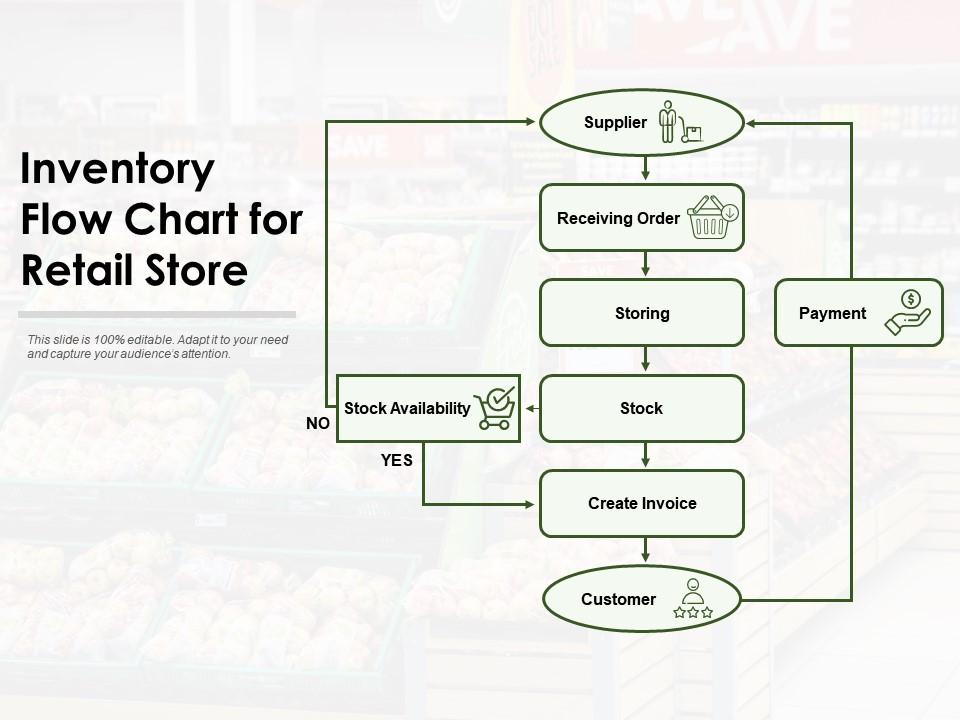
This PowerPoint slide includes a detailed inventory flow chart. It describes the path from supplier to customer in a clear and understandable manner. The flowchart begins with receiving orders. The process then moves on to payment and storage. Later, stock availability is confirmed, and an invoice is generated for the customer. This PowerPoint presentation is useful for retail managers who need a relevant layout to illustrate their inventory processes. 

All in All

Inventory management can be  troublesome if not done with reason and logic. SlideTeam’s PPT Set brings uniformity to retail operations concerning stocking, restocking, and more. With a download of this template, you'll get access to a structure that you can use to explain and refine your inventory processes with minimal effort. The layout is there, you just need to download and use it. 

P.S. Inventory Management isn’t without its challenges. However, it can be made easy with SlideTeam’s Inventory Management Process Flow Chart for Retail Stores. Click here to explore.

FAQs for Inventory flow chart

So you'll want demand forecasting and automated reordering - saves you from constantly playing catch-up. Real-time inventory tracking is huge too. Make sure your POS talks to everything else or you'll be stuck updating spreadsheets forever (been there, not fun). ABC analysis helps you figure out which products actually matter vs the ones just taking up space. Safety stock calculations prevent those "oh crap we're out" moments. Honestly, good reporting dashboards are a game changer - you can actually see what's selling. I'd start by figuring out what's driving you most crazy right now and fix that first.

Dude, inventory tech is a game changer. RFID tags and IoT sensors let you track everything in real-time - no more wondering what's actually in stock. AI forecasting predicts customer demand before they even know what they want (kind of creepy but super useful). Your team can check inventory data from anywhere with cloud systems. Automated reordering stops those awkward "sorry, we're sold out" conversations. Honestly the demand forecasting stuff blows my mind sometimes. Don't try to do everything at once though - pick one system and go from there.

So demand forecasting is basically predicting how much stuff you'll need and when. You look at your sales history - like the past year or two - to spot patterns and seasonal trends. Way better than just winging it, trust me. Without this you're either stuck with tons of inventory collecting dust or constantly sold out of everything people actually want. Both scenarios suck for business. Use your past data plus market info to figure out future demand. Keeps your stock levels right where they need to be and stops customers from bailing to competitors when you're out of stock.

Look at your sales data first - what's actually moving vs sitting there forever? I'd focus on your bestsellers and keep safety stock just for those. ABC analysis is clutch here, honestly. Fast-moving, high-value stuff gets priority. For everything else? Try just-in-time ordering so you're not drowning in inventory costs. Check your turnover rates and ditch products that aren't pulling their weight. Seasonal trends matter too - like, don't order winter coats in March unless you hate money. It's basically a juggling act, but you'll get the hang of it. The goal is avoiding stockouts without your cash being tied up in dead inventory.

Honestly, start with inventory turnover - that's how fast you're moving stuff off shelves. Track your stockout rate too because running out of popular items is the worst. Gross margin return on investment shows which products actually make you money (some might surprise you). Days sales in inventory is clutch for cash flow - tells you how long things sit around. Don't forget carrying costs since storage adds up, and shrinkage catches theft or damage early. But yeah, focus on turnover and stockouts first - they'll hit your sales and piss off customers if you're not watching them.

Honestly, seasonal stuff is a total game-changer for inventory. You've gotta start ordering way earlier than feels right - like Halloween merchandise in August, which seems insane but trust me. Demand spikes are brutal to predict too. Last year's data helps but it's not perfect, and you'll be holding way more stock than normal. Your warehouse space needs get weird during those times. Oh and definitely track your patterns if you're not already - wish someone had told me that earlier. Build extra time into supplier relationships because those big pre-season orders always take longer than expected.

Dude, get the automated inventory software - it's a game changer. No more drowning in spreadsheets (thank god). Real-time stock tracking means you'll know exactly what you have, plus it sends alerts when you need to reorder stuff. The demand forecasting is surprisingly decent too. Best part? It talks to your POS system so everything updates automatically when you make sales. I started with just the basic features because honestly, the advanced analytics can be overwhelming at first. You'll stop running out of popular items or getting stuck with inventory that won't move.

Look, demand forecasting is where you gotta start - dig into your sales history and seasonal patterns to actually predict what you'll need. ABC analysis is clutch here. Focus on your bestsellers first since running out of those will kill you. Safety stock works great for high-demand stuff, but don't overdo it or you'll have cash sitting around in products nobody wants. Most retailers I know just guess and then panic when they're out of stock again. Set up alerts when inventory hits your reorder points so you're not constantly scrambling. Trust me, automation beats gut feelings every time.

Start with automated reorder points and ABC analysis - focus on your high-value stuff first. Vendor-managed inventory is clutch for top suppliers, they basically do the work for you. Ditch those brutal annual counts and do cycle counting instead. Get demand forecasting software to catch seasonal patterns, and definitely connect your POS straight to inventory management. Real-time stock visibility is everything, otherwise you're always behind. Oh, and automate A-category items first - learned that one the hard way.

Oh man, supply chain issues are the worst - they totally mess with your whole inventory game. You end up hunting for backup suppliers while dealing with crazy unpredictable delivery times. Yeah, you'll probably have to stock way more safety inventory than normal, which sucks for cash flow, but running out of product is honestly way worse. I'd definitely spread your suppliers around too - don't rely on just one or two. The trick is getting your backup plans sorted before things go sideways. Maybe sound boring, but flexibility in your planning saves your butt when everything hits the fan.

So inventory turnover is basically how fast you're burning through your stock each year. Higher numbers = better cash flow since you're not sitting on a pile of products forever. Honestly, nothing's worse than staring at slow-moving inventory eating up your budget. You can boost it by nailing your demand forecasting and running promotions to clear dead weight. Tighten up those reorder points too. Oh, and push suppliers for faster delivery times - you don't want to overstock just because shipping takes forever. Track monthly but don't stress about huge jumps, steady progress works better.

Okay so first thing - get your demand forecasting down and build solid relationships with suppliers. I'd focus on high-turnover stuff initially since it's way more predictable. Set up those automated reorder points based on lead times, though fair warning, seeing low stock levels will stress you out at first lol. Your suppliers need to be super reliable with delivery times because one delay screws everything up. Oh and definitely start small! Pick just a few product categories to test with before going all-in. That way if something goes wrong, it won't tank your whole operation.

Yeah, small retailers definitely get hit harder with inventory stuff than big chains. Your cash flow's tighter, so you can't buy in bulk or stock tons of variety like Target does. Most of the time you're tracking everything by hand instead of having those crazy automated systems. Forecasting's brutal too - honestly, one slow week can throw off your whole month when you're dealing with smaller numbers. The cool thing though? You can actually change direction fast and stock exactly what your regulars want, not what works for some generic store in Ohio.

Honestly, data analytics is a game-changer for inventory - it stops you from just guessing what'll sell. You can actually see patterns, like which stuff sells crazy well in summer vs winter. Plus it flags those dead products just sitting in your warehouse forever (ugh, hate when that happens). The best part? You'll know when you're about to run out before you actually do. No more scrambling to reorder at the last minute. It helps you figure out exactly how much to order based on real sales data instead of just winging it. I'd say start with your bestsellers first, then work your way down once you get the hang of it.

Dude, FIFO is everything with perishables - first in, first out, no exceptions. Set up alerts for stuff that's getting close to expiring so you can discount it before it goes bad. Your coolers better work perfectly because one malfunction will cost you big time. I'd do daily inventory checks instead of weekly since this stuff moves crazy fast. Oh and don't wait until the last minute to mark things down - I start discounting when there's still 70% shelf life left. Way better than throwing money in the trash. You'll need good supplier relationships too for quick restocks when you suddenly run low on something.

Ratings and Reviews

0% of 100
Write a review
Most Relevant Reviews

No Reviews