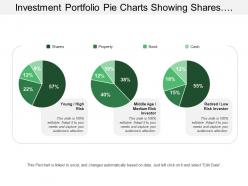
Investment portfolio pie charts showing shares property bond cash risk investor

Rating:
100%
Investment portfolio pie charts showing shares property bond cash risk investor
Slide 1 of 6
Favourites Favourites

Try Before you Buy Download Free Sample Product

Audience Impress Your
Audience
Editable 100%
Editable
Time Save Hours
of Time
The Biggest Sale is ending soon in
0
0
:
0
0
:
0
0
Rating:
100%
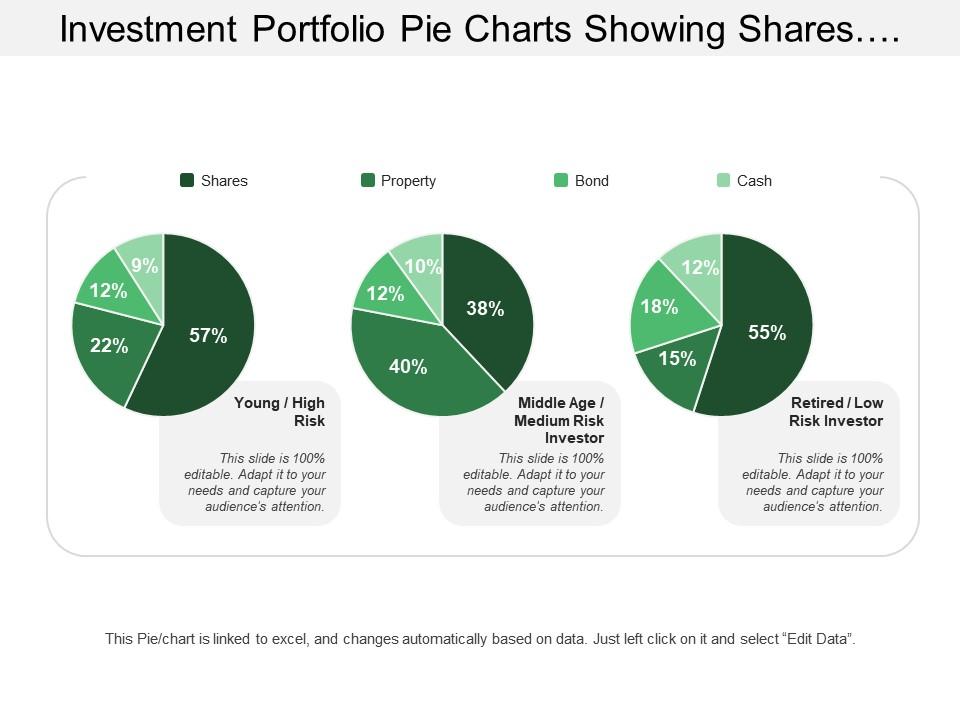
Presenting this set of slides with name - Investment Portfolio Pie Charts Showing Shares Property Bond Cash Risk Investor. This is a three stage process. The stages in this process are Investment Portfolio, Funding Portfolio, Expenditure Portfolio.

People who downloaded this PowerPoint presentation also viewed the following :

FAQs for Investment portfolio pie charts showing shares property bond

Diversification reduces investment risk by spreading assets across different sectors, geographic regions, asset classes, and market capitalizations, preventing overexposure to any single investment. This strategic approach helps investors weather market volatility while maintaining growth potential, with many financial advisors finding that diversified portfolios deliver more consistent long-term returns and enhanced financial stability.

Investors balance risk and reward through diversification across asset classes, geographic regions, and sectors, strategic asset allocation based on time horizons, and regular portfolio rebalancing. This approach enables financial institutions and individual investors to optimize returns while managing volatility, with many finding that systematic risk assessment and dollar-cost averaging ultimately deliver more consistent long-term performance.

Asset classes serve as the fundamental building blocks of diversified portfolios, including stocks, bonds, real estate, commodities, and alternative investments like private equity. These categories enable investors to spread risk across different market sectors and economic cycles, with many financial institutions finding that strategic asset allocation delivers enhanced returns, reduced volatility, and improved long-term wealth preservation outcomes.

Investors should evaluate active versus passive management based on risk tolerance, cost sensitivity, time horizon, and market beliefs, with active strategies offering potential outperformance through professional selection while passive approaches deliver consistent market returns at lower fees. Many financial advisors recommend a strategic combination, with passive funds forming the portfolio core for broad market exposure while active management targets specific sectors or opportunities, ultimately enabling diversified risk management and optimized long-term growth.

Key performance indicators include total return, risk-adjusted returns, benchmark comparisons, Sharpe ratios, and volatility measurements. These metrics enable investors to assess portfolio efficiency by evaluating growth potential, risk management effectiveness, and competitive positioning, with many financial advisors finding that comprehensive analysis ultimately delivers better investment decisions and long-term wealth accumulation.

Investment portfolio rebalancing typically occurs quarterly or semi-annually, though many financial advisors recommend reviewing allocations monthly and rebalancing when asset classes drift 5-10% from target weightings. Through systematic rebalancing, investors maintain risk tolerance alignment, capitalize on market volatilities, and ensure long-term strategic objectives remain intact, with many finding that disciplined approaches ultimately deliver more consistent returns.

Market volatility significantly influences portfolio strategies by prompting diversification adjustments, risk reassessment, and rebalancing frequency modifications to maintain optimal asset allocation. While volatility presents challenges through unpredictable price swings, it also creates strategic opportunities for value investing and tactical adjustments, with many institutional investors finding that disciplined approaches ultimately enhance long-term returns despite short-term fluctuations.

ESG criteria significantly influence investment portfolio decisions by helping identify companies with sustainable practices, strong governance structures, and positive social impact, while screening out those with environmental risks or ethical concerns. Through ESG integration, investors can enhance long-term returns, reduce regulatory and reputational risks, and align portfolios with stakeholder values, with many institutional investors finding that ESG-focused strategies deliver competitive performance while supporting sustainable business practices.

Common investment portfolio mistakes include lack of diversification, emotional decision-making, ignoring risk tolerance, chasing past performance, and neglecting regular rebalancing. These pitfalls undermine long-term wealth building by increasing volatility, reducing returns, and creating concentration risk, with many successful investors finding that disciplined, systematic approaches ultimately deliver more consistent growth and financial security.

Investors can tailor portfolios by aligning asset allocation with specific financial goals, timelines, and risk tolerance levels. For retirement planning, younger investors typically emphasize growth stocks and equity funds, while those nearing retirement shift toward bonds and dividend-paying securities, ultimately delivering personalized strategies that balance growth potential with capital preservation.

Portfolio management tools include robo-advisors, analytics platforms, risk assessment software, automated rebalancing systems, and performance tracking applications. These technologies streamline investment decisions by providing real-time market data, optimizing asset allocation, and minimizing manual oversight, with many financial advisors finding that automated systems ultimately deliver enhanced client outcomes and operational efficiency.

Macroeconomic factors significantly influence portfolio composition by affecting asset allocation decisions, risk assessment strategies, and diversification approaches across different economic cycles. During inflationary periods, investors typically increase commodity and real estate exposure while reducing bond allocations, with many institutional portfolios finding that strategic rebalancing based on interest rates, GDP growth, and currency fluctuations ultimately delivers enhanced returns and risk mitigation.

Bonds provide stability, income generation, and risk diversification in mixed portfolios, acting as counterbalances to volatile equity investments through regular interest payments and principal protection. With many institutional investors finding that strategic bond allocations reduce overall portfolio volatility while delivering steady returns, this combination ultimately enhances long-term wealth preservation and risk-adjusted performance.

Alternative investments enhance portfolio diversification by providing exposure to non-traditional asset classes like real estate, commodities, private equity, hedge funds, and infrastructure projects. These investments typically exhibit low correlation with traditional stocks and bonds, helping reduce overall portfolio volatility while potentially generating higher returns, with many institutional investors finding that strategic allocation to alternatives delivers enhanced risk-adjusted performance.

Tax considerations significantly influence portfolio management by affecting net returns, asset allocation decisions, and investment timing strategies. Strategic tax planning enables portfolio managers to maximize after-tax returns through tax-loss harvesting, asset location optimization, and holding period management, with many institutional investors finding that tax-efficient strategies can enhance overall portfolio performance by 1-2% annually.

Ratings and Reviews

100% of 100
Review Form
Write a review
Most Relevant Reviews
  1. 100%

    by Jones Adams

    Good research work and creative work done on every template.
  2. 100%

    by Cyrus Ellis

    Visually stunning presentation, love the content.

2 Item(s)

per page: