It Product Competition Analysis Comparison Matrix

Rating:
80%
It Product Competition Analysis Comparison Matrix
Slide 1 of 6
Favourites Favourites

Try Before you Buy Download Free Sample Product

Audience Impress Your
Audience
Editable 100%
Editable
Time Save Hours
of Time
The Biggest Sale is ending soon in
0
0
:
0
0
:
0
0
Rating:
80%
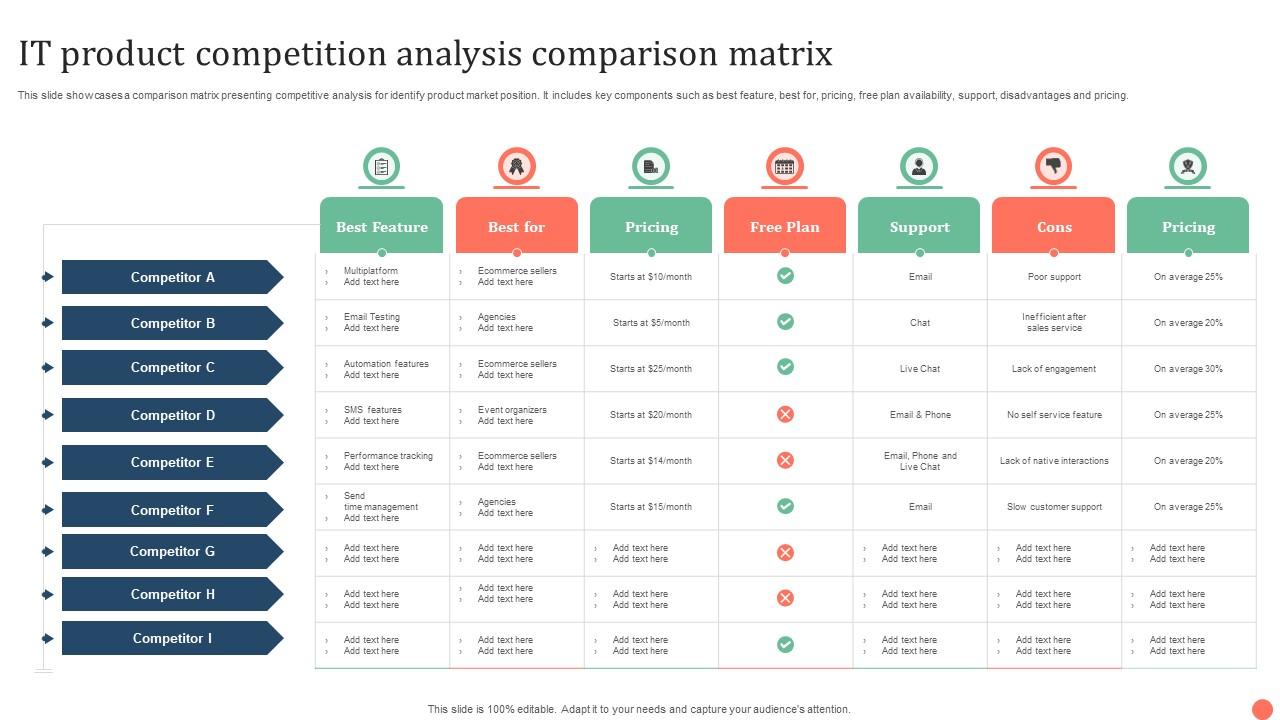
This slide showcases a comparison matrix presenting competitive analysis for identify product market position. It includes key components such as best feature, best for, pricing, free plan availability, support, disadvantages and pricing. Introducing our It Product Competition Analysis Comparison Matrix set of slides. The topics discussed in these slides are Cons, Best Feature, Analysis. This is an immediately available PowerPoint presentation that can be conveniently customized. Download it and convince your audience.
FAQs for It Product Competition

Performance and user experience are your biggest things to compare. Check how fast they process data and if the interface actually makes sense - some are just terrible honestly. Integration matters too since you don't want something that fights with your current tools. Security features can be overkill but clients eat that stuff up. Pricing models vary wildly between products. Cloud vs on-premise deployment is worth considering, plus what their support looks like. Oh, and scalability limits if you're planning to grow. A simple comparison chart helps when you're presenting this to your team.

Oh totally, UX is huge for staying competitive. When products have similar features, people will always pick the one that doesn't make them want to throw their laptop out the window. I've watched so many startups build amazing tech that nobody uses because the interface is trash. Good UX keeps people around longer and makes switching to competitors feel like too much work. Start with your main user flows - that's honestly where most companies mess up. If someone can't figure out your core feature in 30 seconds, you're already losing them to whoever makes it easier.

Ugh, pricing in IT is such a headache but you really can't mess it up. Going too low makes people think your product sucks - weird psychology thing. But you also can't price yourself out when there's always some competitor undercutting everyone. What's worked for me is figuring out who actually values your features vs just wanting the cheapest option. Those are different customer types entirely. Run some pricing tests if you can - maybe A/B test a few price points. Also keep tabs on what competitors are charging because that landscape shifts constantly. The sweet spot exists, it just takes some digging to find it.

Honestly, digging through customer feedback is where you'll find gold. Check out reviews, support tickets, surveys - anywhere people are complaining about existing solutions. I've watched entire teams change direction after realizing what customers were actually frustrated with (not what they assumed). Feature requests that keep popping up? That's your sweet spot, especially if nobody's nailing those yet. The trick is building stuff that solves real problems they're vocal about. Don't get caught up in what sounds cool - focus on what they're literally telling you they want. Those pain points become your differentiators.

AI/ML stuff is everywhere now - literally every vendor slaps "AI-powered" on their product like it's magic dust. Edge computing's the other big thing, plus everyone's going crazy for cloud-native setups. Zero-trust security models are blowing up too, which makes sense I guess. What I'd watch for in your competitive analysis is how they're bundling this stuff together and what they're charging. That's where you'll actually see who's got their act together vs who's just riding the hype train. Microservices frameworks are worth tracking too if you're in that space.

Honestly, just sign up for their free trials and actually use the stuff yourself - that's way more valuable than reading about it. Pricing and reviews on G2 are solid starting points. Your sales team probably knows more than they realize since prospects always mention competitors. Social media's great for finding people venting about bugs and issues (people love to complain lol). I'd also stalk their job postings - tells you what they're building next. Oh and their case studies reveal which customers they're targeting. Just throw everything in a basic spreadsheet and review it every few months.

Focus on market share, customer acquisition cost, and user retention - those three will actually show you how you're doing vs competitors. Revenue per user matters too, plus feature adoption rates. Honestly? Teams waste so much time on vanity metrics that look good in presentations but mean nothing. Are you getting users faster than your competition? Keeping them around longer? Making more per customer? That's what counts. Oh and track Net Promoter Score - word-of-mouth can totally make or break IT products. I'd benchmark against your top 2-3 competitors every quarter to stay sane.

Brand reputation is absolutely massive in IT. People will literally pay more for a name they trust - look at Microsoft Office dominating over cheaper options just because it feels "safe." When products are basically the same, reputation wins every time. It affects everything too - whether someone even considers you, if they stick around, whether they recommend you to others. Honestly, I've seen companies with worse products crush better ones purely on brand strength. If you're scoping out competitors, dig into their reviews and social media mentions. That stuff reveals way more about their real competitive edge than feature lists do.

Okay so when competitors are closing in, you've got a few moves. Target a completely different customer segment where there's less noise. Or reposition what you're selling - highlight features they can't touch. Sometimes you gotta change the whole business model, like switching from one-time purchases to subscriptions. I actually think the coolest pivots happen when companies are getting demolished but suddenly find their sweet spot. Figure out what you absolutely crush at compared to everyone else, then pivot around that. Don't overthink it though - sometimes the obvious move is the right one.

Here's the thing - segmentation is your best friend for carving out space competitors can't touch. Pick a specific slice, like mid-size healthcare vs "everyone with money." Most enterprise software dies trying to be everything to everybody (boring). You'll nail the messaging and features that actually matter to your niche. Pricing becomes way easier too. Honestly, just look at where you're already crushing it with current customers. Those patterns? That's your goldmine. Double down hard on those segments while the big guys fumble around with generic garbage.

Regulations totally reshape tech markets overnight. Look at GDPR - privacy went from bonus feature to absolute requirement instantly. Same with data laws forcing cloud companies to build local servers everywhere. Some companies get lucky if they're already compliant and suddenly have huge advantages. Others? They're scrambling or completely locked out. I swear, watching this happen is kind of fascinating in a chaotic way. My advice - start building compliance into your plans way ahead of time. Playing catch-up later costs a fortune and you'll hate yourself for waiting.

Dude, partnerships totally change the game. Small companies can suddenly punch way above their weight - like that AI startup that teams up with Amazon's cloud services and boom, they're competing with Google. It's wild how fast things shift. Plus they create whole new markets. Remember when Spotify started showing up in Ubers? Nobody saw that coming, but now it's everywhere. Watch out when your competitors start announcing these strategic deals though. That's usually when they're gearing up to move into territory they couldn't handle solo. Smart move, honestly.

Honestly, agile is a game changer because you can actually respond to what customers want instead of guessing. Your competitors are probably still doing those massive 6-month releases while you're shipping updates every few weeks. The sprint cycles let you test stuff, see what works, and change direction if needed. I mean, user expectations change so fast now - especially in tech. Short feedback loops are everything. You'll be iterating based on real data while they're still in planning meetings. Track how often you release compared to them and you'll see the difference pretty quickly.

Honestly, global trends are like a preview of what your local competitors will pull in 6-12 months. Cloud stuff takes off worldwide? Your local businesses will suddenly scramble to add SaaS features. AI, mobile-first design, whatever's trending - same pattern. Think of it like watching a wave roll toward shore. You know it's coming, right? So monitor these trends early and you can either ride that wave or - and this is key - position yourself as the totally different option. Don't just react to what everyone else does. Use the trend data to spot where market gaps will open up locally, then get there first.

Dude, great customer service is like your secret weapon against competitors. Way harder for them to copy than just adding features. Fast problem-solving plus a team that actually gets your product? That keeps customers loyal even when someone else has flashier stuff or cheaper pricing. I've watched companies lose tons of users to technically inferior products just because their support sucked. It creates this switching cost where leaving becomes a hassle for customers. The trick is getting your support people to understand both the tech stuff AND how it affects someone's business day-to-day.

Ratings and Reviews

80% of 100
Review Form
Write a review
Most Relevant Reviews
  1. 80%

    by Li Stewart

    Fantastic collection. Loved how we can personalize these templates as per the requirements. 
  2. 80%

    by Cletus Ross

    They saved me a lot of time because they had exactly what I was looking for. Couldn’t be happier!

2 Item(s)

per page:







