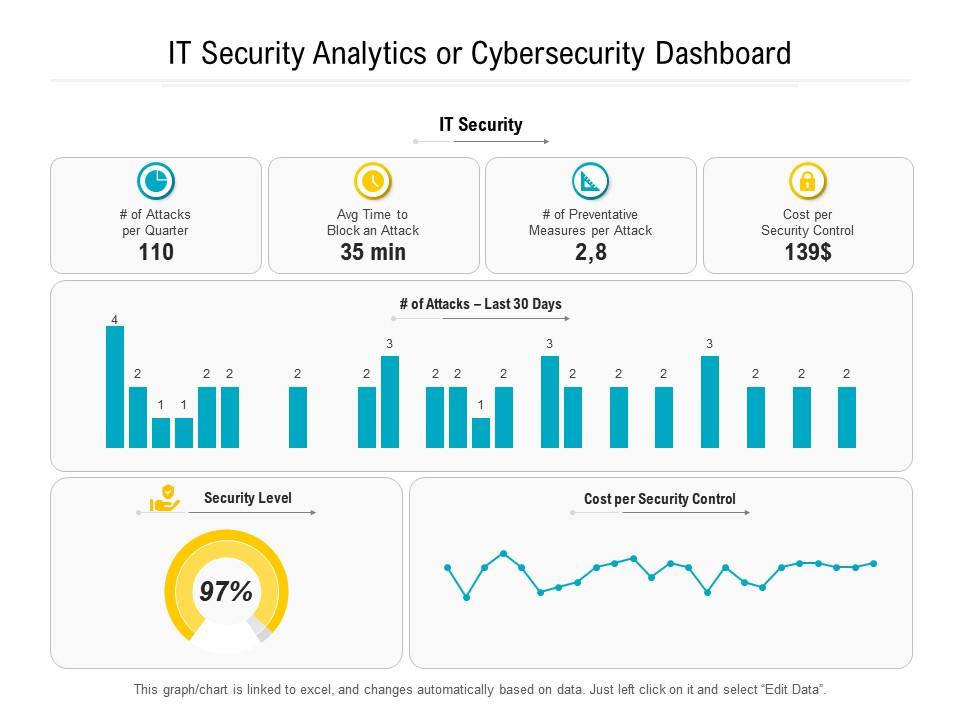
It security analytics or cybersecurity dashboard

Rating:
90%
It security analytics or cybersecurity dashboard
Slide 1 of 2
Favourites Favourites

Try Before you Buy Download Free Sample Product

Audience Impress Your
Audience
Editable 100%
Editable
Time Save Hours
of Time
The Biggest Sale is ending soon in
0
0
:
0
0
:
0
0
Rating:
90%
Presenting this set of slides with name It Security Analytics Or Cybersecurity Dashboard. The topics discussed in these slides are IT Security, Cost per Security Control, Security Level. This is a completely editable PowerPoint presentation and is available for immediate download. Download now and impress your audience.

FAQs for It security analytics

Honestly, start by getting all your security data in one place first - that's the foundation. Then build out detection for both known threats and weird anomalies. You'll need solid incident response workflows too, because when stuff breaks, it breaks fast. The monitoring piece is where everyone screws up though - too many alerts and your team just starts ignoring them. Oh, and don't forget threat intel feeds plus user behavior tracking for insider stuff. Data quality matters more than fancy tools. If your data's messy, nothing else works right.

Honestly, ML is pretty amazing for catching threats because it picks up on patterns we'd never notice in huge amounts of data. So you train it to learn what normal network activity looks like, then it flags weird stuff - like someone logging in at 3am or moving files they shouldn't touch. The algorithms actually get better over time as they learn from mistakes and new attack methods. But here's what I love most about it - no more drowning in useless alerts. It filters out the garbage and shows you what actually matters. Oh, and start with unsupervised learning for spotting anomalies. That's usually where teams see the biggest impact right away.

Honestly, data visualization is a game changer for cybersecurity stuff. Raw logs are brutal to stare at - like trying to find a needle in a haystack while blindfolded. But heat maps? Network diagrams? Those make attack patterns jump out immediately. You'll catch anomalies in seconds that would take hours to spot in spreadsheets. Dashboards showing threat indicators over time are clutch too. I'd start simple with your most critical metrics first. Once you see everything laid out visually, you can't go back to drowning in endless tables of numbers.

Start broad with your real-time alerts, then layer on extra filtering to cut the noise. Adjust sensitivity based on how much risk you can handle - different assets need different rules anyway. It's gonna be messy at first, no way around that. ML models help a ton once they learn what's normal for your network, though that takes time obviously. I'd go conservative with the initial rules and tighten things up as you collect more baseline data. The false positives are super annoying but they drop off once the system figures out your environment's quirks.

Start with detection accuracy - track true positives vs false positives, plus how fast you're catching and responding to threats. Coverage matters too, like what percentage of your attack surface the tool actually monitors. Honestly? Skip the fancy dashboards for now. The real question is whether you're finding threats faster and cutting down noise. Monitor analyst productivity - if they're drowning in 500 useless alerts daily, something's broken. These basics will tell you what you need to know. Once you've got that dialed in, then you can mess around with risk scoring and trend analysis.

Look, cybersecurity analytics is basically your best friend when shit hits the fan. You can trace how attackers moved through your network, see which systems got compromised, and figure out what data they actually touched. Honestly, the timeline stuff alone saves you so much headache - you'll know exactly what happened when. Response time gets way faster too since you're not just guessing. Real-time pattern matching catches similar attacks before they spread. Just make sure your logging is solid first though - can't analyze what you didn't capture.

Honestly, data quality will make you want to pull your hair out - you'll get buried under false alarms constantly. Most security tools don't play nice together either, which makes integration a total pain. Finding people who get both analytics AND cybersecurity? Good luck with that. Plus executives will question every dollar you spend until they see results, which takes forever. Oh, and don't even get me started on trying to prove ROI right away. Best bet is picking one specific problem to solve first. Get a quick win under your belt, then build from there. Trust me on this one.

Threat intel gives your analytics actual context instead of just random alerts. You'll know which groups use certain tactics and what their usual playbook looks like. Way easier to spot real threats vs noise. Your SOC can actually prioritize stuff properly because they understand the risk - plus predict what comes next. Honestly, the false positive reduction alone makes it worth it. I'd start with feeds specific to your industry though, otherwise you're drowning in irrelevant data that doesn't really help your situation.

Honestly, just focus on three big things: consent, only grabbing data you actually need, and being upfront about it. Don't collect everything just because you can - that's where most companies mess up. People should know you're monitoring for security stuff, even if you can't spell out every detection trick. Also set up retention policies so you're not hoarding personal info forever. It's basically about finding that sweet spot between keeping things secure and respecting privacy. Document everything first though, then get a lawyer to look it over. Trust me, it'll save you so much pain later.

Start by cutting out all the personal stuff you don't actually need - names, emails, whatever. Most security analysis works fine with fake identifiers anyway. Encrypt everything obviously, both when it's moving around and just sitting there. Only let your security team access the analytics data too. The annoying part is you'll probably have to audit what you're collecting first - I bet you're grabbing way more personal info than you realize. Pseudonymization is clutch for replacing sensitive data with random IDs. Honestly, half the time we overthink this stuff when basic data minimization would solve most privacy headaches.

Machine learning is getting scary good at catching weird patterns your old-school rules totally miss. Behavioral analytics is another big one - it learns how users normally act so it can spot insider threats. Zero-trust integration is pretty much mandatory now, honestly. Cloud security analytics too since everyone's doing the hybrid thing. You'll also want threat intelligence automation because manually going through all those feeds is a nightmare at scale. I'd figure out what gaps you have first, then tackle whatever's gonna hurt you most if it goes wrong.

So cybersecurity analytics basically gives you the proof you need for compliance stuff. It tracks who's accessing what data and catches sketchy behavior automatically - way better than discovering problems months later when auditors show up. GDPR and HIPAA both want detailed records of how you're handling sensitive info, and these platforms log everything in real time. Honestly, the automated reporting feature is a lifesaver. You won't be scrambling to pull together compliance reports last minute. The alerts are pretty solid too - they'll ping you immediately if something suspicious happens instead of leaving you in the dark.

Honestly, just nail these three things: data quality, retention, and who can access what. Set up validation rules upfront because bad data will make you want to quit - learned that one the hard way lol. Your retention policies need to match compliance stuff, but don't forget storage gets expensive fast with huge log files. Role-based access is clutch so people only see their relevant data. Oh, and document everything about your sources and transformations. Seriously. Future you will hate present you if analysts can't figure out what they're looking at later.

Yeah totally doable on a shoestring budget! I'd start with something like Wazuh or Security Onion - they're free and will show you what's actually happening on your network. Most small businesses think they need some crazy expensive enterprise thing, but basic monitoring is way better than nothing. Set up alerts for weird login stuff, suspicious file transfers, malware signatures - the usual suspects. Oh and automate whatever you can since you probably don't have a full security team sitting around. Pick one thing first though, maybe email or endpoint monitoring? Get the hang of reading that data, then branch out. Building it up piece by piece actually works better anyway.

Depends what you're dealing with budget-wise, honestly. Splunk and IBM QRadar are the heavy hitters - pricey but they'll handle tons of data and have decent ML built in. ELK Stack is solid if you don't mind getting your hands dirty with setup, plus it's free which is nice. I've actually seen small teams crush it with basic SIEM tools when they actually configure them right. The fancy stuff doesn't matter if nobody uses it consistently. Figure out what's currently driving you crazy first, then pick something that fits. Sometimes simple beats sophisticated, you know?

Ratings and Reviews

90% of 100
Review Form
Write a review
Most Relevant Reviews
  1. 80%

    by Daniel Robinson

    Visually stunning presentation, love the content.
  2. 100%

    by Dee Hicks

    Colors used are bright and distinctive.

2 Item(s)

per page: