Key stages in machine learning process

Rating:
92%
Key stages in machine learning process
Slide 1 of 2
Favourites Favourites

Try Before you Buy Download Free Sample Product

Audience Impress Your
Audience
Editable 100%
Editable
Time Save Hours
of Time
The Biggest Sale is ending soon in
0
0
:
0
0
:
0
0
Rating:
92%
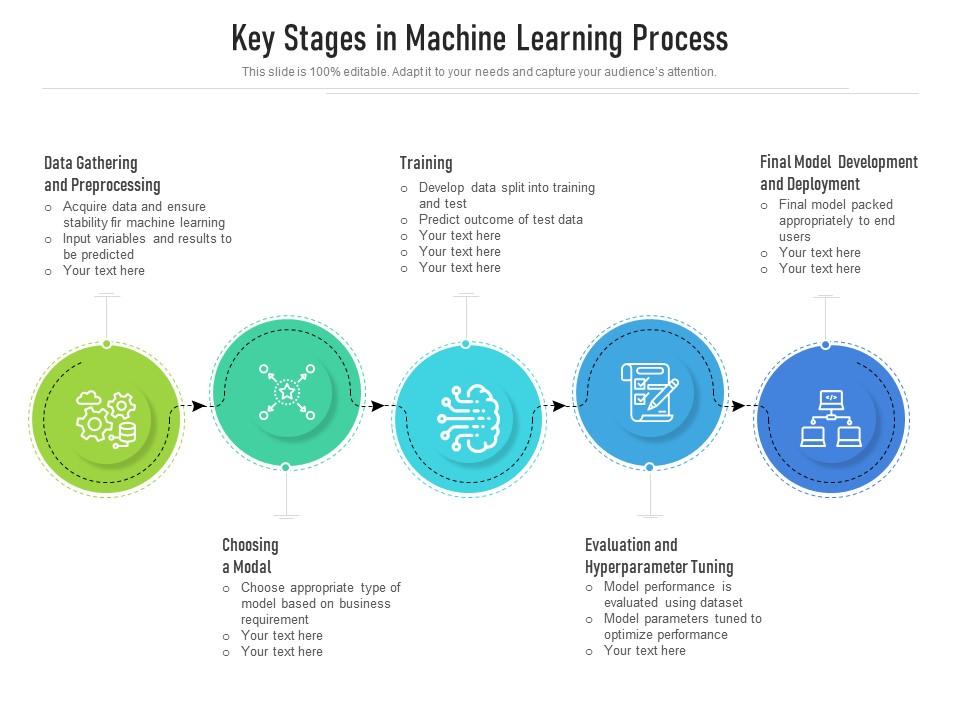
Presenting our set of slides with name Key Stages In Machine Learning Process. This exhibits information on five stages of the process. This is an easy to edit and innovatively designed PowerPoint template. So download immediately and highlight information on Data Gathering And Preprocessing, Final Model Development And Deployment, Evaluation And Hyperparameter Tuning.

People who downloaded this PowerPoint presentation also viewed the following :

FAQs for Key stages in

Machine learning workflows include data collection, data preprocessing, feature engineering, model selection, training, evaluation, and deployment. These stages streamline predictive analytics by ensuring data quality, optimizing algorithm performance, and enabling scalable implementation, with many organizations finding that systematic workflows deliver faster model development, reduced errors, and ultimately enhanced business intelligence capabilities.

Data collection directly determines machine learning project success by influencing model accuracy, reliability, and real-world performance through data quality, volume, and representativeness. Poor collection practices can lead to biased algorithms and failed deployments, while comprehensive, well-structured datasets enable organizations to achieve reliable predictions, reduce operational costs, and gain competitive advantages across applications.

Data preprocessing serves as the foundation for machine learning success by cleaning, transforming, and organizing raw data into formats algorithms can effectively process. This critical step involves handling missing values, removing outliers, scaling features, and encoding categorical variables, with organizations in healthcare, finance, and retail finding that thorough preprocessing significantly improves model accuracy, reduces training time, and ultimately delivers more reliable predictions and business insights.

Effective feature selection techniques include correlation analysis, recursive feature elimination, LASSO regularization, mutual information scoring, and principal component analysis for extraction. These methods streamline model performance by identifying relevant variables, reducing dimensionality, and eliminating noise, with many data science teams finding that strategic feature engineering ultimately delivers faster training times and improved prediction accuracy.

Determining the best machine learning model involves evaluating problem type, data characteristics, performance requirements, and interpretability needs through systematic experimentation with multiple algorithms. Organizations typically test various models using cross-validation, comparing metrics like accuracy, precision, and recall, with many finding that ensemble methods or domain-specific approaches ultimately deliver superior results and competitive advantage.

Model performance metrics include accuracy, precision, recall, F1-score, ROC-AUC, and mean squared error, depending on your specific problem type and business objectives. These metrics work together to provide comprehensive evaluation insights, with many data science teams finding that combining multiple measures delivers more reliable assessment of model effectiveness, ultimately enabling better decision-making and competitive advantage.

Common pitfalls in model training include overfitting, underfitting, poor data quality, inadequate feature selection, and insufficient validation techniques. These challenges can be avoided by implementing cross-validation, regularization techniques, thorough data preprocessing, and systematic hyperparameter tuning, with many organizations finding that structured workflows and continuous monitoring ultimately deliver more reliable models and better business outcomes.

Cross-validation techniques enhance model robustness by testing performance across multiple data subsets, reducing overfitting risks, and providing more reliable accuracy estimates than single train-test splits. Through k-fold and stratified validation methods, organizations in healthcare, finance, and retail achieve better generalization, minimize bias in model selection, and ultimately deliver more consistent predictions when deployed in production environments.

Hyperparameter tuning significantly enhances model performance by optimizing algorithm settings like learning rates, regularization parameters, and network architectures that aren't learned during training. Through systematic approaches like grid search and Bayesian optimization, organizations achieve higher accuracy, reduced overfitting, and improved generalization, with many finding that proper tuning delivers competitive advantages in predictive analytics.

Machine learning models remain relevant through continuous monitoring, regular retraining with fresh data, and performance evaluation against evolving business metrics. Organizations implement automated pipelines for data drift detection, model versioning, and scheduled updates, with companies in finance and healthcare finding that systematic model maintenance reduces accuracy degradation while ensuring competitive advantage in dynamic markets.

Model deployment strategies include containerization with Docker, microservices architecture, blue-green deployments, canary releases, and automated CI/CD pipelines. These approaches streamline production workflows by enabling seamless updates, minimizing downtime, and ensuring scalability, with many organizations finding that strategic deployment frameworks ultimately deliver faster time-to-market and enhanced operational reliability.

Post-deployment ML model monitoring involves tracking performance metrics, data drift detection, model accuracy assessment, automated retraining protocols, and continuous validation processes. Through real-time monitoring dashboards and automated alerts, organizations in finance, healthcare, and retail can identify declining performance, update models with fresh data, and maintain predictive accuracy, ultimately ensuring reliable business decisions and competitive advantage.

Ethical considerations include data privacy protection, algorithmic bias mitigation, transparency in decision-making processes, fairness across demographic groups, and accountability for automated outcomes. These principles guide responsible AI development by ensuring equitable treatment, protecting sensitive information, and maintaining human oversight, with organizations increasingly finding that ethical frameworks enhance customer trust and regulatory compliance while delivering sustainable competitive advantage.

Transfer learning significantly accelerates machine learning development for specialized tasks by leveraging pre-trained models, reducing training time, minimizing data requirements, and improving accuracy with limited datasets. Through this approach, organizations in healthcare, finance, and manufacturing can deploy specialized applications like medical imaging diagnostics or fraud detection systems more efficiently, ultimately delivering faster implementation and competitive advantage.

Machine learning workflows utilize Python and R for programming, TensorFlow and PyTorch for model development, Jupyter Notebooks for experimentation, Apache Spark for big data processing, and Docker for deployment containerization. These technologies streamline operations by enabling faster model iteration, seamless data integration, and scalable deployment processes, with many organizations finding that this strategic combination significantly reduces development time while enhancing operational efficiency.

Ratings and Reviews

92% of 100
Write a review
Most Relevant Reviews
  1. 100%

    by David Snyder

    Very unique, user-friendly presentation interface.
  2. 80%

    by Jake Smith

    Great designs, Easily Editable.
  3. 100%

    by Chester Kim

    Commendable slides with attractive designs. Extremely pleased with the fact that they are easy to modify. Great work!
  4. 100%

    by Clemente Myers

    Easily Understandable slides.
  5. 80%

    by Darius Webb

    Informative design.

5 Item(s)

per page: