Land lease proposal powerpoint presentation slides
Try Before you Buy Download Free Sample Product
Audience
Editable
of Time
Sublet agreement benefits both the lesser and the lessee. It provides a steady income to the owner of the asset. Not every start-up that begins from the ground can afford to buy an asset, thus, renting an asset allows them to build slowly and gradually. Low capital expenditure and tax benefits prove to be a boon for new firms. These content-specific Land Lease Proposal PowerPoint Presentation Slides allows you to formulate a property agreement in a well-organized manner. Employ these accurately designed PPT templates to give a detailed account of all the terms and conditions to formulate an agreement. Make sure every clause is clearly and concisely defined to remove any issue at the later stages, with these expertly curated rental agreement PPT slides. This house lease PPT slideshow allows you to display the signed approval between both the parties to prove credibility and authenticity. Educate your customers about the background and history of your company and the line of services you engage in with this ground agreement PPT design. Mention in detail about the compensation, payment, cancellation, and modification rules by taking the aid of this invigorating PPT presentation. Use this property lease PPT layout to inform the clients about how they can reach you to avail your services. You can easily formulate a plan of action for the growth of your company with this commercial lease PowerPoint graphic. Create a roadmap for the implementation of strategies with these attention-grabbing slides. Describe your firm’s vision, mission, goals, and objectives to build trust with your potential consumers. Showcase the case study of major agreements, the time period, location, budget, and other crucial details by taking the assistance of our content ready residential agreement PowerPoint slideshow. Download our ready-made and systematic PPT theme to present your project, plan, and proposal in an accessible way.
People who downloaded this PowerPoint presentation also viewed the following :
Content of this Powerpoint Presentation
Slide 1: This slide introduces Land Lease Proposal. State Client details, User details and begin.
Slide 2: This slide describes agreement of Land Lease Proposal.
Slide 3: This slide displays Table of Content of the presentation.
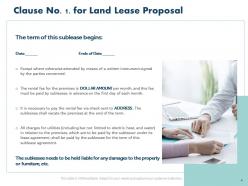
Slide 4: This slide shows Clause No. 1. details for Land Lease Proposal
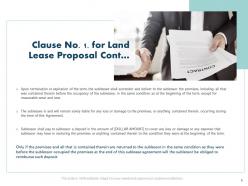
Slide 5: This slide is continued with Clause No. 1. for Land Lease Proposal.
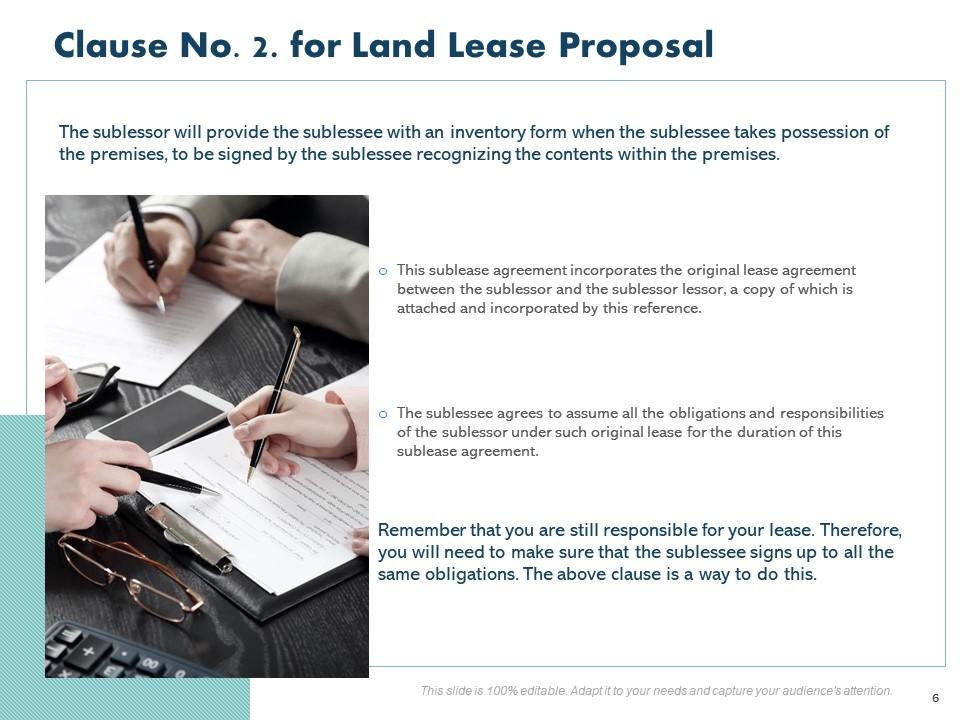
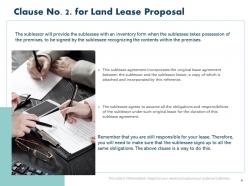
Slide 6: This slide showcases Clause No. 2. details for Land Lease Proposal
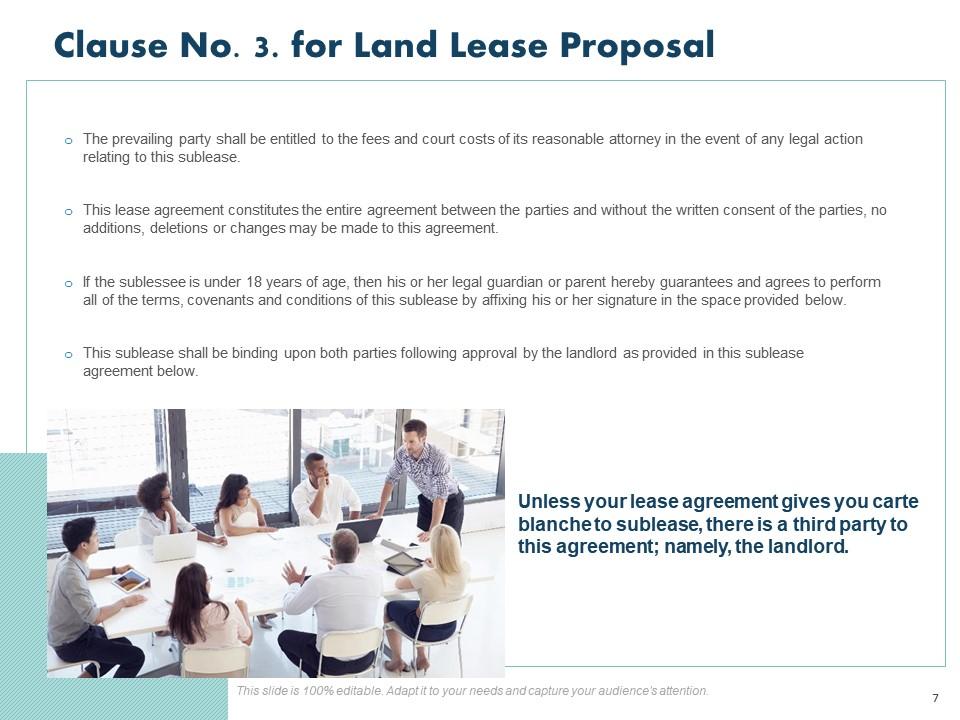
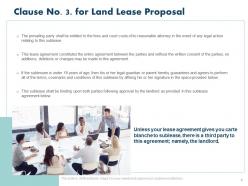
Slide 7: This slide represents Clause No. 3. details for Land Lease Proposal.
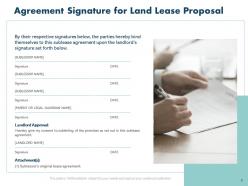
Slide 8: This slide showcases Agreement Signature for Land Lease Proposal.
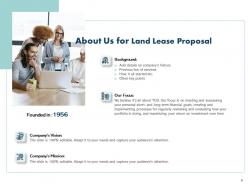
Slide 9: This is About Us slide to showcase Company details like history, Vision, Mission, Goals, Date in which company is founded.
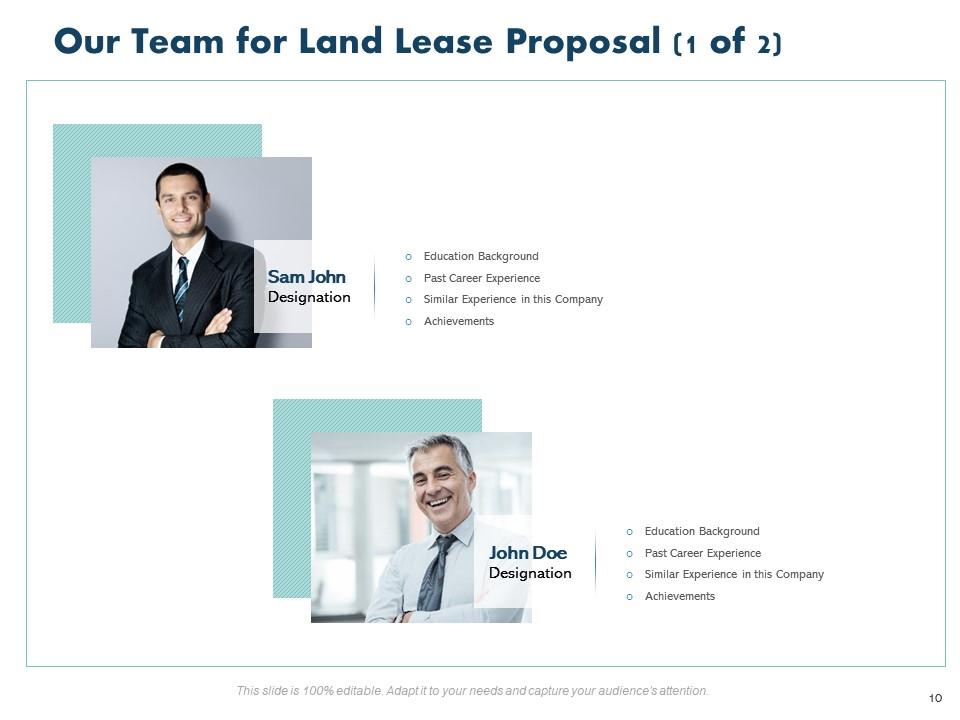
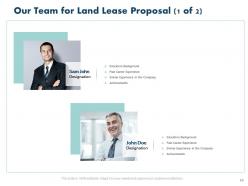
Slide 10: This is Our Team slide with Names and Designations.
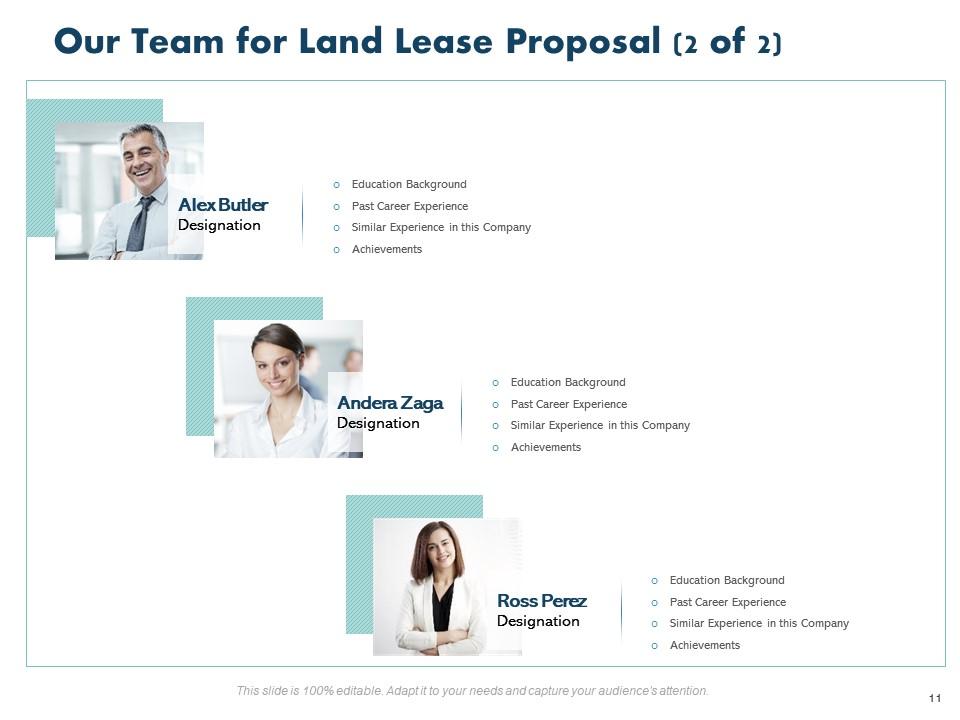
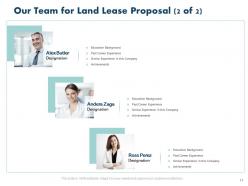
Slide 11: This is Our Team slide with Names and Designations.
Slide 12: This slide showcases Client Testimonials for Land Lease Proposal
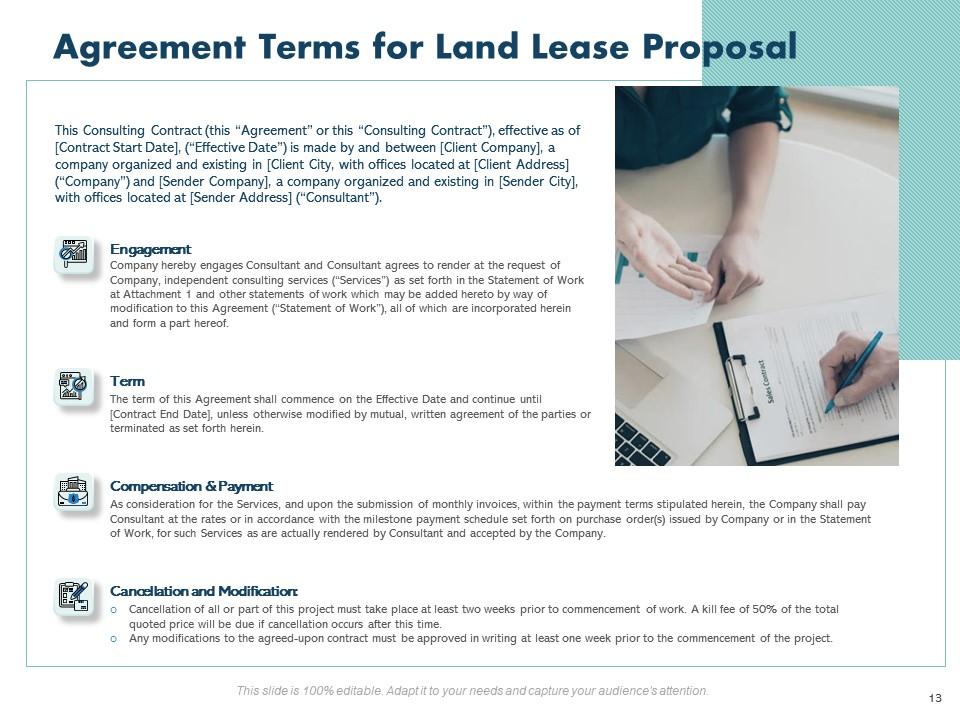
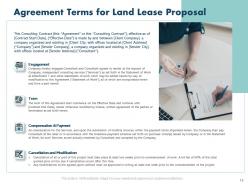
Slide 13: This slide represents Agreement Terms for Land Lease Proposal.
Slide 14: This is Contact Us slide with Email address, Contact number and Address.
Slide 15: This is Icons Slide for Land Lease Proposal.
Slide 16: This slide is titled as Additional Slides for moving forward.
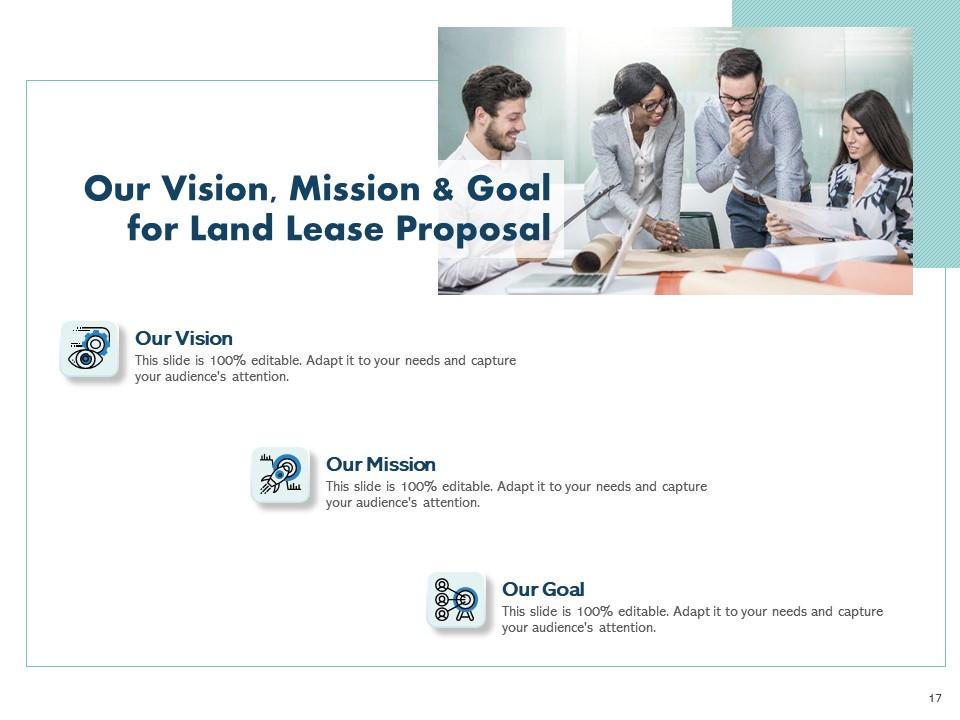
Slide 17: This is Our Vision, Mission & Goal slide.
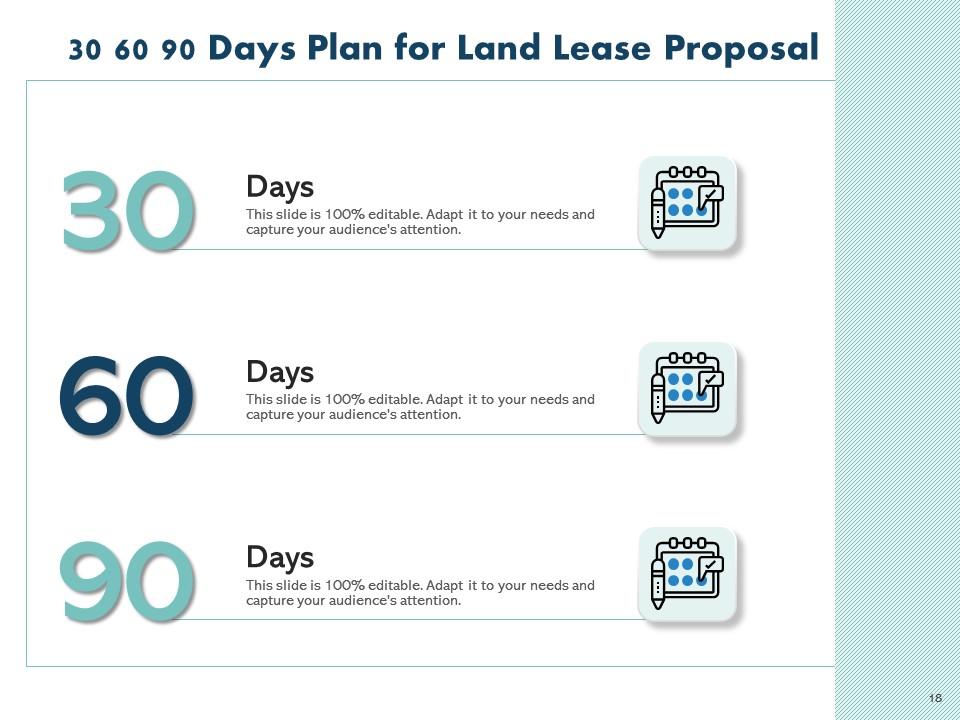
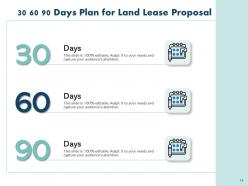
Slide 18: This is 30 60 90 Days Plan slide.
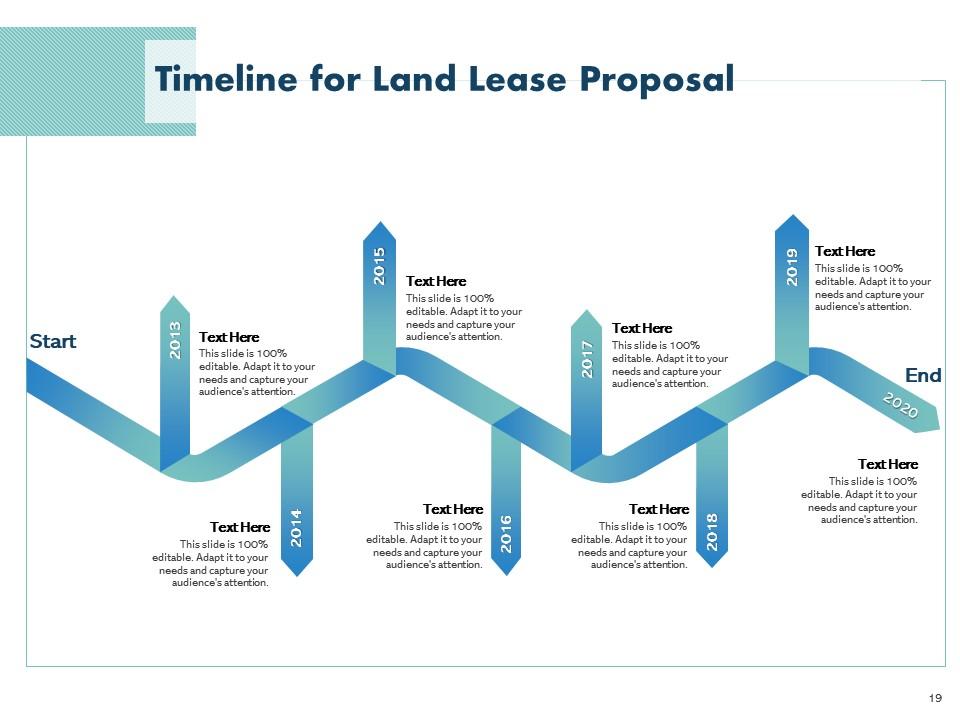
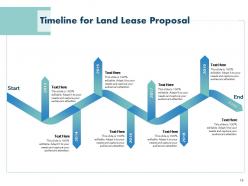
Slide 19: This slide showcases Timeline process.
Slide 20: This slide depicts Roadmap process.
Land lease proposal powerpoint presentation slides with all 20 slides:
Use our Land Lease Proposal Powerpoint Presentation Slides to effectively help you save your valuable time. They are readymade to fit into any presentation structure.
FAQs for Land lease proposal
So for your lease proposal, definitely hit the basics first - how long you want it, monthly rent, payment schedule, who handles maintenance. Then talk about what you're planning to do with the land and any improvements you'd make (landowners eat that stuff up). Oh, and don't skip the boring insurance/liability parts. Financial references help too since they want proof you won't flake on payments. I'd also mention renewal options upfront. You want to look thorough without going overboard - like you've got your stuff together but aren't being weird about it.
Zoning laws control what you can actually do with the property, so they'll directly affect your lease terms. Can't open a mechanic shop in a residential zone - trust me on that one. Your lease should list the allowed uses that match current zoning. Also, think about what happens if zoning changes while you're locked into the lease. Who covers compliance costs? Can you bail early? Definitely check zoning before you sign anything. Oh, and maybe add some language about getting variances later if you think you'll need wiggle room down the road.
Start with DCF models - they're perfect for long-term land leases. Run your NPV and IRR numbers to see if it's actually profitable. Honestly, I'd throw in a basic payback analysis too because sometimes the simple stuff is most telling. Build in annual rent bumps from the start, not later. Test different scenarios with sensitivity analysis - vacancy rates, rent escalations, all that. Oh and if you're planning to eventually sell, don't forget terminal value in your calculations. My buddy made that mistake once and his projections were way off.
Honestly, environmental assessments are huge for land leases - they basically decide if your project happens or not. Clean assessment? You're golden and things move fast. But if they find endangered species or contamination risks, you're looking at expensive fixes, delays, or getting shut down completely. The requirements can feel pretty ridiculous sometimes, but you can't fight them. Start your environmental review super early in the process though - I've seen too many people wait and then scramble when deadlines hit. Trust me, you don't want that headache.
So it really depends on what you're doing with the land. Farms usually go for 1-10 years, which makes sense since crops change. Commercial stuff? Way longer - like 25-99 years because they're dropping serious cash on buildings. Residential ground leases hit that 50-99 year sweet spot. Solar and wind farms stick to 20-30 years to match when their equipment craps out. Mining's weird though - could be 5 years or 50+ depending on what they're digging up. I'd honestly just look at what others in your area are doing and start negotiating from there.
Dude, urban leases are totally different beasts - way pricier, crazy strict zoning rules, and they keep terms short since everyone wants in. Rural stuff? Complete opposite. Longer terms, way more chill about negotiations, but you're dealing with ag restrictions and conservation rules instead. The paperwork will drive you nuts either way, just differently. City deals get buried in municipal red tape and development rights drama. Rural ones obsess over water rights and mineral stuff - honestly kinda fascinating once you get into it. Whatever you pick, nail down the local regulations first. They'll either save your timeline or completely wreck it.
Do your research first - check what similar spaces are going for nearby. Longer lease terms usually work in your favor since landlords hate turnover. Here's what most people mess up: they only bring one offer. Bad move. Come with three different scenarios so you've got options. Don't just focus on rent either - things like tenant improvement money or renewal clauses can save you tons. I always tell people to ask for exactly what you want first, even if it feels aggressive. You can always negotiate down from there. Oh, and prep all this stuff before you even call them.
So basically, your lease rate gets tied to whatever the property appraises for - usually around 6-10% of that value per year. When they do the reappraisal (every 5-10 years or so), your payments go up or down with it. Think of it like your rent getting reset to match current land values. Can be brutal if prices have shot up since your last appraisal - I've seen people get hit pretty hard. You'll want to check your lease terms to see when these appraisals happen and how they calculate everything. That way you won't get blindsided by a huge jump in payments.
Look, regulations are gonna dictate pretty much everything about your land lease deal. Zoning laws, environmental stuff, building codes - you name it. Multiple permits too, which is honestly such a pain. Figure out what applies to your situation right away though, because compliance costs and waiting periods can totally mess up your timeline if you don't plan for them. Some places make it easy, others... not so much. I swear some counties just love making you jump through hoops. But yeah, get ahead of it early and you'll save yourself major headaches later.
Honestly, tech makes land lease drafting way less painful. Contract automation tools handle all the boring standardized clauses for you. AI platforms are pretty solid at spotting missing terms or weird provisions that could screw you over later. Digital signatures are obvious time-savers, but collaborative editing is where it gets interesting - everyone can markup docs simultaneously instead of endless email chains. Oh, and lease management software tracks renewal dates automatically so you don't forget important stuff. Start with a decent template platform first. It'll save you tons of formatting headaches and you won't accidentally miss critical legal language.
Biggest mistake? Not researching what others are charging in your area first. I've watched people completely screw themselves by pricing way too low or ridiculously high. Get super specific about who handles maintenance and what tenants can actually do with the space - that vague stuff will haunt you later. Oh, and definitely check zoning rules and environmental issues upfront. My cousin learned the hard way about contamination problems that weren't disclosed. Everything needs to be in writing, obviously. Don't even think about signing without having a lawyer look it over first.
Honestly, you've gotta be super specific about who does what - like annoyingly detailed. List out structural stuff, yard work, basic upkeep separately for tenant vs landlord. Same with utilities: water, electric, gas, internet, trash. I literally watched a deal blow up because nobody clarified property taxes lol. Also throw in how maintenance requests work and how fast people need to respond. Trust me, make a whole chart if you have to. Otherwise you'll be arguing about a broken faucet at 2am wondering whose problem it actually is.
So basically, subleasing means letting someone else use your leased land. But here's what you need to know - most lease contracts won't let you do this without getting the landowner's approval first. Check your agreement because they're pretty strict about it. The landowner wants to know who's actually on their property, which honestly makes sense. You could get in real trouble or lose your lease entirely if you sublease without permission. My cousin learned this the hard way a few years back. Get written approval before you do anything - don't risk it.
So here's the thing - write your sustainability stuff right into the lease terms instead of hoping they'll just do it on their own. Make organic practices or renewable energy mandatory from day one. I'd include regular environmental check-ins and penalties if they mess up the land. Maybe throw in some bonuses for going above and beyond? Way better than the whole "pretty please" approach. Start with what you actually care about environmentally, then make those non-negotiable in your lease language. Oh and soil conservation is huge - definitely don't skip that part.
Renewable energy leases are totally crushing traditional farming deals right now - landowners are making bank. Most people want shorter, flexible terms instead of getting stuck in 30-year nightmares. You can connect with lessees directly through apps now, which cuts out brokers (though honestly some brokers aren't terrible). Climate stuff is shifting property values in weird ways. Short bursts work better than long commitments these days. If you're looking at land, definitely check its solar/wind potential first. That's where the real money is heading.
-
Perfect template with attractive color combination.
-
Great quality product.
-
Wonderful templates design to use in business meetings.
-
Awesome presentation, really professional and easy to edit.
-
Nice and innovative design.