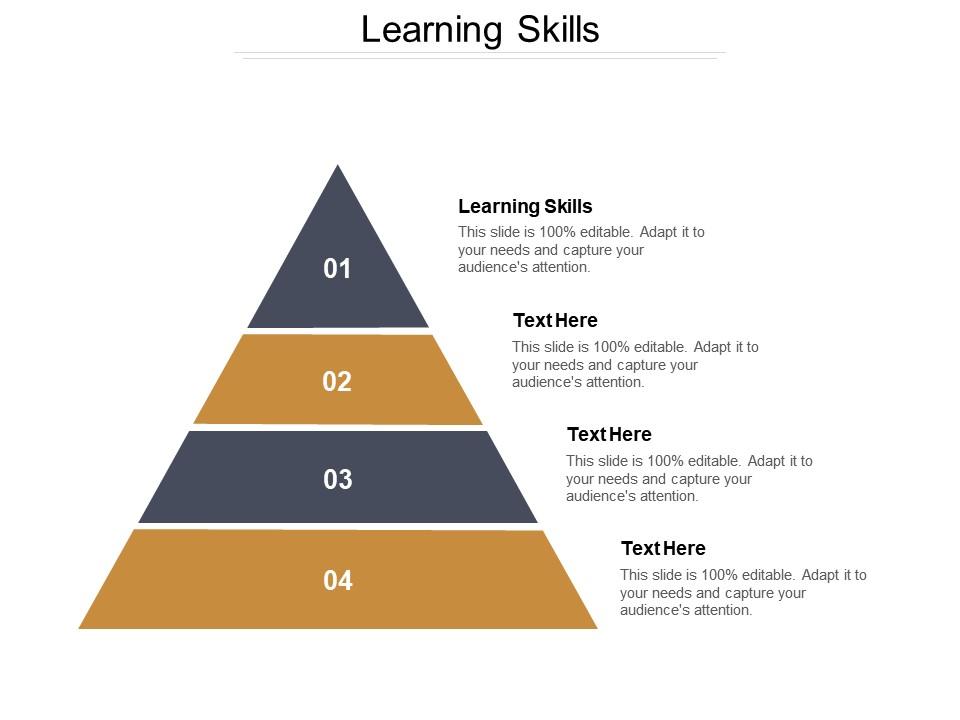
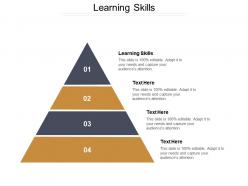
Learning skills ppt powerpoint presentation gallery format ideas cpb
Try Before you Buy Download Free Sample Product
Audience
Editable
of Time
Applaud attempts to generate improvements with our Learning Skills Ppt Powerpoint Presentation Gallery Format Ideas Cpb. Encourage constructive ideas.
People who downloaded this PowerPoint presentation also viewed the following :
Learning skills ppt powerpoint presentation gallery format ideas cpb with all 5 slides:
Get grey cells bubbling with our Learning Skills Ppt Powerpoint Presentation Gallery Format Ideas Cpb. Excite them with your brilliant thoughts.
FAQs for Learning skills ppt powerpoint presentation gallery
Essential digital-age learning skills include critical thinking, digital literacy, adaptability, self-directed learning, and collaborative problem-solving. These competencies enable professionals to navigate information overload, evaluate sources effectively, and leverage technology for continuous skill development, with many organizations finding that employees with strong digital learning capabilities deliver enhanced innovation, faster adaptation to market changes, and sustained competitive advantage.
Active learning techniques enhance retention and understanding by engaging multiple cognitive processes through hands-on practice, collaborative discussions, and immediate application of concepts. These methods, including problem-solving exercises, peer teaching, and interactive simulations, help learners process information more deeply than passive absorption, with many educational institutions and corporate training programs finding that active approaches deliver significantly higher comprehension rates and longer-lasting knowledge retention.
Emotional intelligence enhances learning by improving self-awareness, motivation, and stress management, enabling learners to regulate emotions, maintain focus, and persist through challenges. Students with higher emotional intelligence demonstrate better academic performance, stronger collaborative skills, and more effective problem-solving abilities, ultimately creating more resilient and adaptable learning experiences across educational and professional development settings.
Different learning styles significantly impact educational material effectiveness by influencing how students process, retain, and apply information through visual, auditory, kinesthetic, and reading preferences. When educational content accommodates multiple learning styles through varied formats, interactive elements, and multimedia approaches, institutions see improved comprehension rates, higher engagement levels, and better academic outcomes, ultimately delivering more inclusive and effective learning experiences.
Strategies to improve critical thinking skills include questioning assumptions, analyzing evidence from multiple perspectives, practicing problem-solving scenarios, engaging in structured debates, and evaluating information sources for credibility and bias. These approaches enhance analytical capabilities by encouraging deeper inquiry, fostering intellectual curiosity, and developing systematic evaluation methods, with many educational institutions finding that students demonstrate significantly improved decision-making and reasoning abilities.
Setting specific learning goals significantly enhances motivation and achievement by providing clear direction, measurable milestones, and focused accountability structures that eliminate ambiguity and procrastination. These targeted objectives enable learners to track progress systematically, celebrate incremental wins, and maintain sustained engagement, with many educational institutions and corporate training programs finding that goal-oriented approaches deliver measurably higher completion rates and skill retention.
Collaboration enhances individual learning through peer-to-peer knowledge sharing, diverse perspective integration, real-time feedback exchange, and collective problem-solving approaches. These collaborative methods enable learners to accelerate skill development, identify knowledge gaps more effectively, and build critical thinking capabilities, with many educational institutions and corporate training programs finding that group-based learning delivers significantly improved retention rates and practical application skills.
Incorporating technology into learning practices delivers personalized instruction, immediate feedback, enhanced engagement through multimedia content, flexible scheduling, and improved accessibility for diverse learners. These digital tools streamline educational processes by automating assessments, tracking progress analytics, and enabling collaborative learning environments, with many educational institutions finding that technology integration ultimately reduces costs while delivering more effective, scalable learning experiences.
Educators can assess learning skills effectively through formative assessments, peer evaluations, self-reflection exercises, portfolio reviews, and real-time observation of problem-solving approaches. These methods enable teachers to identify individual strengths and gaps while providing targeted feedback, with many schools finding that diverse assessment strategies ultimately enhance student engagement and academic outcomes.
A growth mindset significantly enhances skill acquisition by encouraging experimentation, resilience through setbacks, and continuous improvement rather than avoiding challenges. This approach accelerates learning across professional environments, with organizations finding that employees embrace complex projects, persist through difficult training phases, and ultimately develop stronger competencies that drive innovation and competitive advantage.
Time management techniques improve learning efficiency by enabling structured study schedules, prioritizing high-impact topics, and minimizing distractions during focused learning sessions. These methods help learners allocate optimal time for different subjects, enhance retention through spaced repetition, and reduce cognitive overload, ultimately delivering better comprehension and academic performance while maximizing educational investment.
Common barriers to effective learning include lack of motivation, distractions, poor time management, fear of failure, and ineffective study methods. These challenges can be overcome by setting clear goals, creating structured learning environments, implementing time-blocking techniques, and adopting growth mindset approaches, with many organizations finding that structured learning programs and mentorship opportunities ultimately enhance skill development and employee performance.
Environment significantly impacts learning through factors like lighting, temperature, noise levels, seating arrangements, and available resources, with studies showing these elements directly influence concentration, retention, and cognitive performance. Optimal conditions include well-lit spaces with natural light, comfortable temperatures between 68-72°F, minimal distractions, ergonomic furniture, and access to necessary materials, ultimately creating focused learning environments that enhance comprehension and academic outcomes.
**INPUT**: What techniques can be used to foster creativity in the learning process? **OUTPUT**: Creativity-fostering techniques include brainstorming sessions, design thinking workshops, collaborative problem-solving, cross-disciplinary projects, and experiential learning activities. These approaches enhance learning by encouraging diverse perspectives, promoting innovative thinking, and connecting theoretical concepts to real-world applications, with many educational institutions finding that students develop stronger critical thinking skills and adaptability for increasingly dynamic professional environments. [Word count: 58 words]
Feedback loops integrate into learning through real-time assessments, peer reviews, self-reflection exercises, progress tracking systems, and iterative content adjustments. These mechanisms enable learners to identify knowledge gaps, adjust study strategies, and reinforce successful approaches, while organizations find that continuous feedback cycles significantly enhance skill retention and accelerate professional development outcomes.
No Reviews