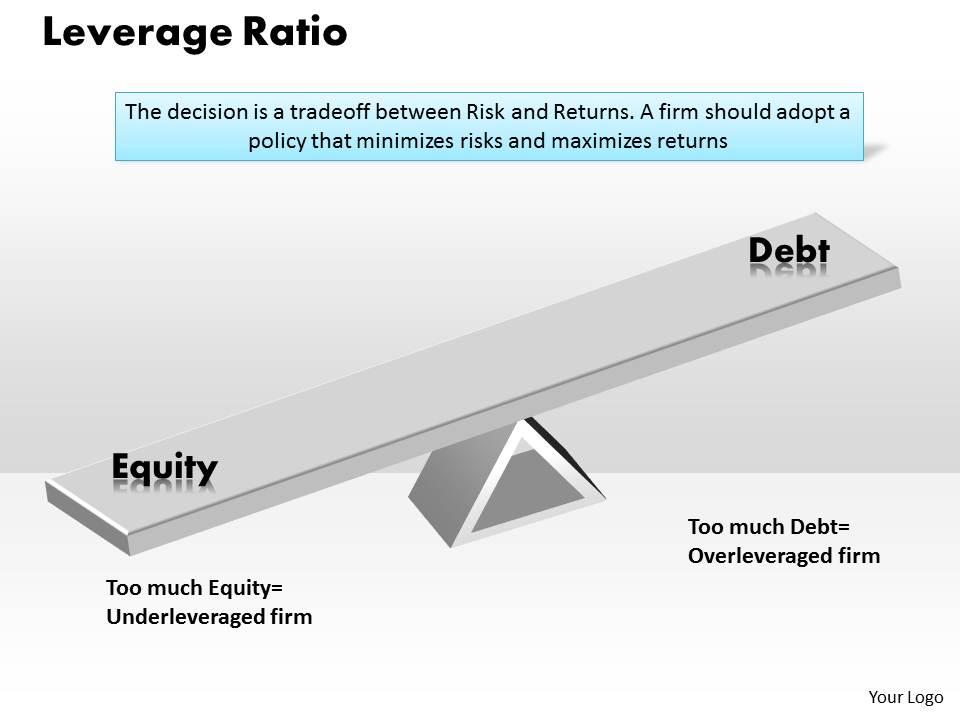
Leverage ratio powerpoint presentation slide template
Try Before you Buy Download Free Sample Product
Audience
Editable
of Time
Our Leverage Ratio Powerpoint Presentation Slide Template cover your back. They ensure you move confidently forward.
People who downloaded this PowerPoint presentation also viewed the following :
Leverage ratio powerpoint presentation slide template with all 5 slides:
Our Leverage Ratio Powerpoint Presentation Slide Template come in all colours shades and hues. They help highlight every nuance of your views.
FAQs for Leverage ratio powerpoint
The leverage ratio measures a company's debt relative to its equity or assets, indicating financial risk and borrowing capacity through metrics like debt-to-equity and debt-to-assets ratios. This ratio enables investors, lenders, and management to assess financial stability, creditworthiness, and growth sustainability, with banks and financial institutions finding that optimal leverage ratios enhance returns while maintaining regulatory compliance and competitive positioning.
Leverage ratios vary significantly across industries, with capital-intensive sectors like utilities and telecommunications typically maintaining higher ratios, while technology and healthcare companies often operate with lower leverage. These differences reflect varying capital requirements, cash flow stability, asset bases, and regulatory environments, with industries requiring substantial infrastructure investments generally accepting higher debt levels to fund growth and operations while maintaining competitive positioning.
The primary components used to calculate the leverage ratio include Tier 1 capital, total exposures, on-balance sheet assets, off-balance sheet items, and derivative exposures. These components work together by providing banks and financial institutions with comprehensive risk assessment capabilities, enabling regulatory compliance and strategic capital allocation, ultimately delivering enhanced financial stability and competitive positioning in increasingly regulated markets.
A high leverage ratio indicates potential financial risk by signaling excessive debt relative to assets or equity, creating vulnerability to cash flow disruptions, interest rate fluctuations, and economic downturns. Companies with elevated leverage ratios face increased bankruptcy risk, reduced financial flexibility, and potential difficulty securing additional funding, with many investors and lenders viewing high ratios as warning signs of unsustainable debt burdens.
A low leverage ratio suggests strong growth potential by indicating conservative debt management, substantial borrowing capacity for strategic investments, and reduced financial risk that attracts investors. Companies with minimal debt leverage can more readily pursue expansion opportunities, acquisitions, and innovation initiatives, while maintaining financial flexibility during market fluctuations, ultimately positioning themselves for sustainable scaling.
Investors use leverage ratios to evaluate debt levels, financial stability, risk exposure, and repayment capacity by analyzing debt-to-equity, debt-to-assets, and interest coverage ratios. These metrics enable portfolio managers, analysts, and institutional investors to identify overleveraged companies, assess bankruptcy risks, and make informed investment decisions, ultimately delivering better risk-adjusted returns.
The debt-to-equity ratio measures a company's financial leverage by comparing total debt to shareholder equity, indicating how much debt financing is used relative to equity investment. This ratio helps investors, lenders, and management assess financial risk and capital structure efficiency, with many financial institutions finding that companies maintaining balanced ratios between 0.3-0.6 demonstrate optimal leverage for growth while minimizing default risk.
Businesses can strategically manage leverage ratios through debt refinancing, equity injections, asset optimization, cash flow enhancement, and timing capital decisions around market conditions. Companies like manufacturing firms and retailers increasingly balance debt levels with growth investments, ensuring operational flexibility while maximizing returns, ultimately delivering sustainable competitive advantage and financial resilience.
Leverage ratios serve as critical risk assessment tools in lending, helping banks evaluate borrower creditworthiness, determine loan terms, set interest rates, and establish credit limits. Through these metrics, financial institutions streamline underwriting processes, minimize default risks, and ensure regulatory compliance, while borrowers with favorable ratios secure better lending conditions, ultimately enabling banks to maintain portfolio health and competitive advantage.
Fluctuating market conditions significantly impact leverage ratios through changing asset valuations, revenue volatility, and varying interest rates that affect both debt servicing capacity and equity values. During economic downturns, companies often experience declining revenues and asset write-downs, increasing their leverage ratios, while market recoveries typically strengthen balance sheets, ultimately requiring strategic debt management to maintain optimal financial flexibility across business cycles.
Leverage ratio limitations include oversimplifying complex capital structures, ignoring asset quality differences, providing limited insight into earnings capacity, and failing to account for off-balance-sheet exposures or risk-weighted considerations. While useful for initial assessments, financial institutions and investors increasingly combine it with profitability ratios, asset quality metrics, and liquidity measures, ultimately delivering more comprehensive risk analysis and strategic decision-making capabilities.
Interest rate changes impact leverage ratios by altering debt servicing costs and asset valuations, with rising rates increasing borrowing expenses while potentially reducing asset values that secure debt obligations. Companies with high leverage ratios face amplified risk during rate increases, as financial institutions, real estate firms, and utilities often experience compressed margins and reduced refinancing flexibility, ultimately affecting their debt-to-equity positions and creditworthiness.
Leverage ratios in M&A assessments evaluate target companies' debt capacity, financial stability, and acquisition financing feasibility by measuring debt-to-equity, debt-to-EBITDA, and interest coverage ratios. Investment banks and private equity firms use these metrics to structure optimal deal financing, assess integration risks, and determine fair valuations, ultimately enabling strategic acquisitions while minimizing financial exposure.
Common misinterpretations include viewing high leverage as automatically negative, ignoring industry context when comparing ratios, and relying solely on book values rather than market values. These misconceptions can mislead investment decisions, with many financial analysts finding that successful ratio analysis requires understanding sector-specific norms, economic cycles, and company growth stages to deliver accurate assessments and strategic insights.
Financial derivatives influence leverage ratios by potentially increasing off-balance-sheet exposures and creating contingent liabilities that regulatory frameworks now require banks to include in calculations. Through credit derivatives, interest rate swaps, and currency hedges, financial institutions can significantly amplify their effective leverage while managing risk exposure, with many banks finding that strategic derivative positioning enhances capital efficiency and competitive positioning.
-
I discovered this website through a google search, the services matched my needs perfectly and the pricing was very reasonable. I was thrilled with the product and the customer service. I will definitely use their slides again for my presentations and recommend them to other colleagues.
-
Great quality product.