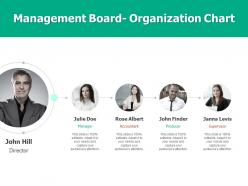
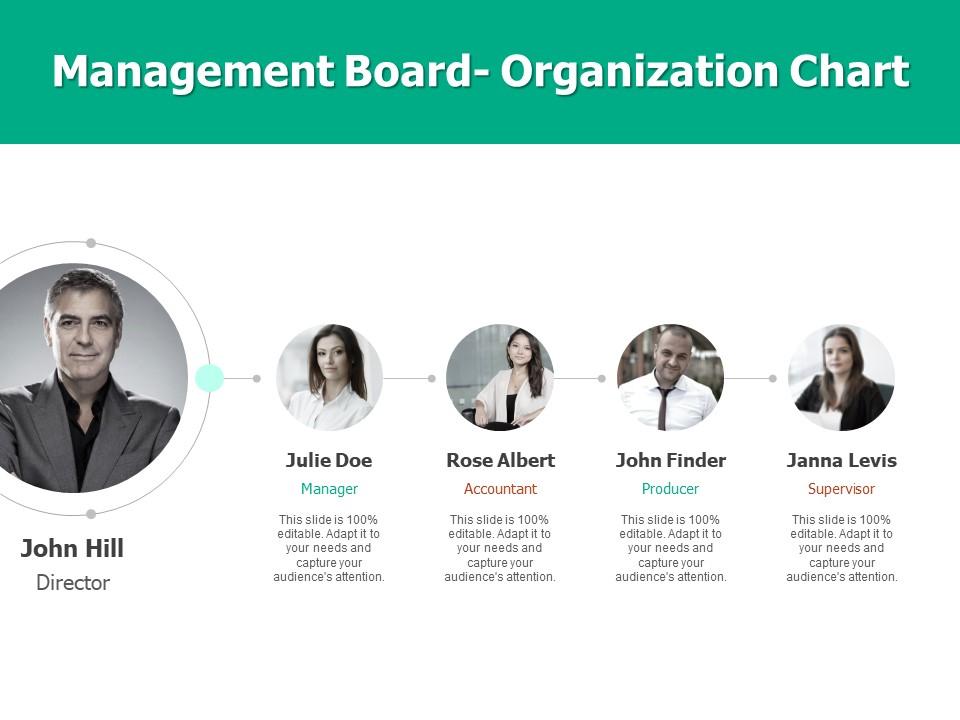
Management board organization chart team ppt powerpoint presentation show styles
Try Before you Buy Download Free Sample Product
Audience
Editable
of Time
Handle diversions that arise with our Management Board Organization Chart Team Ppt Powerpoint Presentation Show Styles. Get back on course at the earliest.
People who downloaded this PowerPoint presentation also viewed the following :
Management board organization chart team ppt powerpoint presentation show styles with all 5 slides:
Get back on course at the earliest with our Management Board Organization Chart Team Ppt Powerpoint Presentation Show Styles. Handle diversions that arise.
FAQs for Management board organization chart team ppt powerpoint
Management boards typically include CEO, CFO, COO, CTO, CMO, CHRO, and department heads representing core business functions like sales, operations, and strategy. These leadership roles streamline decision-making, enhance cross-functional collaboration, and ensure strategic alignment, with many organizations finding that clear board structures ultimately deliver faster execution and improved accountability across all business units.
Management board structure significantly influences strategic decision-making by determining authority distribution, communication flows, and accountability frameworks across organizational levels. Well-designed hierarchies streamline information sharing, accelerate consensus-building, and enhance resource allocation, with many organizations finding that balanced board compositions combining diverse expertise ultimately deliver faster strategic responses and more comprehensive risk assessment in increasingly competitive business environments.
Visual elements that enhance management board organization chart clarity include hierarchical layouts with clear reporting lines, consistent color coding for different roles or departments, professional headshots, standardized fonts, and strategic white space. These design components streamline understanding by creating visual distinction between executive levels, board committees, and advisory positions, while enabling stakeholders to quickly identify key decision-makers and organizational relationships, ultimately delivering improved transparency and more efficient corporate communication.
A well-designed organization chart improves management communication by establishing clear reporting structures, defining decision-making hierarchies, eliminating role ambiguity, and creating transparent accountability pathways. Through visual clarity of relationships and responsibilities, management teams streamline information flow, reduce interdepartmental confusion, and enhance strategic alignment, with many organizations finding that structured communication channels ultimately deliver faster decision-making and improved operational efficiency.
Common pitfalls include unclear reporting lines, overlapping responsibilities, inadequate succession planning, poor visual hierarchy, and failing to reflect actual decision-making processes. Many organizations find that creating overly complex structures, ignoring cross-functional relationships, and neglecting regular updates ultimately undermines board effectiveness, reduces accountability, and creates confusion during critical strategic decisions.
Management board organization charts should be updated immediately following significant structural changes, role modifications, or leadership transitions, with comprehensive reviews conducted quarterly or biannually. Many organizations find that maintaining real-time accuracy through digital platforms enables better transparency and communication, while regular scheduled updates ensure strategic alignment and support effective governance across evolving business landscapes.
Tools best suited for creating management board organization charts include Microsoft Visio, Lucidchart, OrgChart, SmartDraw, and Creately, each offering specialized templates and collaborative features. These platforms streamline chart creation by enabling real-time updates, integration with HR systems, and professional formatting, with many organizations finding that cloud-based solutions deliver enhanced accessibility and seamless collaboration across leadership teams.
An organization chart streamlines board member onboarding by clearly illustrating reporting relationships, committee structures, decision-making hierarchies, and key stakeholder connections within the governance framework. This visual tool enables new members to quickly understand their role within the broader organizational context, identify key contacts across departments, and grasp strategic oversight responsibilities, ultimately accelerating their contribution to effective governance.
Including inter-departmental relationships in a management board organization chart enhances operational transparency, facilitates strategic collaboration, and streamlines decision-making processes across organizational levels. These visual connections enable executives to identify workflow dependencies, optimize resource allocation, and accelerate project execution, while many organizations find that clear relationship mapping ultimately delivers improved communication efficiency and competitive advantage.
Companies customize management board organization charts by incorporating industry-specific roles, regulatory requirements, stakeholder representations, and specialized committees tailored to their sector's unique challenges. For example, financial services firms often include risk management and compliance officers, while healthcare organizations emphasize clinical leadership and patient safety roles, ultimately ensuring governance structures align with operational demands and strategic priorities.
Management board organization charts should display clear hierarchical lines using consistent visual elements, distinct line styles for different relationship types, and logical positioning that flows from top to bottom or left to right. Best practices include using solid lines for direct reports, dotted lines for advisory roles, consistent spacing between positions, and clear labeling of titles and departments, with many organizations finding that color-coding different divisions enhances readability while maintaining professional clarity for stakeholder communications.
Larger organizations require more complex management board charts with multiple hierarchical levels, specialized committees, and diverse functional representations across departments, divisions, and geographic regions. These expanded structures enable better oversight and strategic governance while managing increased operational complexity, with many multinational corporations finding that layered board architectures streamline decision-making processes and enhance accountability across their global operations.
Visual representations of organizational hierarchy deliver significantly clearer communication, faster comprehension, improved accessibility, and enhanced strategic planning capabilities compared to text-based formats. These visual tools streamline decision-making processes, minimize confusion around reporting relationships, and enable better resource allocation, with many organizations finding that employees navigate complex structures more effectively, ultimately delivering stronger operational efficiency and competitive advantage in increasingly complex business environments.
Management board organization charts promote transparency and accountability by clearly defining reporting relationships, decision-making authorities, and individual responsibilities across leadership levels. These visual frameworks enable stakeholders, employees, and board members to understand governance structures, track accountability chains, and identify responsible parties for strategic decisions, ultimately delivering improved oversight, reduced ambiguity, and enhanced corporate governance standards.
The management board organization chart serves as a strategic roadmap for succession planning by identifying key leadership positions, reporting relationships, and potential internal candidates for advancement. This visual framework enables organizations to assess skill gaps, develop targeted leadership development programs, and create clear career progression pathways, ultimately ensuring seamless transitions and maintaining operational continuity during leadership changes.
No Reviews