Management information system showing components and process

Rating:
90%
Management information system showing components and process
Slide 1 of 5
Favourites Favourites

Try Before you Buy Download Free Sample Product

Audience Impress Your
Audience
Editable 100%
Editable
Time Save Hours
of Time
The Biggest Sale is ending soon in
0
0
:
0
0
:
0
0
Rating:
90%
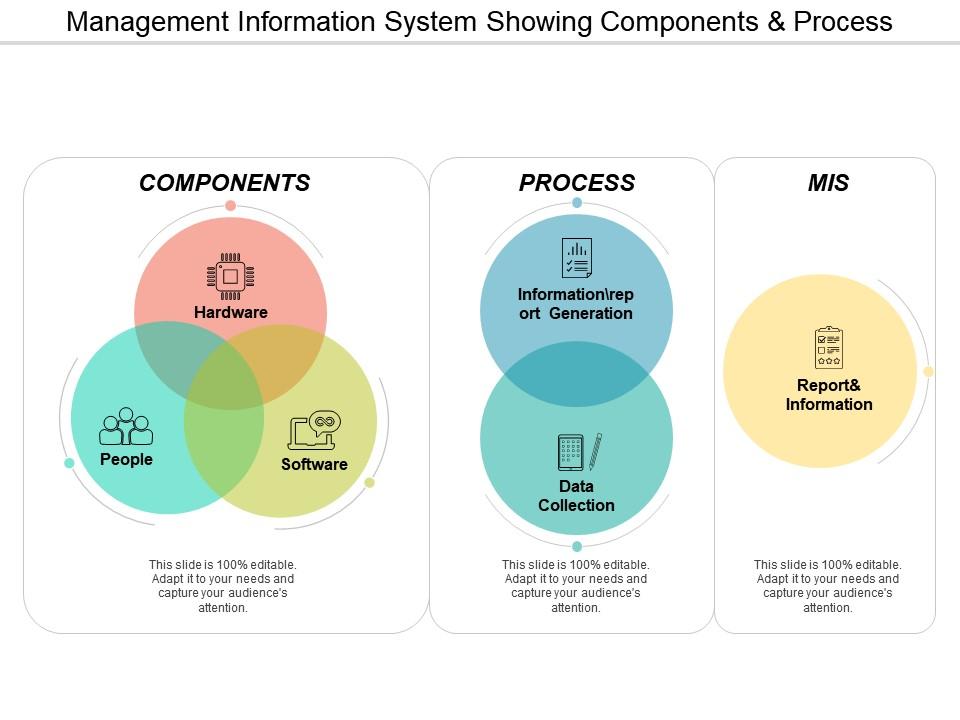
Presenting this set of slides with name - Management Information System Showing Components And Process. This is a three stage process. The stages in this process are Management Information System, Mis, Decision Making System.

FAQs for Management information system showing

Key MIS components include data input systems, processing units, storage databases, output interfaces, and feedback mechanisms. These integrated technologies streamline organizational decision-making by collecting operational data, analyzing performance metrics, and generating actionable reports, with many enterprises finding that strategic MIS implementation enhances resource allocation, improves operational efficiency, and delivers competitive advantage.

MIS contributes to decision-making by providing real-time data analysis, standardized reporting frameworks, and comprehensive performance metrics across all organizational levels. Through centralized data integration, executives can quickly assess market trends, operational efficiency, and resource allocation, while department managers leverage automated dashboards for tactical decisions, ultimately enabling faster, more informed strategic choices.

Data collection serves as the foundational cornerstone of MIS effectiveness, determining the quality, accuracy, and relevance of information available for decision-making processes. Through systematic data gathering from operations, customer interactions, and market sources, organizations can generate comprehensive reports, identify trends, and support strategic planning, with many enterprises finding that robust data collection ultimately delivers competitive advantages and enhanced operational efficiency.

MIS enhances operational efficiency by automating routine processes, centralizing data management, and providing real-time performance analytics across departments. Through integrated dashboards and automated reporting, organizations streamline decision-making, reduce manual errors, and accelerate response times, with many companies finding that strategic MIS implementation delivers cost reductions and improved resource allocation.

Common MIS implementation challenges include data integration complexities, employee resistance to new systems, budget overruns, inadequate training programs, and technical compatibility issues with existing infrastructure. Organizations often encounter workflow disruptions during transition periods, requiring strategic change management and phased rollouts, with many companies finding that comprehensive stakeholder engagement and thorough planning ultimately deliver smoother adoption and better long-term outcomes.

**INPUT**: How does an MIS differ from a Transaction Processing System (TPS)? **OUTPUT**: MIS focuses on aggregating and analyzing data for managerial decision-making, while TPS handles routine operational transactions like sales processing, inventory updates, and payroll functions. Through strategic reporting capabilities, MIS enables managers to identify trends, monitor performance, and plan resources, whereas TPS streamlines daily operations, ultimately delivering both operational efficiency and strategic insights for competitive advantage. **Word count: 60 words**

MIS generates operational reports for daily activities, tactical reports for departmental performance, strategic reports for executive decision-making, exception reports for anomalies, and ad-hoc reports for specific queries. These reports enable organizations to monitor KPIs, track financial performance, and analyze customer behavior, with many companies finding that automated reporting streamlines decision-making and enhances operational efficiency.

MIS supports strategic planning by providing real-time data analytics, performance dashboards, forecasting models, competitive intelligence tools, and resource allocation tracking. These systems enable executives to identify market trends, assess operational efficiency, and evaluate strategic alternatives through comprehensive reporting, with many organizations finding that integrated MIS platforms accelerate decision-making cycles and enhance long-term competitive positioning.

AI and big data revolutionize MIS by enabling predictive analytics, automated decision-making, real-time data processing, and intelligent reporting systems. These technologies streamline operations through enhanced forecasting, personalized customer insights, and operational efficiency, with many organizations finding that strategic integration delivers competitive advantage, reduces costs, and accelerates data-driven decision-making across departments.

Essential MIS skills include database management, systems analysis, data visualization, cybersecurity knowledge, and business process optimization. These professionals streamline organizational operations by integrating technical expertise with strategic thinking, enabling companies across healthcare, finance, and manufacturing to enhance decision-making processes, reduce operational costs, and deliver competitive advantages through data-driven insights.

Organizations ensure MIS data security through multi-layered approaches including encryption, access controls, regular security audits, backup systems, and compliance frameworks like GDPR or HIPAA. These strategies work by restricting unauthorized access, protecting data transmission, and maintaining recovery protocols, with many financial institutions and healthcare organizations finding that comprehensive security measures ultimately deliver customer trust and regulatory compliance while minimizing breach risks.

Manufacturing, healthcare, retail, financial services, and logistics benefit most from MIS implementation due to their complex data requirements and operational scale. These industries leverage MIS to streamline inventory management, enhance patient care coordination, optimize supply chains, and improve regulatory compliance, ultimately delivering faster decision-making and significant cost reductions.

User training significantly impacts MIS success by ensuring proper system utilization, reducing implementation resistance, and maximizing data accuracy and reporting capabilities. Through comprehensive training programs, organizations streamline workflows, enhance decision-making processes, and improve user adoption rates, with many companies finding that well-trained employees ultimately deliver better operational efficiency and strategic insights.

Key MIS performance metrics include system uptime, data accuracy rates, report generation speed, user adoption levels, and cost-per-transaction ratios. These measurements enable organizations to assess operational efficiency, data reliability, and user satisfaction across departments, with many companies finding that tracking response times and decision-making speed ultimately delivers competitive advantage and improved resource allocation.

Cloud-based MIS solutions offer greater scalability, reduced IT overhead, and real-time accessibility compared to traditional on-premises systems, while on-premises solutions provide enhanced data control and customization capabilities. Many organizations find that cloud solutions streamline operations through automatic updates, lower upfront costs, and seamless remote access, ultimately delivering faster implementation and improved operational efficiency across distributed teams.

Ratings and Reviews

90% of 100
Review Form
Write a review
Most Relevant Reviews
  1. 80%

    by Wilson Cooper

    Illustrative design with editable content. Exceptional value for money. Highly pleased with the product.

  2. 100%

    by Dylan Richards

    Illustrative design with editable content. Exceptional value for money. Highly pleased with the product.

2 Item(s)

per page: