Manufacturing process model ppt template
Try Before you Buy Download Free Sample Product
Audience
Editable
of Time
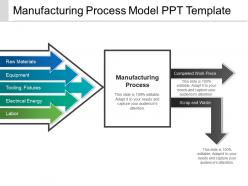
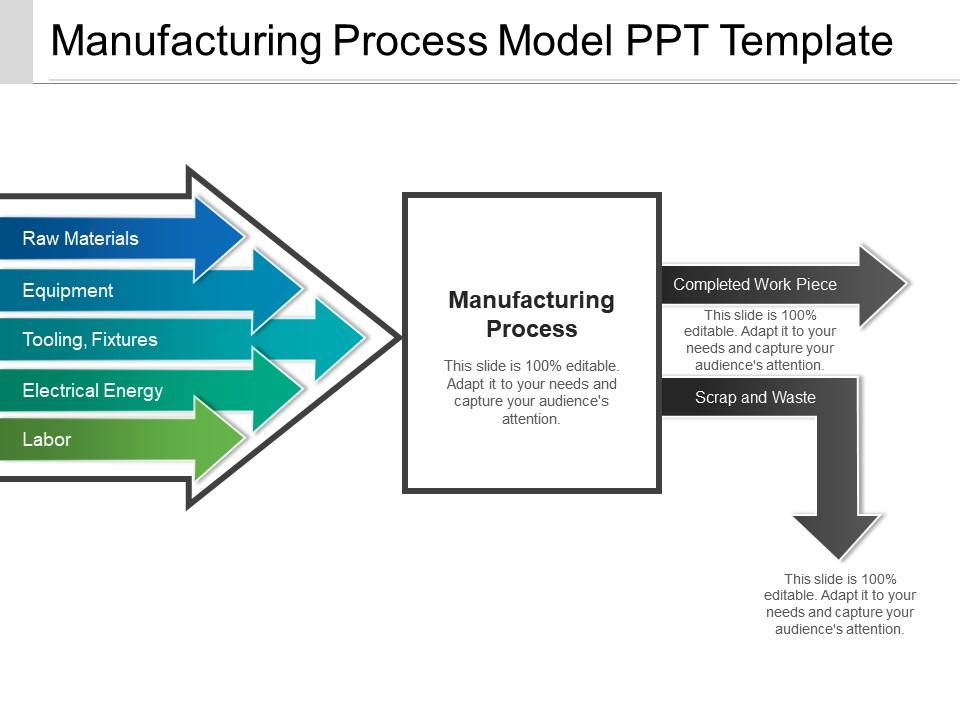
We are offering manufacturing process model PPT template, designed by professional PPT experts. The product manufacturing process template incorporates main processes such as research, analysis, development, and other common processes in production and operations management. A user can explain the entire process by using this manufacturing process model PowerPoint template. Design template is highly useful in product, process and production engineering. You can also use this PPT design to discuss the basic business operations e.g. processing and assembly operations in a structured way. Professionally created models and analysis of manufacturing systems is useful to evaluate the requirement of input and raw materials for production. It can be also used in production planning and quality control. You can highlight inputs like raw materials, equipment, tools, manpower and other resources with the help of this design of the manufacturing process for engineering material. Now, don’t think too much, download this manufacturing process model PowerPoint template design with a single click and apply it to your upcoming presentations. Cross the bridge with our Manufacturing Process Model Ppt Template. Establish the connection between different communities.
People who downloaded this PowerPoint presentation also viewed the following :
Manufacturing process model ppt template with all 5 slides:
Our Manufacturing Process Model Ppt Template are glad to do it for you. They enjoy coming to your aid.
FAQs for Manufacturing process
So manufacturing basically breaks down into five steps: planning (figuring out what you're making), sourcing materials, actual production, delivery to customers, and handling returns. Pretty straightforward on paper. But here's the thing - most companies totally botch the transitions between these phases. That's where everything falls apart. Your planning stage screws up? Good luck, because now production's behind and delivery's a mess. I'd honestly just map out what you're doing now first. Find where you're bleeding time between steps. Oh, and sourcing issues are usually the worst culprit, just saying.
Dude, lean manufacturing totally flips how you think about processes. First thing - map out everything you're doing now and spot all the wasteful stuff. Then redesign your workflow to cut inventory, speed up cycles, and switch from pushing products to pulling based on actual demand. You'll end up with way more visual systems like kanban boards everywhere (honestly they're kinda addictive once you start using them). The whole thing becomes super flexible since you're reacting to real customer needs instead of guessing. Oh, and focus on eliminating those eight classic wastes before you even think about new tech. Start with value stream mapping - it's a game changer.
Honestly, automation is pretty much everywhere in manufacturing now. It handles all the boring repetitive stuff and keeps quality consistent. Assembly lines, quality control - you name it. The crazy part is it's not just basic robots anymore. AI can predict when machines will break down, sensors track everything live, and systems automatically tweak settings when something's off. You'll want to map out where automation already exists in your processes first. Then look for bottlenecks that are slowing you down - those are usually good automation candidates. Your whole workflow changes once you add these touchpoints, so factor that in.
So basically simulation lets you test "what-if" scenarios without messing with your actual production line. Think of it like a sandbox version of your process. You can spot bottlenecks before they happen and see how tweaks affect everything downstream. Honestly way better than learning the hard way with real downtime costs. The visual part is clutch too - watching your process play out catches stuff you'd totally miss in Excel hell. Material flow, machine breakdowns, scheduling... you can model it all. Just pick your biggest headache first and start simple.
So you're gonna want to watch five main things. Throughput's obvious - are you hitting what the model said you would? Quality stuff like defect rates and first-pass yield matter tons too. Cycle time's critical since that's tied to your delivery commitments. Resource utilization sounds boring but trust me, it shows exactly where you're hemorrhaging cash. Oh and cost per unit - can't forget that one. These will catch problems way before they blow up your budget. Start here and you'll actually know what's happening instead of just hoping everything works out.
Honestly, your supply chain is going to dictate pretty much everything about your manufacturing setup. Before you lock down any process design, map out your key suppliers first - where they're located, what their lead times look like, how reliable they actually are. All that stuff directly impacts your batch sizes, timing, even where you put your facility. I learned this the hard way on a project last year. Material availability and logistics constraints aren't just nice-to-haves you consider later - they'll completely reshape your process flow if you don't plan for them upfront.
Honestly, your data's gonna be way messier than you expect - that's always the first shock. People will push back hard because nobody wants their routine messed with. Legacy system integration? Total pain. I'd say start with something small, maybe just one department. Clean up your data beforehand or you'll regret it later. Oh, and definitely get your team involved early so they don't feel like you're forcing some random system on them. Testing takes forever too, so budget extra time for that mess.
Just bake DMAIC cycles right into each manufacturing stage instead of treating Six Sigma like some separate thing. Most places overcomplicate this stuff honestly. Build your control charts and defect tracking straight into the workflow docs so it becomes second nature. Data collection should feel normal, not like extra busy work. Pick one critical step first and wrap the Six Sigma tools around that - way easier than trying to do everything at once. Root cause analysis becomes part of how you actually operate, not something you remember to do later. That's how you make continuous improvement stick.
Dude, AI and machine learning are absolutely crushing it right now. You can predict when equipment's gonna break, catch quality issues instantly, optimize processes automatically - the works. Digital twins are pretty sick too, basically letting you test changes on a virtual copy before touching the real production line. IoT sensors are pumping data everywhere now. Edge computing makes everything way faster (though honestly the tech moves so fast I can barely keep up). My advice? Don't go crazy trying to digitize everything at once. Pick your worst headache and start there.
Material choice completely shapes your manufacturing process - honestly, it's like the foundation for everything else. Thermoplastics? You're looking at injection molding or extrusion. Pick metal instead and now you're dealing with machining, casting, or forming. Each material has its own weird personality quirks (some are just plain difficult to work with). Your temps, tooling, and quality controls all need to match what that specific material can actually handle. I learned this the hard way on a project once. Bottom line - choose materials early and build your process around them. Don't try forcing something that won't work.
Honestly, I'd start with just one thing - maybe switching to recycled materials or cutting energy waste. Don't try to overhaul everything at once, you'll go crazy. Measure where you're at now, then build from there. Renewable energy is a game-changer if you can swing it. Water conservation matters too, but that's probably further down the line. The circular economy stuff is cool - basically your waste becomes someone else's input. I know it sounds overwhelming but pick your easiest win first. Once you see some results, you can tackle the bigger lifecycle changes.
So basically, a QA framework is like having checkpoints throughout your production that catch problems before they hit customers. You map out the critical spots in your process and build quality checks around those. Without it, you're honestly just hoping for the best - which usually ends badly with recalls and angry customers. It's kind of like guardrails on a road, not glamorous but keeps you from going off a cliff. The whole point is catching issues early so you can fix your process instead of dealing with complaints later. I'd start by figuring out where things typically go wrong in your current setup.
Oh man, this is huge. What works in Germany will totally bomb in Thailand - trust me on that one. You've got to adapt everything: how people communicate, who makes decisions, even quality expectations. Some places want everything documented to death, others just go with relationships and talking things through (which honestly caught me off guard at first). Then there's the whole time thing - some cultures are super rigid with schedules, others are way more flexible. My advice? Map out the cultural stuff for each location before you even think about rolling anything out. Way easier than trying to fix it later.
Honestly, training makes or breaks everything. I've watched so many good processes completely fall apart because people didn't understand the "why" behind what they're doing. Your team needs to get how their piece connects to everything else - not just their own little corner. Without that bigger picture, you'll end up with sloppy work and people who can't figure out what went wrong when things break. Plus frustrated employees who feel lost, which nobody wants. Map out what each person actually needs to know first. Then build training that covers both the technical stuff and helps them understand the whole flow.
So basically you'll want to grab real production data and stack it up against what your model predicted. Track stuff like cycle times, defect rates, throughput - then loop that back into your parameters. Honestly, the automation part is pretty sweet since sensors can handle most of the data collection. Your model gets smarter over time as it sees actual variations and weird issues that pop up. Oh, and don't try to do everything at once - that's a nightmare. Pick one critical step, get the instrumentation right, then expand from there. Way less headache that way.
-
It saves your time and decrease your efforts in half.
-
Understandable and informative presentation.
-
Excellent work done on template design and graphics.
-
Great quality product.