Market capitalization powerpoint slides

Rating:
90%
Market capitalization powerpoint slides
Slide 1 of 7
Favourites Favourites

Try Before you Buy Download Free Sample Product

Audience Impress Your
Audience
Editable 100%
Editable
Time Save Hours
of Time
The Biggest Sale is ending soon in
0
0
:
0
0
:
0
0
Rating:
90%
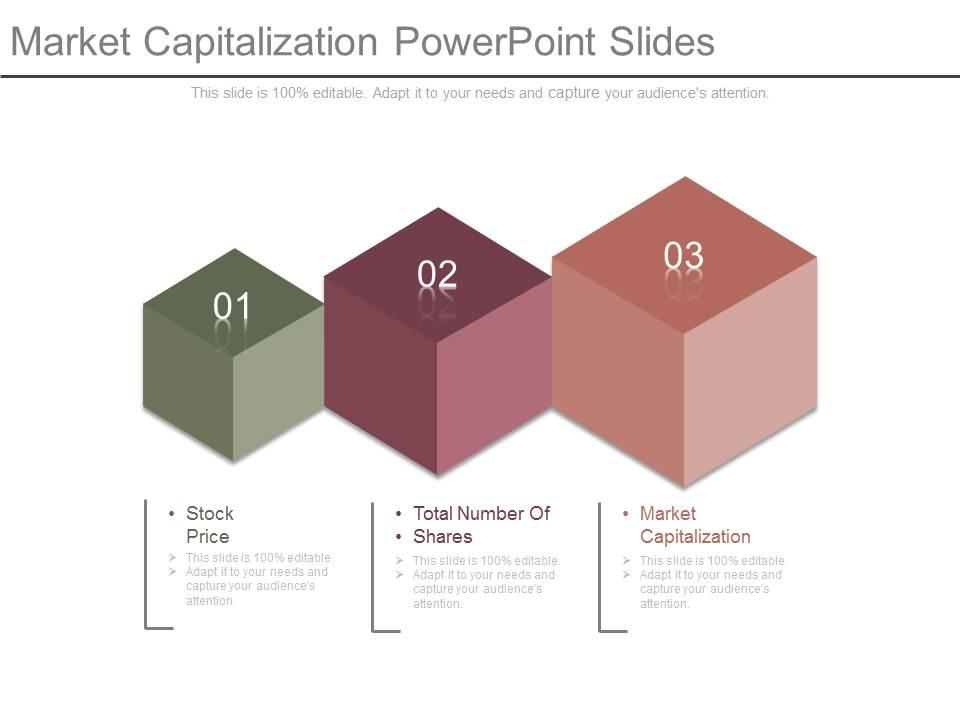
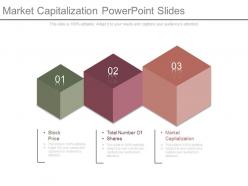
Presenting market capitalization powerpoint slides. This is a market capitalization powerpoint slides. This is a three stage process. The stages in this process are stock price, total number of shares, market capitalization.

People who downloaded this PowerPoint presentation also viewed the following :

FAQs for Market

Market capitalization fluctuates due to earnings performance, investor sentiment, industry trends, economic conditions, and company-specific events like mergers or leadership changes. These factors drive stock price volatility, with financial institutions and tech companies experiencing significant swings during earnings seasons, ultimately affecting valuations and competitive positioning in increasingly dynamic markets.

Technology companies typically achieve higher market capitalizations through rapid scalability, innovation premiums, and growth potential, while healthcare firms often maintain stable valuations driven by consistent demand and regulatory moats. These sector dynamics create distinct investment patterns, with technology stocks experiencing greater volatility but higher multiples, and healthcare delivering steady returns through demographic trends and essential services, ultimately influencing overall market composition.

Market capitalization serves as the foundation for calculating key valuation metrics like P/E ratio, with P/E determined by dividing market cap by total earnings or stock price by earnings per share. These metrics work together to provide comprehensive valuation insights, with investors in sectors like technology, healthcare, and financial services finding that combining market cap with P/E ratios enables more strategic investment decisions and competitive market analysis.

Investors use market capitalization to gauge risk by categorizing stocks into large-cap, mid-cap, and small-cap segments, with smaller companies typically presenting higher volatility but greater growth potential. Large-cap stocks generally offer stability and dividends, while small-cap stocks deliver higher returns with increased risk, enabling portfolio managers to balance risk tolerance with growth objectives across different market segments.

Market capitalization significantly influences investment strategy selection, with large-cap stocks often favoring value investing through dividend yields and stability, while small-cap stocks typically align with growth investing strategies seeking rapid expansion potential. These market cap considerations enable portfolio managers to balance risk and return profiles across sectors like technology startups versus established financial institutions, ultimately delivering diversified investment approaches that match investor risk tolerance and return objectives.

Market capitalization significantly enhances a company's access to capital markets by improving investor confidence, reducing perceived risk, and increasing institutional interest. Larger companies with higher market caps can issue bonds more easily, attract sophisticated investors like pension funds and mutual funds, and negotiate better lending terms, while smaller firms often face higher borrowing costs and limited funding options.

Market capitalization determines stock weightings in most index funds, with larger companies receiving proportionally greater representation in the portfolio. This cap-weighted approach means that major corporations like Apple or Microsoft significantly influence fund performance, while smaller companies have minimal impact, ultimately delivering broad market exposure that mirrors overall economic trends but concentrates risk among the largest market players.

Market capitalization fluctuates with macroeconomic factors as inflation erodes purchasing power and corporate earnings, while interest rate changes affect borrowing costs, investment flows, and discount rates used in stock valuations. Rising inflation typically pressures valuations downward, whereas falling interest rates enhance market cap by making equities more attractive than bonds, with technology and growth sectors experiencing amplified sensitivity to these shifts.

Large-cap companies offer stability and liquidity but slower growth, mid-cap companies provide balanced growth potential with moderate risk, and small-cap companies deliver higher growth opportunities with increased volatility. These market segments enable strategic portfolio diversification, with many investors finding that combining large-cap stability, mid-cap balance, and small-cap growth potential optimizes returns while managing risk across different market conditions.

Share buybacks reduce the number of outstanding shares while potentially increasing the stock price, which can positively impact market capitalization through improved earnings per share and enhanced investor confidence. Companies like Apple and Microsoft have successfully used buybacks to optimize capital allocation, return value to shareholders, and strengthen their market positions, ultimately delivering higher valuations and competitive advantages in increasingly dynamic markets.

Market capitalization limitations include its reliance on volatile stock prices, exclusion of debt levels, susceptibility to market sentiment, inability to reflect intrinsic value, and oversimplification of complex business fundamentals. While market cap provides quick comparative insights across industries like technology and manufacturing, many investors find that combining it with debt-to-equity ratios, revenue multiples, and cash flow analysis delivers more comprehensive investment decisions and strategic assessments.

Mergers and acquisitions significantly impact market capitalization through share price fluctuations, with acquiring companies often experiencing temporary decreases due to premium payments, while target companies typically see increases reflecting acquisition premiums. These transactions ultimately reshape combined entity valuations through operational synergies, cost reductions, and expanded market reach, with many corporations finding enhanced competitive positioning and streamlined operations deliver long-term shareholder value.

Global market capitalization standards vary significantly across regions, including different calculation methodologies, free-float adjustments, sector classifications, regulatory requirements, and reporting frequencies. While developed markets like the US and Europe emphasize free-float methodologies and stringent disclosure standards, emerging markets often use total share approaches, with many exchanges increasingly adopting international standards to attract foreign investment and enhance global competitiveness.

Market capitalization correlates with competitive advantage through enhanced access to capital, strategic acquisition capabilities, and investor confidence, though size doesn't guarantee market dominance. Companies with higher market caps often leverage their financial resources for research and development, talent acquisition, and market expansion, while smaller firms can outperform through innovation and agility, ultimately delivering specialized solutions that challenge industry leaders.

Tech startups increasingly demonstrate higher market capitalization relative to revenue compared to traditional businesses, driven by scalability potential, digital-first operations, and investor appetite for growth. While traditional companies like manufacturing and retail maintain steady valuations based on tangible assets, tech startups leverage software solutions, data analytics, and platform models to achieve premium market multiples, ultimately delivering faster expansion and competitive positioning.

Ratings and Reviews

90% of 100
Write a review
Most Relevant Reviews
  1. 80%

    by Dave Shaw

    Easily Understandable slides.
  2. 100%

    by Dwayne Matthews

    Very unique and reliable designs.

2 Item(s)

per page: