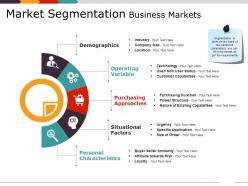
Market segmentation business markets ppt examples
Try Before you Buy Download Free Sample Product
Audience
Editable
of Time
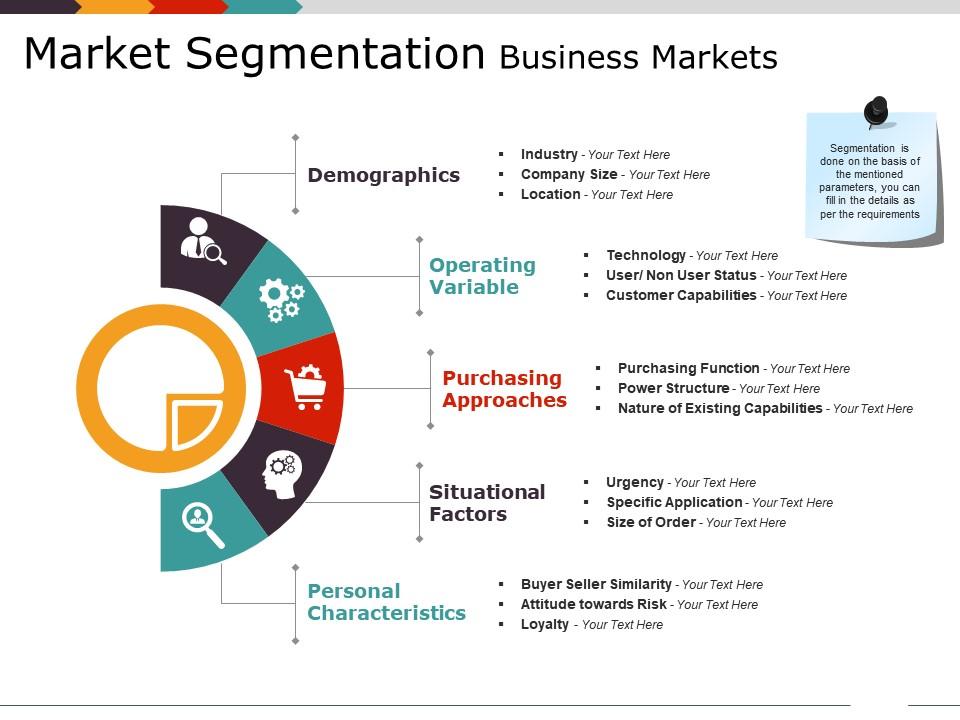
Incorporate this Market Segmentation Business Markets PPT Examples PowerPoint presentation in your company business report. You can discuss the importance of market segmentation with this PPT layout. This market survey PowerPoint theme can prove to be a valuable tool in determining the variable characteristics which distinguish one set of customers from another. With this business PPT theme, customer preferences can be effectively highlighted depending on the various factors such as geographic, demographic, psychographic and behavioral segmentation. Employ this marketing PowerPoint template to discuss the Segmentation, Targeting and Positioning (STP) process for implementing effective marketing strategies for every section of the customer. This managerial PPT layout can be used to describe the challenges in targeting the right customer segment. Also, the fundamentals of sales and marketing can be efficiently showcased using this consumer-oriented PowerPoint theme. Download our visually appealing market research PPT template for improving your firm’s overall business growth without wasting your company’s resources.
People who downloaded this PowerPoint presentation also viewed the following :
Market segmentation business markets ppt examples with all 5 slides:
Catch the attention of buyers with our Market Segmentation Business Markets Ppt Examples. They advertise your goods effectively.
FAQs for Market segmentation business
Look for segments that are measurable, accessible, substantial, differentiable, and actionable. They need to be big enough to actually matter. Can you reach them with your marketing? Do they respond differently to your messaging - because if not, why bother segmenting at all? Honestly, I see people get way too fancy with segments that sound smart but are totally impractical. You'll want to measure each segment's size and make sure your team can realistically target them. Oh, and don't go crazy - test one or two segments first instead of trying to juggle five right off the bat.
So here's what I'd do - look at your existing customers first since you already have that info. Break them down by the obvious stuff like age and income, but don't stop there. What do they actually care about? How do they shop - are they impulse buyers or researchers? I swear psychographic data is way more useful than people think. Once you've got those patterns, make 2-3 solid personas. Test different messages with each group instead of that generic "one size fits all" approach. The whole point is getting specific enough that people actually think "yeah, this brand gets me."
Okay so demographic segmentation is like your starting point for figuring out customer behavior. Age, income, gender, education - all that stuff reveals pretty clear buying patterns. Millennials vs boomers is the obvious example, right? Totally different shopping habits and what they care about. Demographics give you the "who" though, not the "why." You'll want to add psychographics and behavioral stuff on top of that - like what actually motivates people. I always tell people to map out your main demographic groups first, then dig into the lifestyle and attitude data. That's when things get interesting and you can really understand what makes them tick.
So psychographic segmentation is basically targeting people by their values and attitudes instead of just age or income. Way smarter approach IMO. Like, eco-friendly shoppers will respond to sustainability messaging whether they're 25 or 55, right? You'll craft messages that actually connect because you get what drives them. I'd start by surveying your current customers about their interests and values - that's how you build those profiles. Honestly beats the hell out of guessing based on demographics alone. Plus your engagement rates will probably thank you for it.
So many options here! Google Analytics gives you solid demographic stuff, and social media platforms have decent built-in insights too. Survey tools like SurveyMonkey are clutch for understanding what customers actually want. Your CRM is probably sitting on a goldmine of purchase data you're not using yet. I'm weirdly obsessed with Excel for cluster analysis - super basic but it gets the job done. Tableau's amazing if you want to get fancy with visualization. Start with whatever you already know though. Don't overcomplicate it right off the bat.
Yeah so basically where you sell totally changes how you get your stuff to people. Rural Montana? You're probably working with local distributors. NYC? Direct shipping or big retail chains make more sense. Climate's a pain too - can't ship ice cream to Arizona the same way you would to Minnesota, obviously. Different regions have different infrastructure and shopping habits, so your whole distribution setup needs to match. Honestly, it's like solving a puzzle where every piece is a different shape depending on location.
So market segmentation is basically how you stop sending the same boring message to everyone. You group people by what they actually care about or how they behave. Way better than blasting generic stuff that nobody reads, right? Each segment gets messaging that hits different - like actually speaks to their specific problems. Your open rates will thank you. Start small though, maybe 2-3 groups max. I learned this the hard way after creating like 8 segments and confusing myself. Test different approaches for each group and see what sticks.
Honestly? Data quality is gonna be your biggest nightmare. Customer info is usually spread across like 5 different systems and half of it's wrong anyway. Plus targeting multiple segments gets pricey quick - I've watched teams burn through their entire budget trying to personalize everything. Markets change fast too, so those personas you spent months building? Probably outdated already. Oh, and don't even get me started on keeping everything synced when your team's already stretched thin. My take: pick 2-3 solid segments first. Test what actually moves the needle, then expand from there. Way less headache.
Honestly, just pick 2-3 customer groups to start with - maybe by age or how often they buy from you. Don't overthink it! Small businesses actually have it easier here because you can really dig into who your customers are. Check out your current customers first and see what patterns jump out. Then tweak your messaging for each group instead of trying to appeal to literally everyone (which never works anyway). I'd probably start with something simple like segmenting by buying habits, then test different approaches. You'll be surprised how much better your marketing performs when it feels personal.
So here's the thing - segmentation lets you stop wasting energy trying to please everyone. Pick specific customer groups and really nail what they want. Your messaging becomes way more relevant than competitors doing the generic spray-and-pray approach. You'll end up owning these smaller spaces instead of getting lost in the noise. Honestly, most companies are terrible at this because they're scared to exclude people. But that's exactly what makes it work. Look for segments your competitors are half-assing or completely missing - that's your opening.
Dude, the targeting tools now are insane compared to what we had even like 3 years ago. AI can spot these tiny customer segments that you'd never catch manually. Real-time data means no more waiting around for months to see if your campaign actually worked - you can tweak things instantly. Honestly, behavioral tracking beats those old survey methods by a mile. Way more accurate. I'd say just pick one small campaign and mess around with these tools. That's how you'll figure out what clicks with your audience without risking your whole budget.
Track your conversion rates by segment first - that's the big one. Also watch customer acquisition costs and lifetime value differences between groups. Campaign response rates are honestly your quickest win to measure. Don't sleep on the qualitative stuff either though - satisfaction scores and engagement per segment matter too. Compare everything to your pre-segmentation numbers or you're just guessing. Oh, and start small with like 3-4 key metrics. You can always pile on more data later once you've got a solid baseline going.
Culture basically drives everything your customers do, so you can't ignore it when segmenting. Different groups have totally different values, family setups, and buying habits. What crushes it with individualistic customers might completely flop with collectivist ones - learned that the hard way once. Language matters obviously, but so does stuff like color choices and how direct your messaging is. Don't just stereotype though, actually research the dominant cultural groups in your market. Figure out what specific values make them buy. Test everything because assumptions will bite you.
So basically, you can charge different prices to different customer groups depending on what they actually care about. Airlines do this perfectly - same plane, but business class pays way more for legroom while budget travelers just want cheap seats. Price-sensitive customers get your basic version, while people who want premium features pay premium prices. It's honestly pretty smart because you're not stuck with one price that either leaves money behind or scares people away. Figure out which groups would happily pay more for extras, then give them that option.
Oh absolutely, market segments change all the time - way faster than most people think. Consumer habits shift, new tech pops up, demographics evolve. It's wild how quickly your customer groups can become irrelevant. I'd say review your segments every 12-18 months minimum. Look at fresh data and watch for weird behavioral patterns that don't fit your current buckets anymore. Companies get burned constantly by sticking with old personas for years (honestly, it's painful to watch). Set up quarterly check-ins on your key metrics. Catches problems before they snowball into missed opportunities.
-
Innovative and Colorful designs.
-
Enough space for editing and adding your own content.