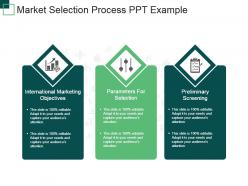
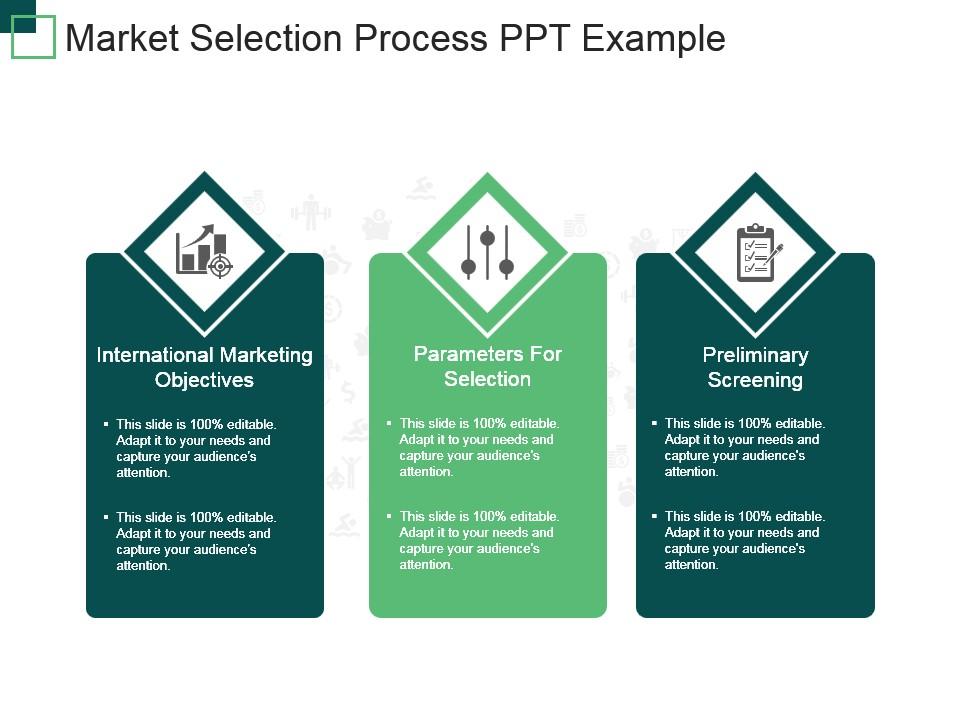
Market selection process ppt example
Try Before you Buy Download Free Sample Product
Audience
Editable
of Time
Initiate action to halt further harm with our Market Selection Process Ppt Example. Get a grip over injuries.
People who downloaded this PowerPoint presentation also viewed the following :
Market selection process ppt example with all 5 slides:
Folks feel almost ecstatic due to our Market Selection Process Ppt Example. They experience a huge amount of joy.
FAQs for Market selection
Key criteria for selecting a target market include market size and growth potential, competitive landscape analysis, customer accessibility and purchasing power, alignment with company capabilities, and regulatory considerations. These factors enable entrepreneurs to identify viable segments by assessing demand patterns, entry barriers, and resource requirements, ultimately delivering focused strategies and sustainable competitive advantage in increasingly crowded markets.
Demographic factors significantly influence market selection by determining purchasing power, consumer preferences, population density, age distribution, and cultural consumption patterns. Companies analyze income levels, education demographics, and lifestyle trends to identify viable target segments, with retail brands finding younger populations drive technology adoption while healthcare services focus on aging demographics, ultimately enabling strategic resource allocation and competitive positioning.
Market research serves as the foundation for informed market selection by providing critical insights into consumer behavior, competitive landscapes, market size, growth potential, and regulatory environments. Through comprehensive data analysis, surveys, and competitive intelligence, organizations can evaluate market attractiveness, identify optimal entry strategies, and minimize investment risks, ultimately enabling strategic decisions that deliver sustainable competitive advantage and long-term profitability.
Understanding consumer behavior is crucial for market selection because it reveals purchasing patterns, preferences, decision-making processes, and price sensitivity within target demographics. This insight enables businesses to identify markets with strong demand alignment, optimize product positioning and marketing strategies, and minimize investment risks, with companies in sectors like retail, technology, and financial services finding that behavioral analysis ultimately delivers higher conversion rates and sustainable competitive advantage.
Competitive analysis contributes to market selection by identifying market gaps, assessing competitor strengths and weaknesses, and revealing underserved customer segments that present strategic opportunities. Through comprehensive competitor evaluation, businesses can pinpoint markets with favorable competitive dynamics, avoid oversaturated sectors, and position themselves strategically, ultimately enabling more informed entry decisions and sustainable competitive advantage.
Businesses can use market research surveys, competitive analysis tools, demographic data platforms, financial modeling software, and SWOT analysis frameworks to evaluate potential markets. These methods enable organizations to assess market size, customer demand, and competitive landscapes across sectors like retail, healthcare, and financial services, ultimately delivering data-driven insights that minimize investment risks and maximize growth opportunities.
Economic factors significantly influence market selection by affecting purchasing power, infrastructure development, currency stability, and regulatory environments, particularly in emerging markets where volatility creates both risks and opportunities. Through careful analysis of GDP growth, inflation rates, and consumer spending patterns, businesses can identify markets with strong potential while mitigating economic uncertainties, ultimately delivering strategic positioning and competitive advantage.
Common pitfalls include insufficient market research, overestimating market size, ignoring competitive landscapes, underestimating entry costs, and failing to validate customer demand early. These mistakes streamline by conducting thorough due diligence, engaging target customers directly, and analyzing competitor positioning, with many organizations finding that systematic evaluation frameworks ultimately deliver more accurate market assessments and strategic advantage.
Brand positioning significantly influences target market selection by aligning product attributes, messaging, and value propositions with specific consumer segments' needs, preferences, and purchasing behaviors. Companies positioning themselves as premium brands typically target affluent demographics, while value-focused positioning appeals to cost-conscious consumers, with many organizations finding that strategic positioning clarity streamlines market identification and enhances competitive differentiation.
Cultural factors significantly influence market selection by determining consumer preferences, communication styles, business practices, and regulatory expectations that directly impact product acceptance and operational success. Understanding cultural nuances enables companies to tailor offerings effectively, avoid costly missteps, and build authentic customer relationships, with many global brands finding that cultural alignment ultimately delivers higher market penetration and sustainable competitive advantage.
Technology revolutionizes traditional market selection by enabling real-time data analytics, AI-powered consumer behavior prediction, automated competitive intelligence gathering, and digital market testing platforms. These tools streamline decision-making by delivering faster market insights, reducing research costs, and enhancing accuracy, with many organizations finding that technology-driven approaches significantly accelerate their market entry strategies.
Scalability is crucial for market expansion because it determines long-term growth potential, resource efficiency, and sustainable competitive advantage across different regions. Markets with scalable infrastructure, adaptable business models, and growth-ready consumer bases enable companies to leverage economies of scale, streamline operations, and maximize return on investment, ultimately delivering faster market penetration and sustained profitability.
Key performance indicators include market share growth, customer acquisition costs, revenue per customer, conversion rates, and competitive positioning metrics. These metrics enable organizations to evaluate market penetration effectiveness, optimize resource allocation, and measure return on investment, with many companies finding that tracking both financial and operational indicators ultimately delivers comprehensive insights for strategic market expansion decisions.
A product's lifecycle stage significantly influences market selection by determining target customer readiness, competitive positioning, and resource allocation strategies. Early-stage products often target innovator segments and niche markets, while mature products focus on mass markets and cost-sensitive segments, with many companies finding that aligning market characteristics with lifecycle demands ultimately delivers optimized penetration strategies and sustainable competitive advantage.
Niche marketing delivers targeted customer engagement, higher profit margins, and reduced competition, while mass marketing provides broader reach, economies of scale, and market diversification opportunities. Through focused strategies, niche approaches enable deeper customer relationships and premium pricing, whereas mass marketing streamlines operations and maximizes volume, with many organizations finding that hybrid approaches ultimately balance risk while optimizing market penetration across multiple segments.
-
Great quality slides in rapid time.
-
Professional and unique presentations.