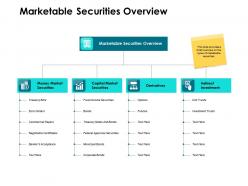
Marketable securities overview ppt powerpoint presentation format
Try Before you Buy Download Free Sample Product
Audience
Editable
of Time
Chip away at the blocks with our Marketable Securities Overview Ppt Powerpoint Presentation Format. Create a bit of artistic brilliance.
People who downloaded this PowerPoint presentation also viewed the following :
Marketable securities overview ppt powerpoint presentation format with all 5 slides:
Create a bit of artistic brilliance with our Marketable Securities Overview Ppt Powerpoint Presentation Format. It allows you to chip away at the blocks.
FAQs for Marketable securities overview ppt
Marketable securities are liquid financial instruments that can be quickly converted to cash through public exchanges, including stocks, bonds, treasury bills, and money market funds. Unlike illiquid investments such as real estate or private equity, these securities offer immediate trading flexibility and transparent pricing, enabling investors and organizations to maintain cash flow while earning returns on excess capital.
Common marketable securities include stocks, government bonds, corporate bonds, treasury bills, certificates of deposit, and money market instruments. These securities enable investors to diversify portfolios, generate income through dividends and interest, and maintain liquidity for strategic opportunities, with many financial institutions finding that balanced combinations deliver enhanced returns while minimizing risk exposure.
Marketable securities enhance liquidity management by providing readily convertible assets that can be sold quickly without significant price impact, offering flexible cash flow solutions during unexpected expenses or opportunities. Through strategic allocation of short-term treasury bills, commercial paper, and money market funds, businesses maintain operational flexibility while earning returns, ultimately delivering enhanced financial stability and competitive positioning in volatile markets.
Investors should consider credit risk, market volatility, liquidity constraints, interest rate sensitivity, and issuer financial stability when evaluating marketable securities. These factors collectively determine potential returns and capital preservation, with many institutional investors finding that diversification across asset classes, duration matching, and regular credit assessments ultimately deliver more stable portfolio performance.
Marketable securities valuations fluctuate directly with market conditions through supply and demand dynamics, interest rate changes, economic indicators, and investor sentiment shifts. During market volatility, bonds may increase in value as safe havens while stocks decline, with many portfolio managers finding that diversified marketable securities help maintain liquidity and strategic flexibility across changing market environments.
Marketable securities serve as essential portfolio building blocks, offering liquidity, risk diversification, and stable returns through government bonds, corporate securities, and money market instruments. These liquid investments enable investors to balance growth-oriented assets with safer alternatives, while providing quick access to cash when needed, ultimately delivering both capital preservation and strategic flexibility in an increasingly volatile market environment.
Gains or losses from marketable securities are reported differently based on classification, with trading securities reflected in the income statement as unrealized gains/losses, while available-for-sale securities show unrealized changes in other comprehensive income. Banks and investment firms increasingly find that proper classification streamlines financial reporting, enhances transparency for stakeholders, and ultimately delivers more accurate performance metrics for strategic decision-making.
Tax implications for marketable securities include capital gains taxes on profits, dividend income taxation, and potential losses for tax deduction purposes. These tax considerations vary by holding period, security type, and investor status, with many investors finding that strategic timing of purchases and sales, combined with proper portfolio diversification, ultimately delivers tax efficiency while maintaining competitive investment returns.
Interest rates inversely affect debt securities' market value, with rising rates decreasing bond prices and falling rates increasing them. This relationship occurs because existing bonds with lower yields become less attractive when new securities offer higher rates, while financial institutions, pension funds, and investment managers actively adjust their portfolios to capture optimal returns in changing rate environments.
Marketable securities offer high liquidity, quick access to capital, lower transaction costs, and portfolio diversification, while long-term investments provide higher potential returns, compound growth, and inflation protection. However, marketable securities present greater volatility and lower yields, whereas long-term investments require capital commitment and reduced flexibility, with many financial institutions finding that strategic combinations of both approaches ultimately deliver balanced risk management and optimized returns.
Companies utilize marketable securities strategically by maintaining liquidity reserves while generating returns, diversifying investment portfolios, and creating flexible financing options for future acquisitions or expansion. These instruments enable organizations to optimize cash management, hedge against market volatility, and maintain operational flexibility, with many financial institutions and corporations finding that strategic securities portfolios ultimately deliver enhanced financial stability and competitive positioning.
Investors must navigate disclosure requirements, insider trading laws, market manipulation regulations, tax reporting obligations, and fiduciary duty standards when managing marketable securities. These regulatory frameworks enhance market transparency and investor protection, with financial institutions and fund managers finding that proactive compliance streamlines operations, reduces legal risks, and ultimately delivers stronger client trust and competitive positioning.
Marketable securities generally offer superior liquidity compared to real estate, private equity, or commodities, as they can be converted to cash within days through established exchanges. However, they present higher liquidity risk than cash equivalents or treasury bills, with many financial institutions finding that maintaining diversified portfolios across asset classes helps balance immediate liquidity needs against return optimization.
Best practices for monitoring marketable securities include regular performance analysis, diversification reviews, risk assessment updates, liquidity evaluations, and market trend monitoring. Through systematic portfolio rebalancing, automated tracking systems, and benchmark comparisons, financial institutions streamline oversight while minimizing risk exposure, ultimately delivering enhanced returns and strategic asset allocation in increasingly volatile markets.
Technological advancements revolutionize marketable securities through algorithmic trading, real-time analytics, blockchain settlement systems, mobile platforms, and AI-driven risk assessment tools. These technologies streamline operations by enabling faster trade execution, reducing settlement times, and enhancing portfolio transparency, with investment firms and financial institutions finding significantly improved operational efficiency and competitive advantage.
No Reviews